Devonshire Apple Cake

Four years ago this month, we moved a little bit further West along the South coast of England to a village in Devon so that my husband could take up a residency in clinical veterinary pathology at Exeter. When we moved, we had one daughter and a cat. Our ‘new’ house in Devon was dilapidated and old-fashioned with aluminium window frames, Imperial plumbing and rubber-coated electrical wiring.

Four years on and our lives have changed immeasurably. Two daughters and a son have taken control of every room in our house with their arsenal of toys. The rooms they run through are newly built and refurbished after a rennovation project that has taken the best part of the last two years to complete. I have several more grey hairs (hmm … I wonder why) and far fewer good nights of sleep πŸ˜‰ .

Every year on the anniversary of our move, my husband has taken a variety of baked goodies into work to share with his colleagues. This year, he requested an appple cake.

Living in Devon, I thought it might be symbolic to try a recipe for Devonshire Apple Cake that I found in a cookbook by Margaret Wilson. As if to prove Melinda’s theory of the British and their propensity for dried fruits, the recipe does indeed include a substantial amount of raisins and currants in addition to the namesake apples. Inspired by Melinda’s observations, I not only soaked these in water before using them in the recipe, but also added a tot of whisky left over from our Burn’s Night celebrations (it worked well and the dried fruits were deliciously plump and moist, but perhaps apple brandy would have been more in keeping …?!).
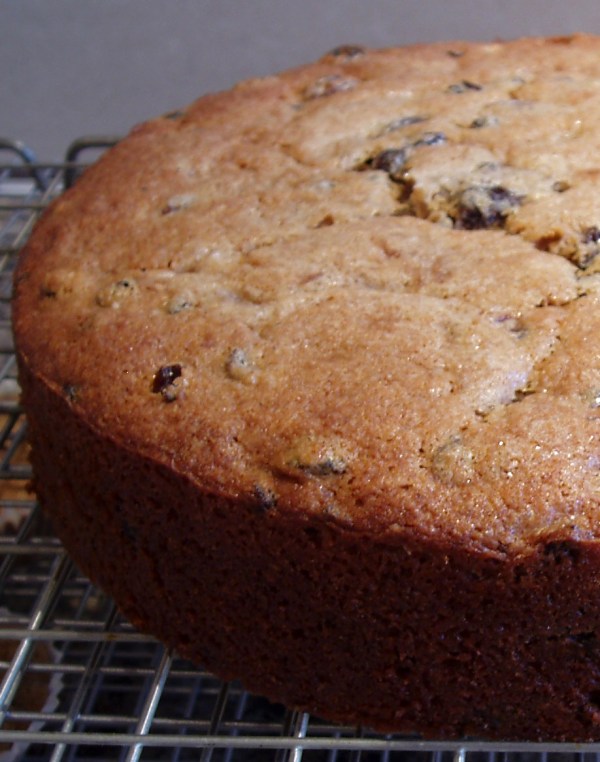
apple cake

A word of warning: the recipe stipulates using an “8-inch shallow cake tin”, which in my mind translates to something like my 8″ x 1 1/2″ pan. The little line drawing underneath the recipe in my book shows a circular cake, so I assume that the pan is intended to be round. When I came to fill my 8-inch shallow cake tin with the batter, it was obvious that my idea of ‘shallow’ is somewhat less generous than that of Margaret Wilson as my poor little pan was soon drowning under an engulfing splurge of cake mixture. I hastily dug out some cupcake cases from my newly-organised baking shelf and scooped out a good 7 cupcakes-worth of batter from the pan. Fortunately for me, this near-disaster at least provided me with some miniature samples of my own to taste – my husband and his colleagues devoured the cake-proper today, leaving not a single crumb.
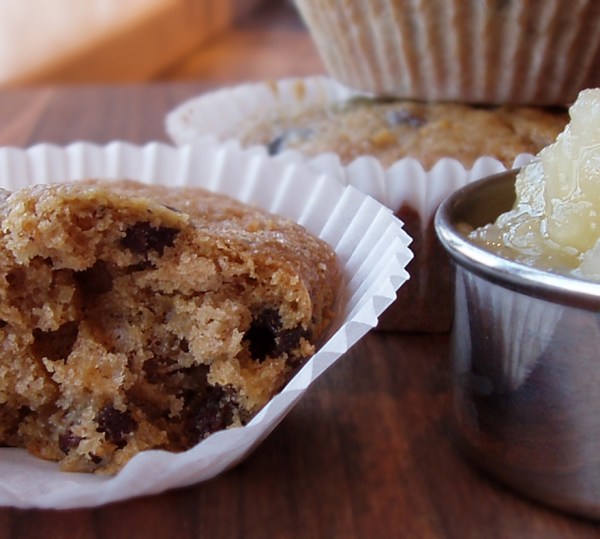
apple cupcakes

Devonshire Apple Cake (adapted from a recipe by Margaret Wilson)

225 g (8 oz) plain flour
1 tsp bicarbonate of soda
1/2 tsp cinnamon
1/2 tsp ground ginger
1/2 tsp mixed spice
275 g (10 oz) mixed sultanas, raisins and currants
2 eggs
450 g (1 lb) cooking apples, peeled and chopped
150 g (5 oz) unsalted butter
175 g (6 oz) light muscovado sugar
pinch of salt
caster sugar for sprinkling
grated rind of 1 lemon
2 tbsp Devon cider

Grease and line an 8-inch shallow cake tin with parchment paper. preheat the oven to 325 degrees F/170 degrees C.

Soak the dried fruit in hot water (plus a tbsp of whisky or apple brandy) for 10 minutes.

Meanwhile, cook the apples in the cider until they are soft and mushy. Mash any remaining lumps with a fork. Leave to cool.

Cream the butter, sugar and lemon rind in a large bowl. Gradually beat in the eggs.

Sieve together the flour, spices, bicarbonate of soda and salt. Fold in alternately with 225 ml (8 fl oz) of the apple sauce (feed the remainder to your youngest child πŸ˜‰ ).

Strain the dried fruit and stir into the mixture until evenly incorporated.

Place the mixture in the prepared cake tin (until no more than 3/4 full – use any remaining mixture to make cupcakes πŸ˜‰ ). Sprinkle the top with castor sugar.

Bake in the centre of the oven for 1 to 1 1/2 hours (note: my own ‘shallow’ cake was done in 40 to 50 minutes; the cupcakes took 12 minutes). Cool in the pan for 10 minutes before transferring to a wire rack.

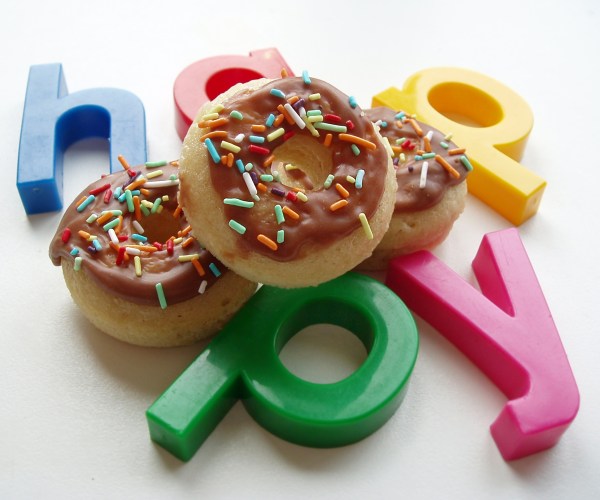
Happy Doughnuts

Supermarket shopping with the girls in tow always has the potential to become a very expensive affair. Take yesterday, for example. Despite numerous advance reminders of the enormous bag of sweets we collected last Thursday (I blame Santa), our procession towards the bakery department prompted clamours for the chocolate-covered doughnuts on display there.

I muttered that we could make some. The girls wanted to know when. Later. When we get home? I sort of mumbled a bit, which they took to be a firm agreement.

That’s why we were all in a chocolatey, doughnutty, sticky mess when O arrived home from work yesterday evening. The girls were very happy with their doughnuts. T was very happy spreading chocolate, largely around his mouth as far as I could see, but considered the doughnuts themselves far too suspicious to attempt to eat. I’m sure he’ll change his mind about this in another year or so.

happy doughnuts

The recipe for the doughnuts was written on the packaging of my mini baked doughnut tin. It offers a delicious and simple alternative to recipes that call for deep-fat frying of the doughnuts, but does rely on your having the pans for this. Even although you’d be hard pushed to regard doughnuts as a healthy option, it does make me feel slightly better about myself as a Mum when I see my children tucking into doughnuts that have been plucked from the oven rather than from the greasy depths of a pan filled with hot cooking fat!

And so, in celebration of all things seasonal, I’d like to wish everyone extremely happy doughnuts πŸ™‚ .

happy doughnuts 2009

Mini Baked Doughnuts (adapted from Judge Bakeware)

1 tbsp (1/2 oz) butter
225 g (8 oz) plain flour
1 tsp vanilla extract
175 g (6 oz) castor sugar
2 tsp baking powder
175 ml (6 fl oz) milk
2 large eggs, beaten
1/2 tsp salt

Preheat the oven to 160 degrees C (325 degrees F). Wipe the pan wells with a little cooking oil to prevent sticking.

Melt the butter in a small saucepan.

Combine the remaining ingredients in a large mixing bowl. Add the melted butter and stir thoroughly until the batter is smooth.

Pour the batter into the doughnut shapes, filling each no more than 3/4 full. Bake in the centre of the oven for 15 minutes (when tested with a skewer, the skewer should be clean). The doughnuts will come out easily if you carefully release the edges with the blade of a knife before attempting to pull them out of their wells.

Leave to cool, then decorate with chocolate sauce* and sprinkles.

* We make our current favourite chocolate sauce by melting 3 to 4 oz of chocolate together with a tablespoon of golden syrup, 1/2 oz of butter and 1 to 2 tablespoons of water.

Treatment of Choice

Earlier today, Lauren posted a question on Rose’s blog about why the microwave and not a conventional oven is used in the preparation of kate flour. Although this isn’t the first time I’ve been asked this question, I haven’t actually tried heat-treating flour in my own oven until now. As I responded on Rose’s blog:

I haven’t tried heating flour in a conventional oven (yet!), but I have read about it. In relation to pancake springiness, heat-treatment at 120 degrees C for 2 hours in an oven has been shown to have the same improving effect as chlorination (Seguchi, 1990). Interestingly, incubation of starch granules at room temperature for 233 days also has the same effects on the starch granule’s oil-binding capacity (Seguchi, 1993). However, more recent scientific analysis suggests a different mechanism of starch gelatinisation when the granules are heated in a microwave compared to conduction heating (Palav & Seetharaman, 2006). Microwave heating (but not conduction heating) results in granule rupture, which in turn has an effect on the rheological behaviour of the dough or batter.

Lauren then asked about how to avoid the ‘toasted’ taste when microwaving flour, which is something I have also been thinking about for some time now. Chocolate cakes are one way of masking the flavour (and they always find an appreciative audience among my children), but it would be lovely to be able to solve the ‘colour or crumb‘ conundrum.

It’s funny how the majority of my flour experiments took place whilst builders were working intensively on our home last year. Perhaps the arrival of our plumber this morning acted subconsciously as the final call-to-action today. Whatever the spur, it wasn’t long before 10 oz of soft 00 grade flour was in the oven at 120 degrees C for 2 hours!

From some distant reading, I also recalled an invention in which pharmaceutical substances were prepared in a microwave without scorching by means of continual tumbling (if anyone finds a reference for this memory, do let me know –Β  I didn’t bookmark the source when I first came across the information). I wasn’t up for continual tumbling today, but I did wonder if perhaps the toasting problem was a result of too little agitation during heating. Now, I have been known to shout and rant a bit at electrical appliances in the past, but I opted instead to agitate the flour every 10 seconds by opening the microwave door and swirling it quickly with a fork. It took about 10 minutes of microwaving-time (which equates to about 18 minutes of preparation time) before the flour reached 130 degrees C.

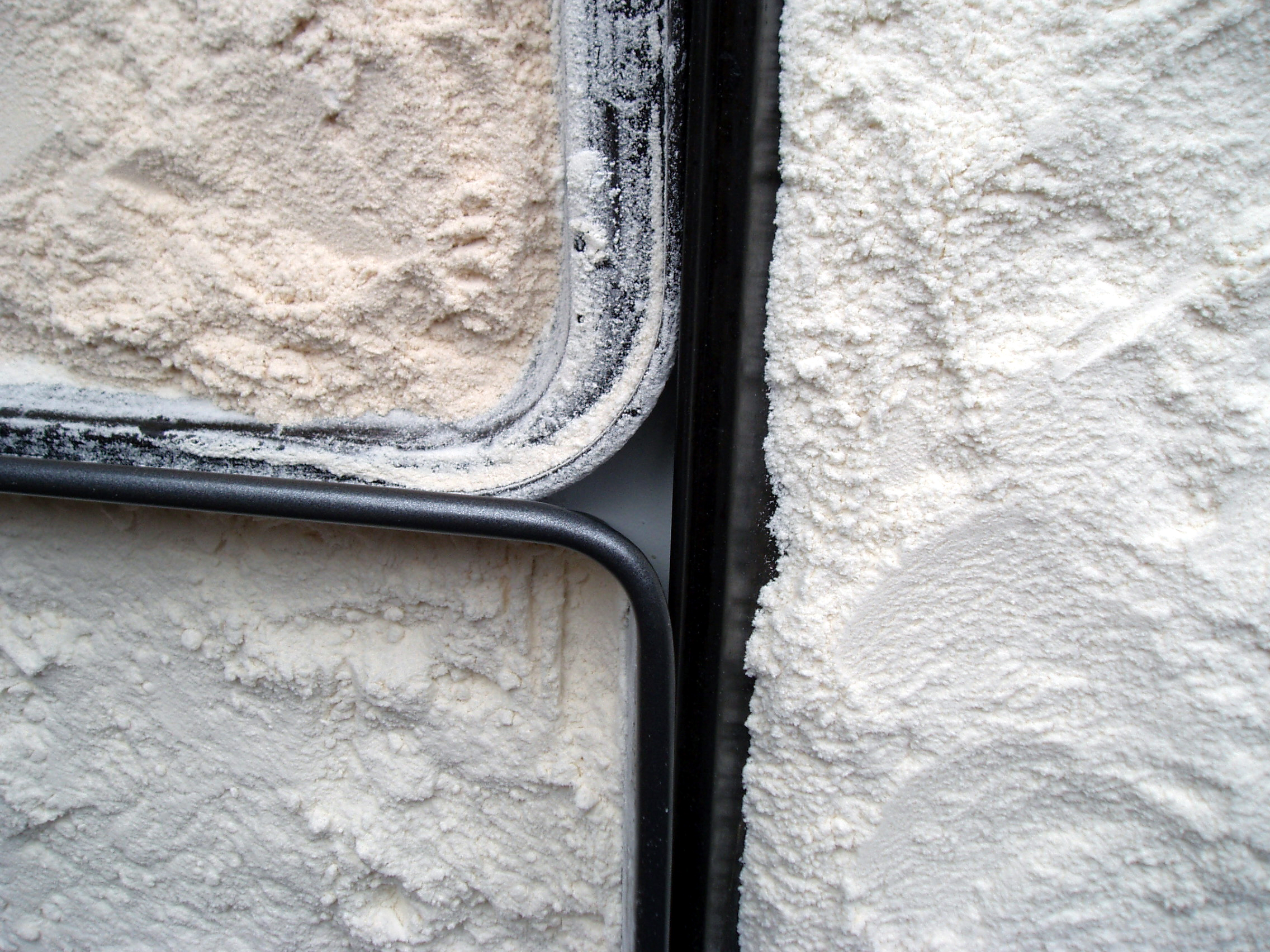
Here are my 3 different flour-treatments of today: to 130 degrees C with 1-minute agitation in the microwave (top-left); to 130 degrees C with 10-second agitation in the microwave (right); 2 hours at 120 degrees C in the oven (bottom-left).

flours

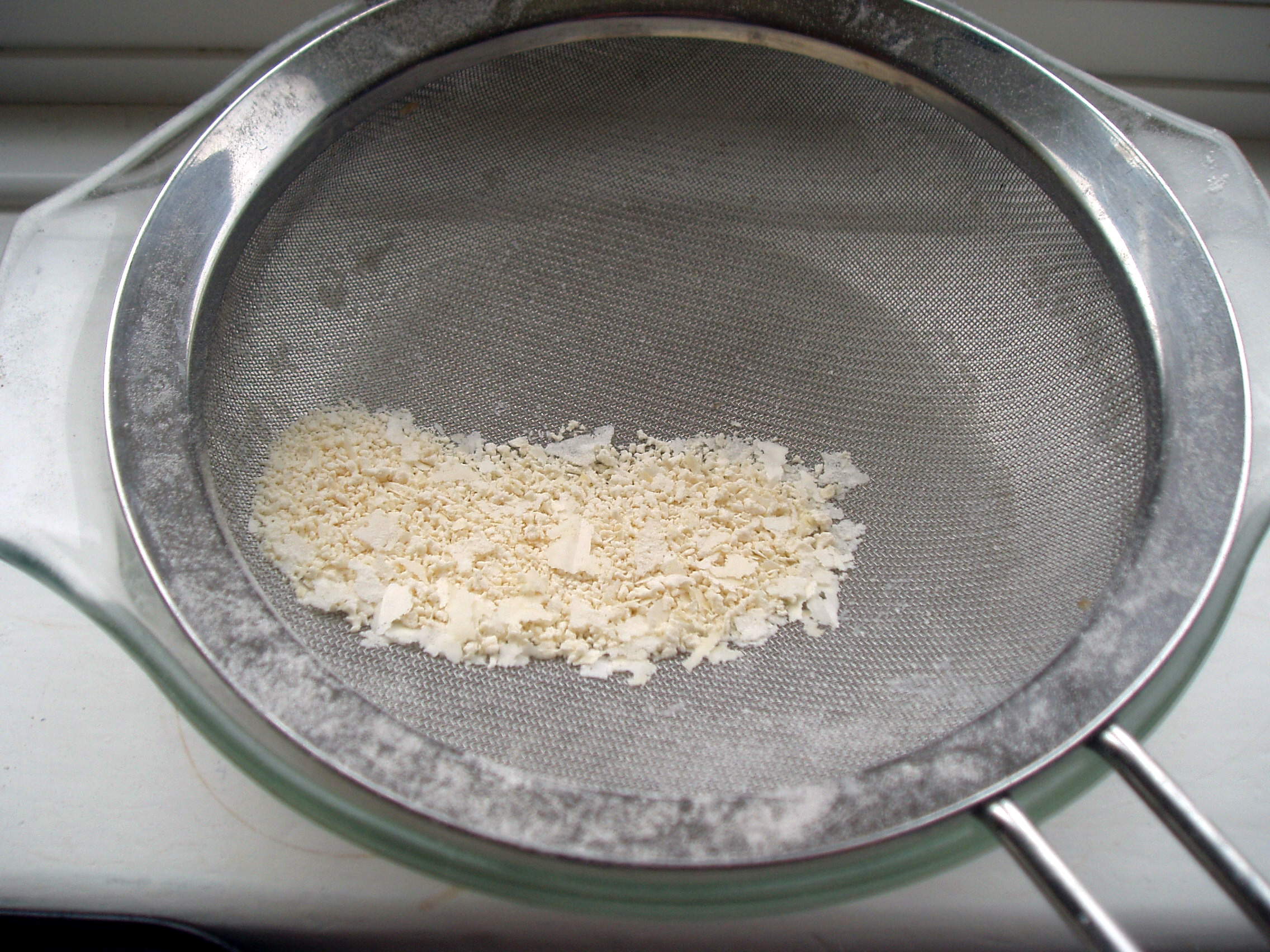
As well as being less toasted than the less-agitated microwaved flour, the whiter-microwaved-flour also produced considerably less wastage on sieving:

aftersieving

I then proceeded to bake cakes using the 2 whitest flours: one lazy lie-in from the oven; one greatly-agitated from the microwave. I am excited to report that both flours produced a yellow butter cake without any taste of toasting and far beyond anything that can be achieved without flour-treatment.

In terms of vital statistics, the microwaved-flour cake rose just over 1 cm higher than the oven-flour cake and had a slightly finer, more delicate crumb. Although today revealed a choice of flour-treatment, for me the ‘battle’ is won by the microwave on two counts: crumb and environment (apparently, the microwave uses about 75% less energy than a conventional electric oven).

battleofthecakes

October Celebrations

If you had knocked on our door last night, you would have been greeted by four witches, a baby pumpkin, Morticia Addams and a princess. Okay, you may have been surprised to find the princess (M, who has been practising dressing-up as a witch since at least July, suddenly decided last night that she would rather wear a pink, sparkly costume), but the rest of the crew were probably normal enough among family gatherings on October 31st.

Earlier in the day, I collected together an assortment of black bin-liners and cobweb material so that my husband could transform our upstairs playroom into a witch’s lair for our 3 children and two of their friends. We prepared witch’s hair (black spaghetti), cauldron stew (bolognaise sauce), a snake-pit jelly and ghostly biscuits. I even went to the unaccustumed length of buying black eyeliner, mascara, glittery white powder and black nail varnish to complete my Morticia look (if it was off-putting to play the piano last night with black nails, I can confirm that it is even more so to type with them now!).

Underneath the party cliches and hype however, Hallowe’en has ancient roots that remind us of the changing seasons and our connections to the land. Standing at the end of summer, the festival once marked the beginning of a New Year in the old Celtic calendar. How fitting therefore that this October should also be a time for Rose Levy Beranbaum to both celebrate the 20th anniversary of The Cake Bible and to look forward to the publication of her new book in 2009!

It was in more ways than one therefore that our celebrations last night were completed by Rose’s Pumpkin-Walnut Ring (which I made in a loaf tin, being completely unable to find a small-enough tube or Bundt pan in any local shops last week).

Happy Hallowe’en to everyone and Happy Birthday to The Cake Bible. πŸ™‚

Apple Custard Autumn

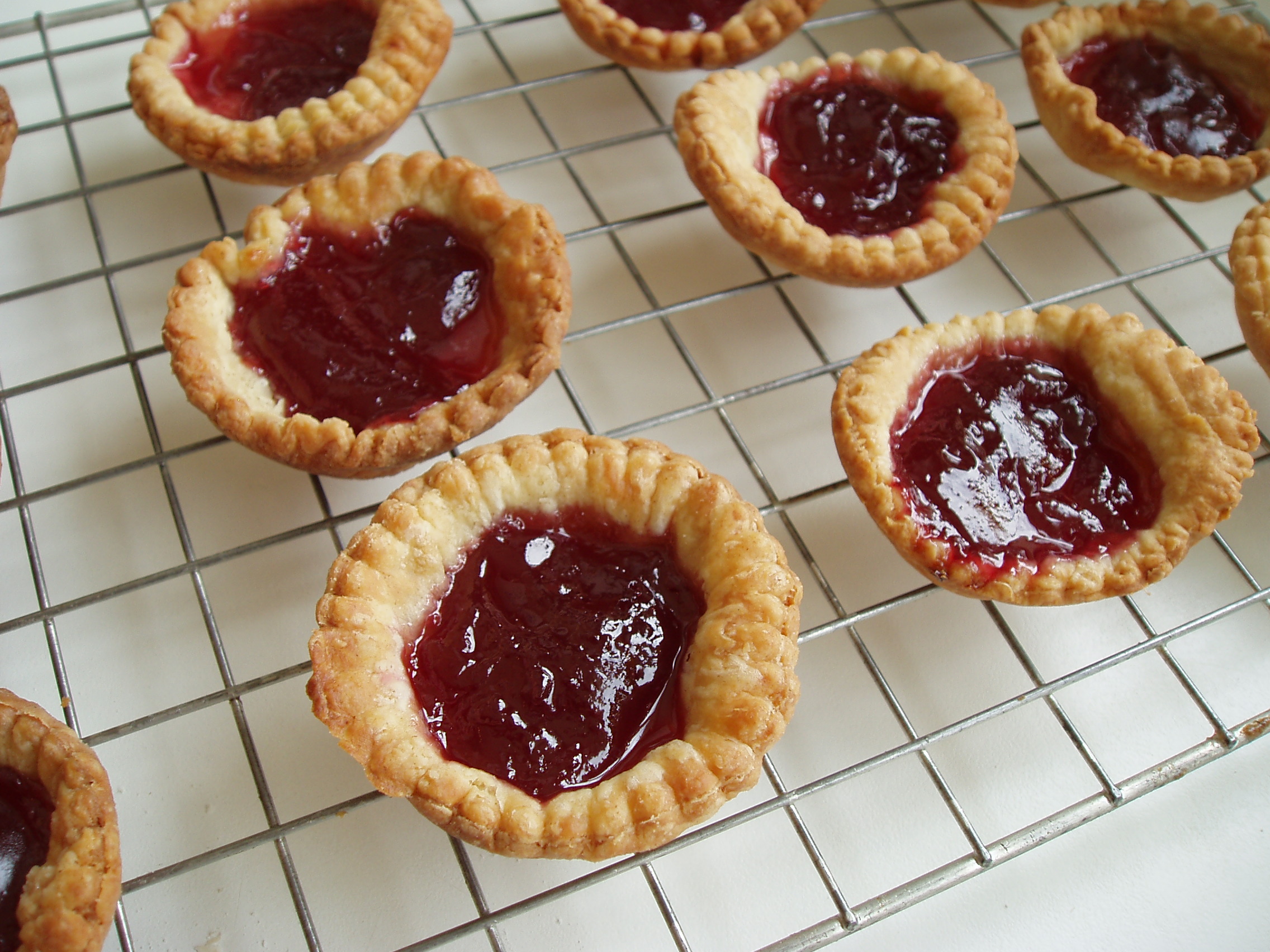
I’ve been even busier than usual recently as O has been away from home taking professional exams in the States. The children have been wonderful in his absence, but they don’t leave many opportunities in the day (or night!) for sitting in front of a computer. On the other hand, M (my 3 yr-old) has developed a passion for baking of all sorts. I have only to look at a wooden spoon or whisk and she’s dragging a chair across the kitchen so that she can climb up beside me and ‘help’. She knows exactly what goes into our bread (“flour, water, salt and east”, as she says!) and can even turn her very own pastry into “jam hearts”.

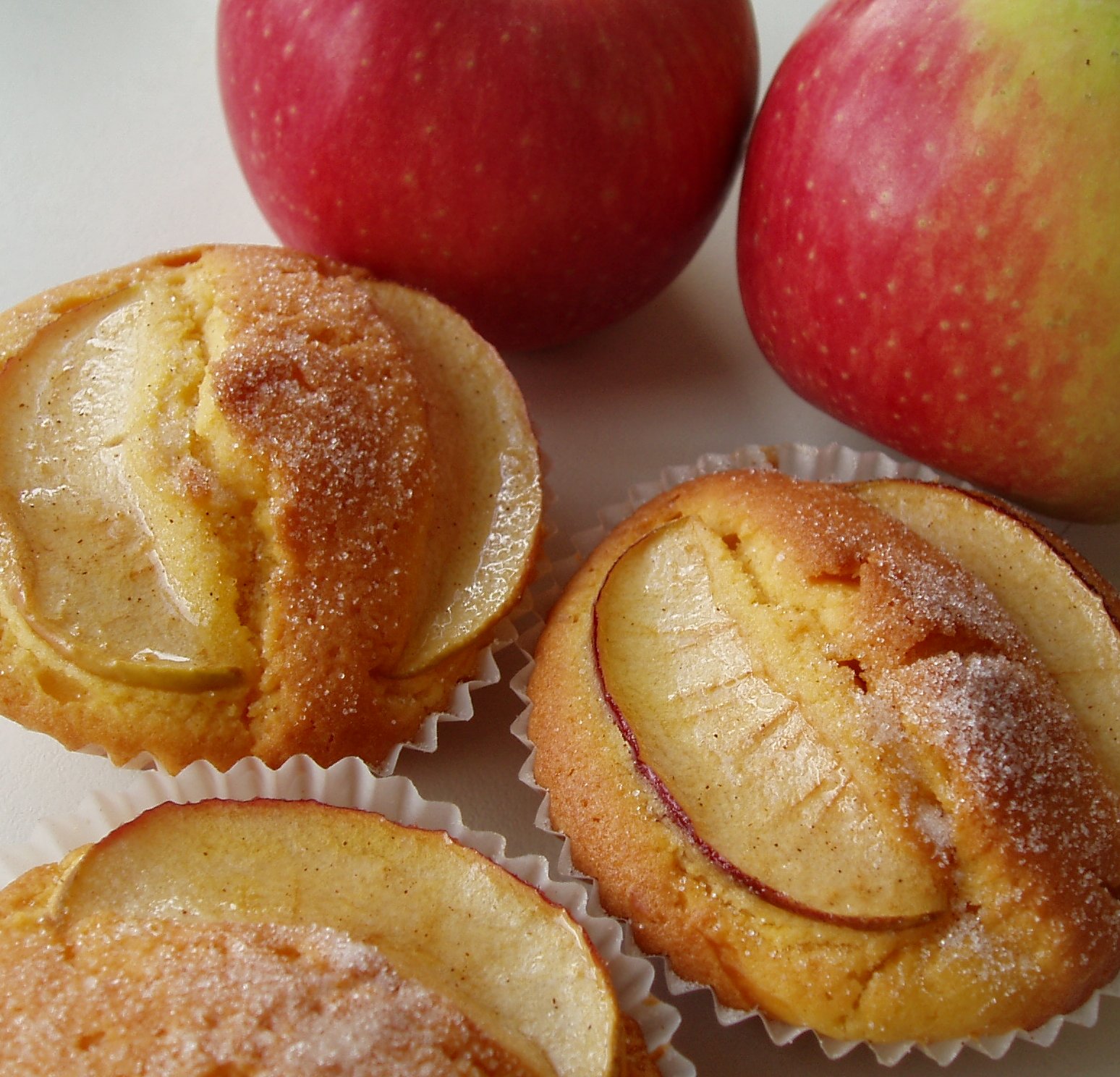
With the start of a new term and thoughts of Christmas in the not-too-distant future (believe me, they are already counting down the sleeps!), my 2 girls have also been very aware of the increasing signs of Autumn since O has been away, especially on our daily morning walks to school when their misty breath hangs in the air. Last year, I wrote about the apples that are in abundance at this time here in Devon and once again, it seemed fitting to turn to the fruit in our baking at home. And so today, M and I made Apple Custard Cupcakes from a recipe that (sshhh … I copied out of a book before sending it to my sister a couple of days ago as a birthday present) … hrmmmm *clears throat noisily.*

If I wasn’t staring at the dwindling possible hours of sleep left to me tonight, I’d post the recipe right now. If my children hadn’t woken me several times every night for this last month, then possibly I’d welcome the thought of staying up beyond their bedtime to write out the recipe. As it is, I’m wimping out and going to bed, leaving you (for now!) with only a photo of our latest baking adventure.

  • Enter your email address to subscribe to this blog and receive notifications of new posts by email.

    Join 289 other subscribers
  • Seasonal Recipes

    candied peel

    baileys chocolate truffles

    gingerbread men

    mince pies

    fudge

    smarties cookies

  • Freshly Made

  • Categories

  • Favourite Feasts

  • Awards

    DMBLGIT Award
  • Archives

  • wordpress visitor counter
  • Adventures in food by Kate Coldrick from Woodbury in Devon.