Cookies for Uncle Mark

I’d like to talk to you for a moment about my brother-in-law, keeping my fingers crossed that he won’t mind too much that I’m doing so. The recipes I’m about to present won’t really make much sense without hearing just a little of his story.

Uncle Mark, as he is known by my children, has been seriously ill over the course of the last two years. A grueling combination of surgery, intensive chemotherapy and radiotherapy, whilst largely achieving its goals, has unfortunately also had some unwanted consequences. Considering Uncle Mark’s passion for cheese and chocolate, it seems to be especially cruel that he is now no longer able to digest fats.

Low-fat and fat-free cooking throws up its own challenges, none felt more keenly than in the area of baking. At Christmas last year, I made a fatless chocolate/raspberry cake that Uncle Mark (perhaps politely?) complimented by carrying home the left-overs. It may have been the brandy syrup with which I laced the cake … but Aunty Lucy emailed me to ask for the recipe.

Following this apparent success, I wondered whether he might also like a couple of low-fat cookie recipes and decided to do a spot of online research to discover the principles of fatless baking. I stumbled upon a goldmine of information on fruitful fat substitutes by Sandra Woodruff, excerpted from her book, The Best-Kept Secrets of Healthy Cooking. Rather than reproduce her insights here, I’ll leave you to find out which conversions give the best results, how to calculate the amount of fruit to use, how to avoid toughness when eliminating fats, how long to bake your fat-free goodies for and at what temperature by clicking on the links above.

And when you’ve done that, please do return here for some As-Fat-Free-as-Possible Banoffee Cookies and Melt-in-the-Mouth Gingerbread.

To Uncle Mark, with love.
xxx

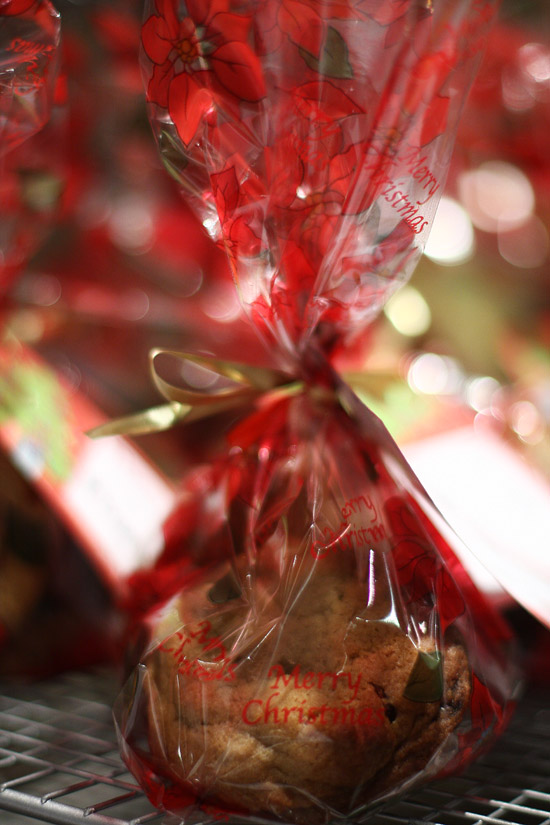
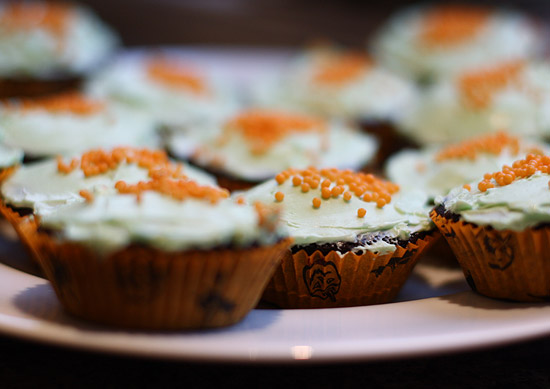
Errr … yes, that photo does have chocolate chips in it, and no, they’re not fat-free. Sorry. It’s just that I wanted to test out the cookies on my children before offering the recipes to Uncle Mark, and T helped with the baking … I’m sure you get the picture. You could pretend that they’re brandy-soaked raisins, if that helps …

Banoffee Cookies

3 1/2 oz mashed banana
5 1/2 oz granulated sugar
6 1/2 oz light muscovado sugar
1 tsp vanilla extract
3 egg whites (3 1/2 oz without shells)
2 oz porridge oats, blitzed to a flour in a food processor
8 oz plain flour
4 oz rice flour
1 tsp baking soda/bicarbonate of soda
1 tsp salt
7 oz raisins, soaked for 10 mins in a little hot water or brandy, then strained

Preheat the oven to 180 degrees C.

Beat together the banana and sugars in a large mixing bowl.

Add the vanilla and egg whites gradually, beating to incorporate.

Stir in the dry ingredients, mixing until just combined. Add the drained raisins and stir to incorporate evenly.

Drop generous tablespoons of the dough onto parchment-lined baking trays (allow room for spreading). The dough is very sticky, so the parchment lining really helps here when removing the cookies after baking.

Bake for 8-9 minutes (8 minutes gives toffee pools, whilst 9 mins gives a drier cookie).

Remove with a spatula and allow to cool on wire racks.

Makes c. 23 cookies.

Gingerbread Cookies

1 oz pitted dates, finely chopped
2 1/2 oz sweet potato purée
5 oz castor sugar
7 oz dark muscovado sugar
1 tsp whisky
2 eggs (3 1/2 oz without shells)
2 1/4 oz porridge oats, blitzed to a flour in a food processor
9 oz plain flour
4 oz rice flour
1 tsp baking soda/bicarbonate of soda
1 tsp salt
1 tbsp ground ginger

Preheat the oven to 180 degrees C.

Beat together the dates, sweet potato and sugars in a large mixing bowl.

Add the whisky and eggs gradually, beating to incorporate.

Stir in the dry ingredients, mixing until just combined.

Roll generous tablespoons of the dough into balls. Place on an ungreased baking tray and squash to a 3/4  inch thickness with a spatula, the heel of your hand or the back of a fork.

Bake for 8 minutes.

Remove with a spatula and allow to cool on wire racks.

Makes c. 23 cookies.

White Christmas Cookies

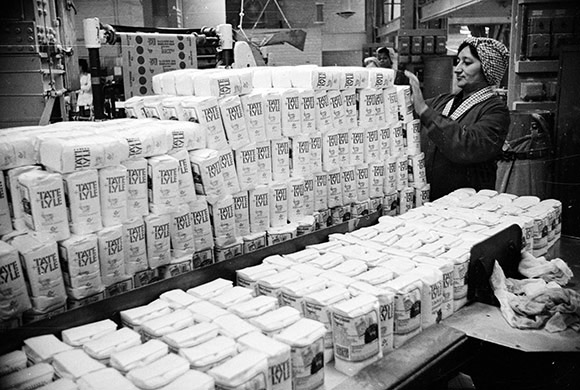
This post started out nearly three months ago as an exposition on sugar.

Photograph: D Morrison/Express/Getty Images

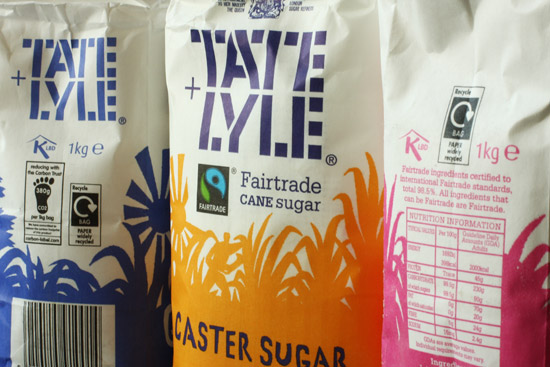
More specifically, I planned to write about the new Fairtrade sugars of Tate & Lyle and the 6000 small-scale sugar cane growers in Belize who have benefited from this conversion of the sugar giant’s retail range. I wanted to tell you how the farmers now receive a Fairtrade Premium in the region of US$60 per tonne for their crop as a result of the certification. This really has significant effects on investment in environmental and economic changes. Raynaldo Aban, a sugar cane farmer from San Joaquin village in Corazal, Belize, described how crucial this premium is to his community:

“The income that we will get will help us in many projects, such as infrastructure, and community development. I would like to tell the people from Great Britain that Belize has a good quality of sugar, and that farmers in Belize will benefit a lot from being certified as Fairtrade.”

I should mention that, whilst I had noticed the Fairtrade logo on bags of Tate & Lyle sugar more than three months ago and had already mentally added them to the list of brands I will put in my shopping trolley, I hadn’t planned to post about this switch until I received an email from the agency representing Tate & Lyle. The cynical among you might now be thinking, “Aha – I thought you said you didn’t do advertising on your blog.” Well, no. I actually said that I rarely find anything to inspire me in the sort of generic, ‘write-about-this-and-we’ll-send-you-loads-of-freebies’ emails that seem to do the rounds in the food blogging world. I’m more than happy to receive suggestions that attune with my own passions and views however, and I welcomed an opportunity to delve further into the background behind Tate & Lyle’s conversion to Fairtrade.

I have to confess that I find Tate & Lyle’s new Fairtrade website more interesting than their Facebook page, We Love Baking, but that’s probably because I still don’t really ‘get’ Facebook. With three children, I struggle to find time even to check my email once a day, so I’m an unlikely candidate for becoming part of an active online community anymore. But that’s not Facebook’s fault, and the Tate & Lyle baking group certainly appears to be motivated and encouraging.

So why has it taken me so long to get around to writing this post? Well, as I just said, I’m slightly tied up in the taxi-driving madness of motherhood these days, so any job that doesn’t directly involve placating screaming children tends to be relegated to the bottom of the to-do list. But Tate & Lyle very kindly sent me a package of their Fairtrade sugar samples in a follow-up to their original email, so surely I could have kicked my ass into gear before now? Okay, okay, I know – but you see, the problem wasn’t solely a time-issue thing. I couldn’t decide exactly which recipe I most wanted to write about.

First of all, there was the best chocolate chip cookie recipe ever. The one that used Tate & Lyle’s Fairtrade granulated sugar.

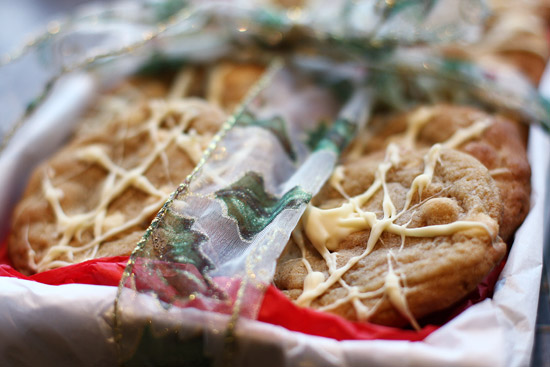
Then there was the one for the white chocolate and cardamom cookies we made for the children’s ballet teacher at the end of term. Drizzled with melted white chocolate, the rich cardamom mingled with the perfumes of vanilla to create almost lemony overtones. Besides, I also wanted to tell you about the ballet school’s show and urge anyone within distance to hurry to the Manor Pavillion in Sidmouth on January 15th/16th next year to see The Lost Girl and other ballets.

Then the snow fell, fairy lights twinkled in the trees and we found ourselves racing headlong towards a breathtakingly beautiful white Christmas. We mixed together the seasonal colours and created orange-spiced cookies bursting with pistachios, cranberries and white chocolate chips for our neighbours.

It might have been three months in the making, but I would finally like to conclude my overdue exposition on sugar with perhaps the best gift of all (depending on your aversion or otherwise to cookies) – the recipe for the best-ever chocolate chip cookie with variations for white chocolate cardamom and seasonal colour varieties.

Enjoy – and Happy Holidays 🙂

Best Ever Chocolate Chip Cookies (by me and according to my children)

7 3/4 oz butter, softened
5 1/2 oz Fairtrade granulated sugar
6 oz Fairtrade light brown muscovado sugar
1 tsp vanilla extract
2 large eggs (3 1/2 oz without shells)
12 3/4 oz strong white (bread) flour
1 tsp baking soda
1 tsp salt
12 oz plain/milk chocolate chips

Preheat the oven to 190 degrees C.

Cream the butter and sugar in a large bowl.

Lightly beat the eggs together with the vanilla and add gradually to the creamed mixture.

Mix together the dry ingredients, then stir into the dough until just combined.

Stir in the chocolate chips.

Drop large tablespoonfuls of the dough onto ungreased baking trays, leaving plenty of room for the cookies to expand during baking. Bake for 8-10 minutes in the pre-heated oven (9 minutes in my oven gives the best results for a crunchy-on-the-outside/soft-in-the-middle texture).

Remove the cookies carefully with a spatula and cool on wire racks.

Makes c. 30 cookies.

White chocolate and cardamom variation: replace the plain/milk chocolate chips with white chocolate chips or chunks and add the ground seeds from 3 cardamom pods to the dry ingredients.

Seasonal colours variation: replace the plain/milk chocolate chips with 6 oz white chocolate chips or chunks and also stir in 4 oz dried cranberries, 4 oz chopped pistachios and the grated zest of 1 orange.

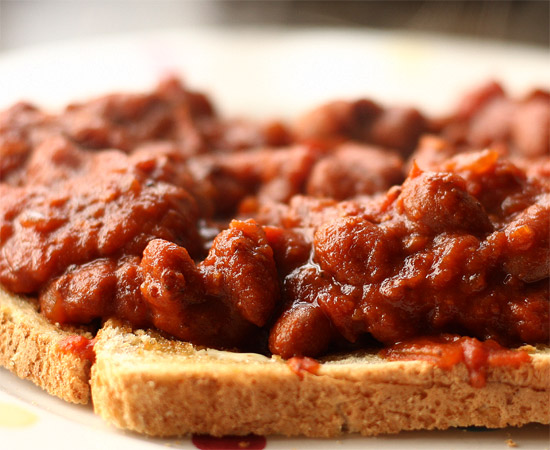
Baked Beans for Cold Days

I have a cold. My head aches, my eyes are streaming and my nose is dripping. Drip, sniff, drip, sniff, sneeze.

L also has a bug, only she has managed to sing her way through her choir practice and leap about in her Grade 3 ballet exam this weekend. Oh – and keep me awake most of the night too. But we won’t talk about that.

One of my favourite cookbooks for cold days like these is Ainsley Harriott’s Feel-Good Cookbook. And one of the ultimate feel-good, comfort foods has to be baked beans on toast.

Well, how lucky can I be? There’s a recipe for Best Boston Baked Beans on page 28 of Ainsley’s book. Only I can’t wait 8 hours for the beans to soak. And I don’t have any belly pork. And I want my comfort fix tonight, before my shivering limbs collapse me into a little heap on the kitchen floor and I can’t scrape together the energy to open a can let alone stir a large, simmering pot with a wooden spoon.

So you’ll see, if you have Ainsley’s cookbook, that I took a few shortcuts. And because I didn’t soak any beans, I didn’t have any soaking liquid, so I had to make a few alterations there, too.

Apologies in advance if anyone follows this recipe and thinks they have ended up with a huge stonking amount of baked beans. If you aren’t seeking as much comfort as I was when I doubled Ainsley’s recipe, feel free to halve the amounts below. But don’t blame me if you find yourself wishing you’d made more. I’m convinced the feel-good factor of this dish increases exponentially the more of it there is.

Baked Beans (adapted from a recipe by Ainsley Harriott)

4 tbsp olive oil
2 onions, diced
6 garlic cloves, crushed
4 tsp English mustard powder
4 tbsp light muscovado sugar
4 tbsp molasses sugar
1 tsp smoked paprika
2 tbsp tomato puree
800g (2 tins) chopped tomatoes
8 slices of unsmoked streaky bacon
470g (2 tins) tinned borlotti beans, drained
1 pint chicken stock
1/2 pint water
2 bay leaves
2 tsp dried thyme
salt and freshly ground black pepper

Preheat the oven to 160 degrees C/ 310 degrees F.

Heat the oil in a large casserole pan. Add the onion and cook gently until it softens and begins to caramelise.

Stir in the garlic, mustard powder, sugars, paprika and tomato puree. Cook gently for a minute, stirring to prevent the mixture sticking to the bottom of the pan.

Add the chopped tomatoes and stir.

Cut the bacon into small pieces and add to the pot.

Add the beans, stock, water, bay leaves and thyme. Stir thoroughly and bring to the boil. Cover the pot with a tight-fitting lid and cook in the oven for 3 1/2 to 4 hours until the beans are soft and the sauce has thickened (stir occasionally during this cooking time to make sure that the sauce doesn’t dry out).

Season and eat on thick slices of hot buttered toast.

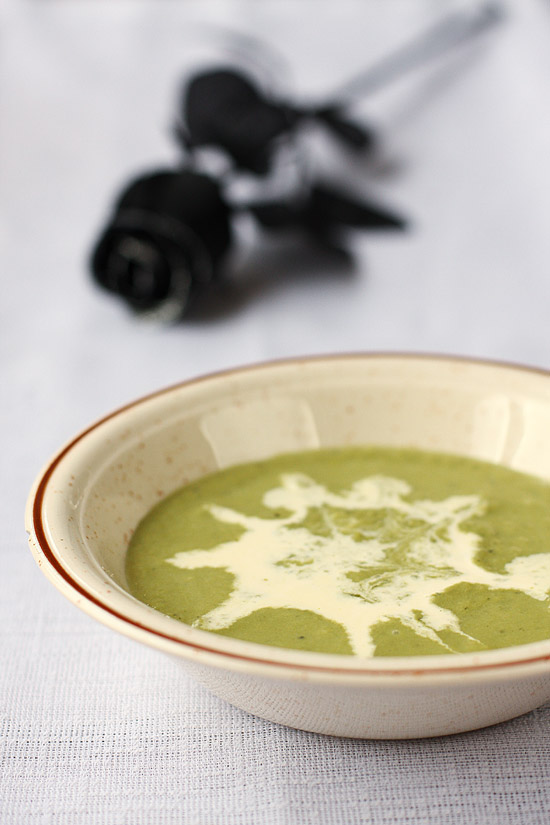
Witches Broth (or Pea and Mint Soup)

I first met this soup at a Mother’s day lunch and never imagined that I’d be calling it Witches’ Broth and serving it up myself a few years later at a Hallowe’en party. I should assure you that this renaming says more about the thick green colour of the soup than it does about my views on motherhood …

It is hardly a well-kept secret that Hallowe’en ranks high on my list of all-time favourite festivities. It comes at a magical time of year when the days are shortening, the air is cooling and the trees are resplendent in their cloaks of fiery colours. The children’s excitement is on a par with that of Christmas in our house as they delve deep down into their dressing-up box to pull out black gowns, orange and green-striped stockings, pointed hats and vampire fangs. We decorate the house with silvery cobwebs, read stories of errant witches and shiver at the bone-rattling skeletons in Berlioz’ dream of a Witches’ Sabbath.

I think that what makes this festival particularly special for me is that there are no pre-conceived ideas about what form the traditions should take and no expectations of receiving presents among our children. They enjoy themselves enormously through the simple pleasure that comes from sparking their imaginations and partying with friends.

Unlike in the depressing scene depicted by William Langley, we have amiable neighbours who are happy to collude in a little organised trick-or-treating, while our costumes and party trimmings are largely homemade and provide an opportunity for creative fun.

Far from being an imported custom, the roots of Hallowe’en extend further back in Britain than those of the seemingly more traditionally-celebrated Guy Fawkes night. In fact, the origins of Hallowe’en practices in America can themselves be traced to the arrival of Scottish and Irish immigrants during the nineteenth century.

So pull up your cauldrons, grab your wooden spoons and join us for a warming bowl of witches’ broth 🙂 .

Witches Broth: Pea and Mint Soup (adapted from a recipe by Charlotte Kilvington)

2 oz unsalted butter
1 large onion, peeled and chopped
600 mls chicken stock
2 lb frozen peas
1 head of firm lettuce, eg. Iceberg
a handful of fresh mint, chopped
300 mls milk

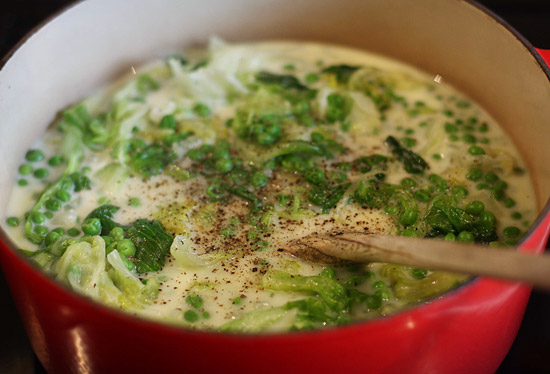
Melt the butter in a large saucepan. Add the onion and fry gently to soften.

Add the stock and frozen peas. Bring to the boil and simmer until the peas are tender.

Add the lettuce and mint. Continue cooking until the lettuce has wilted.

Stir in the milk.

Blend in a food processor and season to taste.

Serve with a swirl of single cream on top – pull through from the centre outwards with a toothpick to create a spider’s web.

Apples Galore

Many years ago when anything was possible, I pushed an apple pip into the ground and it grew into an apple tree. My apple tree moved with me to two new childhood homes and eventually grew sweet apples that I ate in memory of that first original fruit.

When my parents moved to Devon earlier this year, they tried to bring some part of this apple tree with them. My Dad attempted to graft some winterbound twigs onto new stock, whilst a friend planted fresh cuttings in a transportable mini cold frame. It was the wrong time of year, it was the nature of things – all of these much-appreciated attempts failed (although I still have a pressed leaf from the cuttings of my apple tree).

At the same time as when my parents were preparing to pack up their moving crates however, O and our children planted a new apple tree in our front garden with its own story to tell.

Last November, O brought home a young apple tree from St Bridget Nurseries. He told us how a staff member at the nurseries had helped him to carry the tree to his car. It had been a struggle to wedge the tree into the boot of the car without snapping or trapping any of the precious branches, and they were both tired from the effort. Having recently been in the States where he had learned to reach automatically for his wallet at times like this, O offered to tip the man. The man replied that he wanted no tip, but would instead welcome an apple from the tree the following year.

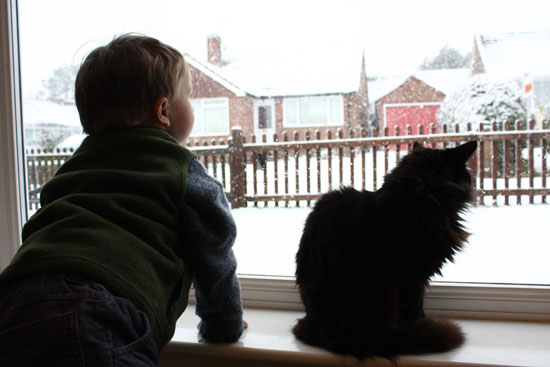
We planted the tree and worked hard to lay turf over the ground before the first frosts came, only to wake up to an unprecedented covering of snow that lasted for the first two months of our newly-designed garden’s life.

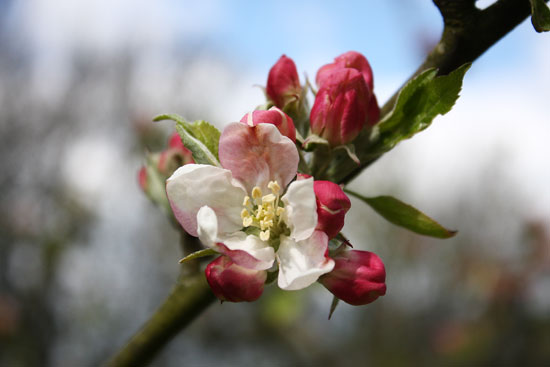
As the ground began to thaw and the dark days started to lengthen, we worried that the young tree had not survived the ill-timed freeze and watched anxiously for signs of growth. Crocuses and daffodils planted at the foot of the tree peeked tentatively through the grass as if unsure about the rewards of pushing upwards through the frozen earth. Buds on the tips of the bare apple tree branches swelled minutely and we held our breath as we waited for Spring to explode.

Among the apples we have collected from our tree this year, one is reserved for the man from the garden centre. We will be taking it to him later today. Fingers crossed he enjoys his slow-to-mature tip!

I’m not alone in turning my thoughts to apples at this time of year. Yesterday saw the 21st anniversary of the autumnal celebration of Apple Day with events around the world to inspire and inform an orchard revival. Close to home, Otterton Mill is hosting food tasting, apple bobbing and other family activities tomorrow, whilst we have the opportunity to press our own apples into juice at Matthews Hall in Topsham on Sunday (perhaps we may grow sufficient apples for a drop or two of juice next year!). There’s still time to discover an Apple Day event near you …

Apparently, the association of apples with Hallowe’en is all down to the Celts. They believed that fruits grew magically in the Island of Apples, an enchanted place that was only accessible by passing through water. So next time you find yourself snorting water as bobbing apples bonk your nose at a Hallowe’en party, it may help to remember this mystical isle.

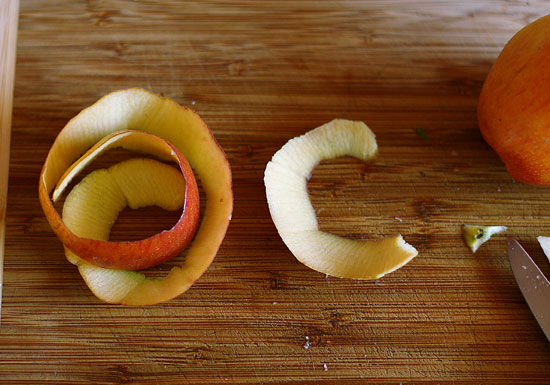
One of my own favourite apple traditions as a child was to throw the peelings over my shoulder to discover the initials of the person I would marry. Well, would you just look at that … spooooky!

I thought that now would be a good time to share a recipe I was inspired to create recently. It’s a dish for those seasons of mellow fruitfulness when the morning mists cling to the path of the river towards the estuary and the crisp evening skies fill with the aroma of wood smoke from bonfires and hearths.

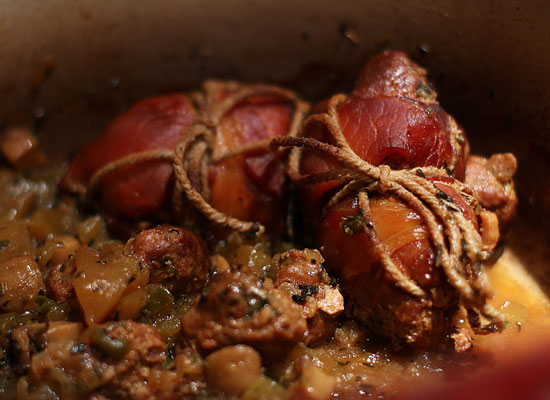
Pork and Apple Sausage Parcels in Apple Stew

2 small onions, halved and cut into long slices
2 sticks celery, diced
6 mushrooms, diced into large chunks
1 green chilli, chopped finely
3 dessert apples, peeled, cored and diced
1 tsp dried sage
1 tsp dried thyme
freshly ground black pepper, to taste
150 ml chicken stock
8 oz pork fillet
6 pork and apple sausages
6 rashers unsmoked back bacon
500 ml dry cider

Using an ovenproof 10″ saucepan with lid:

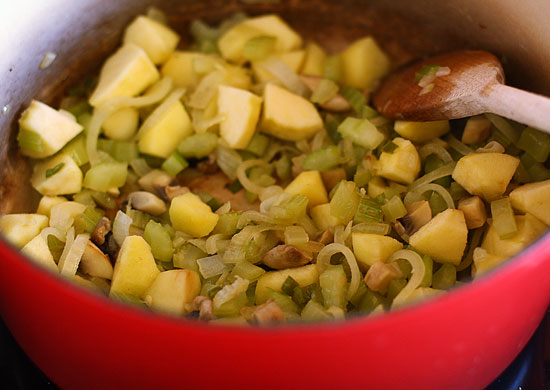
Fry the onions, celery, mushrooms and chilli in 2 to 3 tbsp olive oil to soften.

Add diced apples, herbs and chicken stock.

Cut the pork into 4 slices, then bash each with a mallet into rectangles. Split 3 of the sausages from their casings and divide the sausagemeat between the pork rectangles. Roll each rectangle and wrap with bacon (1 1/2 slices per pork parcel). Secure with string.

Split the casings of the remaining sausages and make balls out of the sausagemeat. Add to the pan and fry to brown.

Place the pork parcels on top of the apple stew and add the cider (it should come halfway up the sides of the pork parcels).

Cover and place in the oven at 160 degrees C for 1 1/2 hours.

Untie the parcels to serve. Serve with mashed potatoes or rice.

  • Enter your email address to subscribe to this blog and receive notifications of new posts by email.

    Join 289 other subscribers
  • Seasonal Recipes

    candied peel

    baileys chocolate truffles

    gingerbread men

    mince pies

    fudge

    smarties cookies

  • Freshly Made

  • Categories

  • Favourite Feasts

  • Awards

    DMBLGIT Award
  • Archives

  • wordpress visitor counter
  • Adventures in food by Kate Coldrick from Woodbury in Devon.