Recipes offer a tangible glimpse of the past and bring history books alive, inspiring the imagination to go beyond the dry details of facts and lists of dates. Eating is both a necessity and a cultural practice. It is a natural daily activity that enmeshes a person in their own time and place. If the unfamiliar foods of a foreign country in today’s world can stimulate feelings of displacement, how much more powerful is this experience when transposed across time? Food brings us vividly face-to-face with people from long ago and recreates them for us as complex characters with the full range of human emotions and needs.
When L told me that they were ‘doing’ the Anglo Saxons at school, I struggled to dredge up any relevant information about the period from my own history lessons. I could tell you a fair amount about what the Romans did for us and I knew who won the Battle of Hastings in 1066, but the bit in between was slightly foggy to say the least. Weren’t there some Vikings around at some point too? How did they fit into the grand parade of marauding conquerors?
Wikipedia attempts to clarify:
Anglo-Saxon England refers to the period of the history of England that lasts from the end of Roman Britain and the establishment of Anglo-Saxon kingdoms in the 5th century until the Norman conquest of England in 1066 … Facing the threat of Viking invasions, the House of Wessex became dominant during the 9th century, under the rule of Alfred the Great. During the 10th century, the individual kingdoms unified under the rule of Wessex into the Kingdom of England, which stood opposed to the Danelaw, the Viking kingdoms established from the 9th century in the North of England and the East Midlands. The entire kingdom of England fell to Danish invasion in 1013, and was ruled by the House of Denmark until 1042, when the Anglo-Saxon House of Wessex was restored until 1066, when the last Anglo-Saxon king, Harold Godwinson, fell at the Battle of Hastings
Did you get that? Did you feel any tingling thrill of empathy with centuries-old travellers, any frisson of familiarity with a human thirst for life? Did you recognize yourself in that encyclopaedic entry?
Contrast this with the seafarer poet who told of his feet fettered by cold, bound by frost in cold clasps. Cares seethed hot about his heart and hunger tore from within his sea-weary soul as he imagined hearing the laughter of men and the drinking of mead in the sounds of the curlew and the singing gull. His spirit twisted out of his breast and soared out in the waterways, over the whale’s path and through all the corners of the world in search of heaven.
Such depictions of endurance, suffering, loneliness and spiritual yearning make it easy to imagine that this elegy was written only yesterday, but it wasn’t. It was written more than a thousand years ago in Old English and survives in hand-copied form in the 11th-century Exeter Book. Poetry such as this shows us that history can still be very much alive today, resonant with the reality of human existence.
With half-term upon us and O absent in Cambridge, I decided to involve my children in a little ‘living history’ project of our own. “Let’s have an Anglo-Saxon feast for dinner tonight,” I declared.
“I want fish fingers and chips,” T told me. He’s only 3, so I guess history’s a bit of a tricky concept for him. L thought the idea was okay and M wanted to know if it was the same as having a party, in which case it would be fine with her too.
Unfortunately, I didn’t realise then that there are very few, if any, authentic Saxon recipes around today. This isn’t because food was unimportant to the Anglo-Saxons – descriptions of feasts in Beowulf reveal the importance of feasting as a social display of wealth and prosperity. In a time of famine and frequent invasion, the ability to present an abundance of food to guests must have been a true sign of a person’s hospitality and good farming fortune.
If I can dare to offer an opinion on why there is such a lack of extant records of how food was prepared (which is either pretty brave of me or pretty foolish, given that I barely knew anything at all about the Anglo-Saxons a few days ago), I would suggest that it is because their food was local and cooked simply. Recipes just weren’t necessary.
In this Saxon-style version of Nigel Slater’s Simple Suppers, no-one would have thought to write down a procedure for cooking. There were few established trade routes and spices were expensive. Ingredients would therefore be familiar and their preparation commonplace. I think this apparent simplicity in Anglo-Saxon cookery is behind the following exchange between the teacher and the cook in Aelfric’s Colloquy:
Teacher: What can we say about you, cook? Do we have need of any of your skills?
Cook: If you drive me away from your community you would eat your vegetables raw and your meat rare; and, moreover, without my skill, you would be unable to have good rich broth.
Teacher: We do not care about your skill, it is of no importance to us, since we can cook what needs to be cooked and eat what needs to be eaten.
To recreate an Anglo-Saxon dish therefore, we needed to find out more about the foods that were available among the local resources at that time. L was keen to tell me about Anglo-Saxon farming methods and gave me an animated account of how there were “loads of boggy fields and they didn’t want one person to get the only good field, cos that wouldn’t be fair, so they gave everyone a bit of the good field in a strip” (fairness is important to 8-year-olds). We then discovered a goldmine of accumulated knowledge from a re-enactment society and an attractive presentation of this same material for children on food and drink in Anglo-Saxon life.
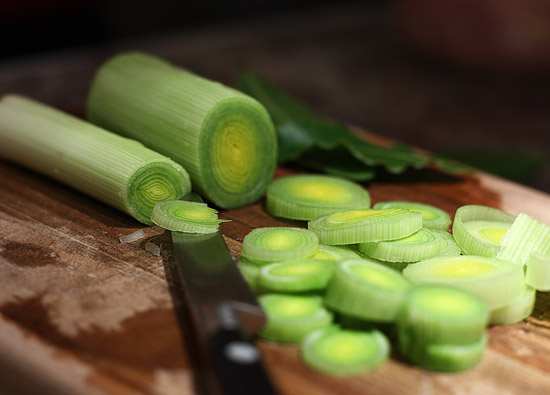
Beans, peas, onions, white carrots, cabbage and leeks were cultivated, and wild foods such as garlic, nuts and herbs were collected. Common crops included wheat, barley, oats, rye and spelt. Grains would be ground into flour to make bread, the only staple source of starch in Anglo-Saxon diets. Sheep, cows, goats, pigs and chicken were raised on farms for meat and other foods, while hunters supplemented the table with deer, wild boar, hares and a variety of wild birds. Streams and rivers provided fish such as eels, pike, minnow, trout and sprats. Sea-fishermen caught herring, salmon, oysters, mussels, plaice, flatfish, lobsters and so on, but these delicacies were unavailable to anyone living too far inland. Butter and cheese were produced in dairies, and both the coastal and inland extraction of salt allowed these and other commodities to be seasoned and preserved. Apples, pears, peaches and wild summer berries were gathered from the trees and bushes.
We noted several important foodstuffs that were either entirely unavailable or largely unused in Anglo-Saxon cooking (apart from the obvious things that is, like Coco-Pops and Findus Crispy Pancakes). Sugar didn’t arrive in England until the Crusades in the 12th century, so honey was used as the major form of sweetener. Despite Mary Savelli’s best claims in her book on the Tastes of Anglo-Saxon England, tea was neither available at that time nor a common ingredient of mead. Pepper and other spices were prohibitively expensive for all but the most wealthy, while wheat also was used in limited amounts by common people due to its cost. And potatoes – yes, O’s favourite form of starch wasn’t brought to England until the 1580s. Turkeys, tomatoes and apricots also weren’t introduced until the 16th century.
I had more difficulty in tracking down information on cooking oil. It seems that the Romans brought olive oil over with them, but I’m not sure if they left it here when they went. Vegetable oil is referenced by Stephen Pollington in The mead hall: the feasting tradition in Anglo-Saxon England when he describes “a richer form of bread [that] could be obtained by adding egg, milk, cream or vegetable oil to the mixture,” but I can’t find anything to corroborate this. Without wanting to deviate too far from authenticity but unwilling to render our own lard for the experiment, we decided that using vegetable oil would be acceptable for us.

It was interesting to discover that the Anglo-Saxons did leave us a form of recipe in their prescriptions for medicines. Although I doubted that my children would appreciate receiving an Anglo-Saxon cure for their dinner (unless it tasted like Calpol, that is), the various charms and concoctions described in leechbooks of the time suggest that the Anglo-Saxons were familiar with and used a wider range of herbs in their cooking than we do today:
“If anyone has the water-elf disease, then his nails will be wan and his eyes will water and he will wish to look down. Give him this medicine: carline thistle, hassock, the lower part of iris, yewberry, lupine, elecampne, marshmallow head, fen-mint, dill, lily, cock’s-spur grass, pennyroyal, horehound, dock, elder, earthgall, wormwood, strawberry leaves, comfrey; mix with ale, add holy water to it, then sing this charm three times” …
… or, as it was written in Old English:
Gif mon biþ on wæterælfadle, þonne beoþ him þa hand-
næglas wonne and þa eagan tearige and wile locian niþer.
Do him þis to læcedome: eoforþrote, cassuc, fone nioþo-
weard, eowberge, elehtre, eolone, merscmealwan crop,
fenminte, dile, lilie, attorlaþe, polleie, marubie, docce, ellen,
felterre, wermod, streawbergean leaf, consolde; ofgeot mid
fealaþ, do hæligwæter to, sing þis gealdor ofer þriwa …
Listen to this being read.
We soon discovered that bread was of central importance to the Anglo-Saxons, not only as food but also as a payment for rent and a marker of social hierarchy. This is reflected in the Old English vocabulary of the time. The word for a ‘loaf’ (hlaf) is found in the word for ‘lord’ (hlaford), itself derived from the term hlaf-weard, or ‘bread-guardian’. Just as we talk about the ‘bread-winner’ of a family today, the Old English term denoted the fact that the lord was responsible for providing food for his people. Accordingly, a retainer of the lord was called a hlafæta, or bread-eater. The lord’s wife, on the other hand, was known as the hlæfdige, or ‘bread-maker’. The modern term ‘lady’ is derived from this word.
As the only form of starch, bread was an essential part of every Anglo-Saxon meal. Made from mixed wholegrain flours ground from wheat, barley, rye, oats, beans and even peas, loaves could be leavened with beer balm or sourdough. Bread was eaten with fresh cheese or used to scoop up accompaniments such as briw, or broth. As the baker said in Aelfric’s Colloquy:
Teacher: What do you say, baker, how does your skill benefit us, or can we lead our live without it?
Baker: You can live for some time without my craft, but you cannot live well for a long time without it. For without my craft the whole table would appear bare, and without bread all your food would become vomit.
Nice.

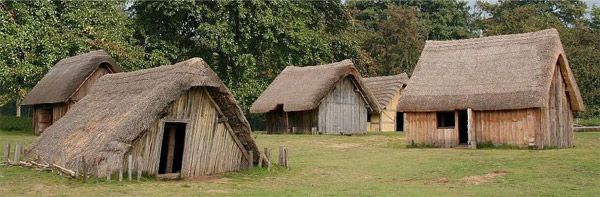
So, how could we turn this list of ingredients into a possible period-like dish? Evidence from archaeological sites and contemporary illustrations shows that Anglo-Saxons used large cooking pots or cauldrons suspended over fires either inside or outside the home. These would be most useful for boiling and stewing meat and vegatables, which is consistent with references to soups, stews, pottages and broths in Anglo-Saxon literature. Cooking in this way would have been both practical and economical – pots could be left to simmer over the course of a day while other jobs were attended to, with the added bonus of preserving nutritional juices and wasting little material in the cooking process.
Small iron skillets and griddles suggest that flat breads and omelettes may have been prepared indoors, while large, enclosed clay ovens show that bread was also baked outside. Meat was often boiled in a bag in the cauldron along with the vegetables, but could also be spit-roasted or grilled for special occasions. Sometimes no pots or utensils at all were used and food was cooked outside in an earthen pit lined with hot stones. This method of cooking gives us an interesting linguistic connection between the Old English word for ‘pit’ (seaþ) and our own term for being in a state of boiling-like agitation, ‘seethe’ (this makes more sense if you know that the funny-looking p sort of letter in Old English writing is pronouned ‘th’).

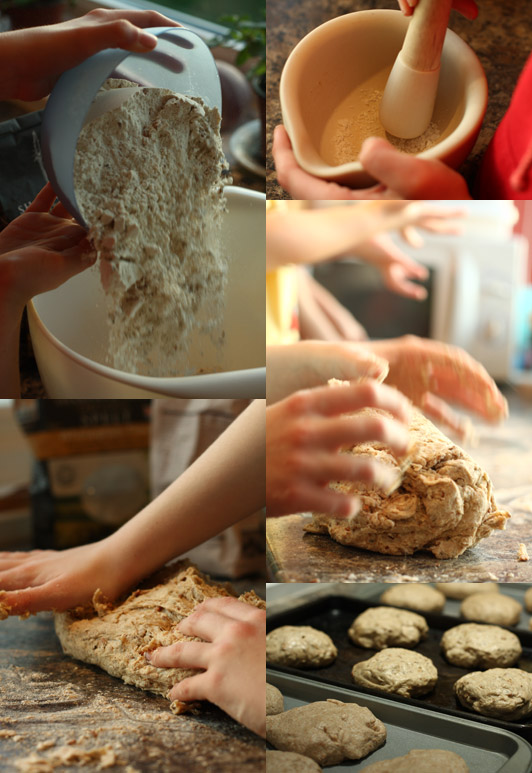
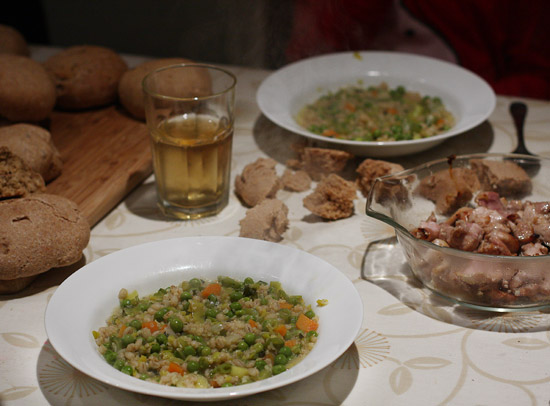
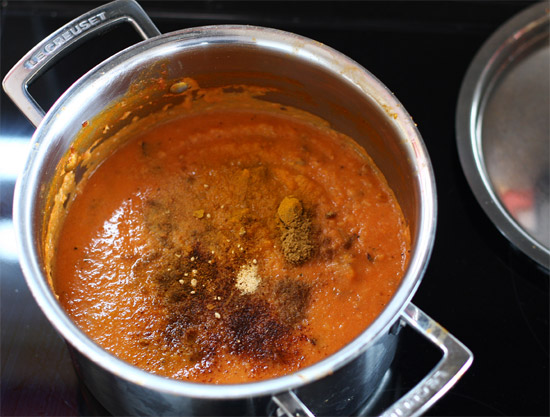
For our own feast, we decided to prepare a broth of leeks, beans, peas and barley in the closest thing we have to a cauldron and hearth fire (aka a red Le Creuset pot and an induction cooker zone). Each one of my three children wanted to make their own batch of bread buns using different flours from each other so that they could compare the tastes of the various wholegrains. Whilst pork or beef would perhaps have featured more regularly on an Anglo-Saxon table, M was adamant that she wanted chicken. Not having a handy spit tucked away in the corner of the kitchen, we did the next best thing and spiked chicken pieces onto barbeque skewers.
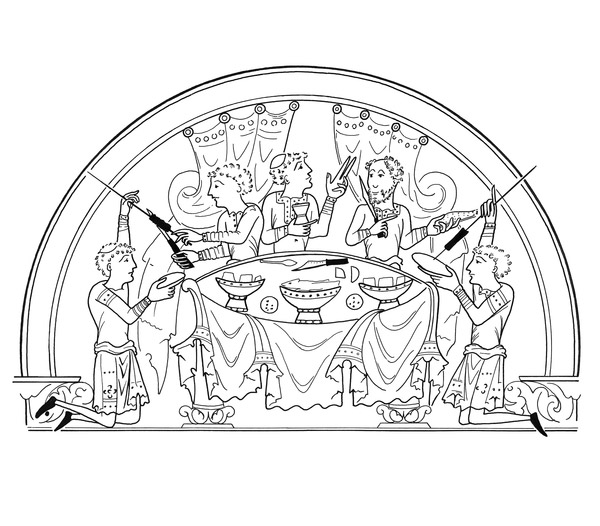
The bread was an enormous success. Everyone enjoyed being ‘in charge’ of their own batch of dough and M ate three of her own spelt-flour bread buns in one go while they were still warm and fresh from the oven. The broth was hearty and delicious (and provided nutritious leftovers for the next day). I think we all felt most Anglo-Saxon when eating the sticky, garlicky chicken with our fingers (although the Anglo-Saxons used spoons and knives, they didn’t appear to see a need for inventing forks as cutlery). With much quaffing of ginger ale, fervent singing and dramatic story-telling, we certainly felt a little closer to our ancient ancestors!
Anglo Saxon Broth with Bread and Spit-Roasted Chicken
Bread
1 lb wholegrain flour (eg. Doves Farm Malthouse bread flour or Sharpham Park wholegrain spelt flour, singly or in combination)
1/2 tsp salt
1 tsp quick yeast
1 tsp honey
300 ml water
1 tbsp vegetable oil
Combine the flour, salt and yeast in a large mixing bowl.
Add the honey and vegetable oil to the water, then stir into the dry ingredients (add more or less water as required – the dough should be tacky but not so sticky that you can’t get it off your hands easily).
Knead for 10 minutes until smooth and stretchy.
Shape into a ball, place in an oiled bowl, cover with cligfilm (or a damp cloth if you haven’t any authentic Anglo-Saxon clingfilm to hand 😉 ) and leave to rise until doubled in size, about 1 hour.
Divide into five or six pieces (approx. 5 oz each or 4 oz each piece) and shape into buns. Place on a baking tray, cover and leave to rise for about 30 minutes.
Preheat the oven to 180 degrees C.
When risen, bake the buns in the oven for 20 minutes. Remove and cover with a clean, dry cloth to keep the crusts soft.
Broth
4 1/2 oz pearl barley
500 ml ale
4 tbsp vegetable oil
1 onion, diced
1/2 lb trimmed leeks, sliced
1 clove garlic, crushed
2 carrots, diced
4 oz green beans, sliced
1 1/4 pints water
2 bay leaves
handful fresh mint leaves (1/4 oz)
12 oz frozen peas
1 tsp honey
2 1/2 oz bulgar wheat
salt, to taste
Put the barley and ale in a medium-sized saucepan, bring to the boil then cover and simmer gently until the barley is soft, c. 50 mins to 1 hour.
Heat the oil in a large saucepan (this is your cauldron). Add the onion, leeks, garlic and carrot. Cook gently until softened.
Stir in the beans and water. Simmer gently until the beans are softened.
Add the bay leaves, mint, peas and honey to the cauldron. Simmer gently for a further 5 minutes.
Stir in the softened barley and ale.
Just before serving, stir in the bulgar wheat. Leave to stand for a couple of minutes, then stir. Check seasoning and add salt if necessary.
Spit-Roasted Chicken
4 tbsp vegetable oil
4 cloves garlic, crushed
2 tsp honey
6 chicken thigh fillets, diced
Mix together the oil, garlic and honey in a medium-sized bowl or measuring jug. Leave to stand for 15 minutes to infuse the flavours.
Add the chicken thigh pieces and stir to cover evenly with the infused oil. Marinade for at least 30 minutes.
Preheat the oven to 200 degrees C.
Thread the chicken pieces onto barbeque skewers and suspend across a baking tray. Drizzle over any remaining oil or garlic.
Cook in the oven for 15 to 20 minutes until the chicken is fully cooked.
To serve: Place the bread on a wooden board in the centre of the table. Remove the chicken pieces from the skewers and place in a large serving bowl on the table. Serve the broth in individual bowls (wooden, if possible) with spoons. Each person should help themselves to the bread and chicken, eating them with their hands and using the bread to scoop up copious amounts of the good rich broth.















 amerrierworld.com