Will the summer sunshine disappear if I comment on it? Or perhaps it’s about to disappear anyway. The weather right now certainly seems too good to be true for all things Jubilee …
But then, as the sun him(her?)self once told Frank O’Hara:
Just keep on
like I do and pay no attention. You’ll
find that people always will complain
about the atmosphere, either too hot
or too cold too bright or too dark, days
too short or too long.
If you don’t appear
at all one day they think you’re lazy
or dead. Just keep right on, I like it.
A sun with attitude.
“Awesome!” as L would say (and she should know, being someone not unfamiliar with the concept of attitude).
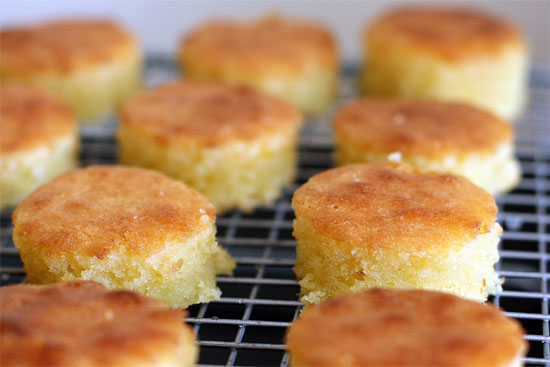
I made some little sundrops for the children’s school summer fête last weekend. They didn’t really look chock-a-block full of attitude, but I have to tell you that there was no way they were going to let me dress them in anything other than their natural, feisty golden colours. And when you consider that these could be just about the only sweet celebration treats you’ll find right now that don’t come in various shades of red, white or blue …
Now – that’s attitude for you 😉
Lemon Almond Sundrops
7 oz butter
7 oz caster sugar
4 eggs
zest and juice of 1 lemon
2 tbsp orange flower water
2 oz plain flour
7 oz ground almonds
6 oz icing sugar
1 tbsp lemon juice
2 tbsp water
Preheat the oven to 180 degrees C. Grease and baseline a 9″x12″ rectangular baking tray.
Cream butter and sugar, then add eggs gradually. Stir in the lemon zest and juice, and the orange water.
Carefully fold in the flour and ground almonds.
Scrape the batter into the prepared pan and smooth evenly. Bake for 30 minutes until golden and springy. Leave for 5 minutes to cool before turning out onto a wire rack.
Prepare the glaze by mixing together the icing sugar, lemon juice and water.
When the cake is just cool enough to handle, use a circular biscuit cutter to cut out … well, circles really (what else can I say?). I used a diameter of 1 7/8″, which made 24 circles.
Dip the tops of each sundrop in the glaze and return to the wire rack to set. Lick your fingers (because they’ll be very sticky by now).
After L’s successful guest post in October, my younger daughter told me today that she also wanted to write a guest post for A Merrier World (not that there’s ever a hint of sibling rivalry between them, of course …) So, here is M – she is six years old and has been having a lot of fun at school this term …
We have been learning about the Ancient Romans at school. A Roman centurion came in to help us learn about them. We made shields and then we had a battle with the Year Ones. We used balls instead of cannons and swords. The Year Ones (who were supposed to be the Celts) kept on running away, so we won. The centurion also brought in some fish sauce that smelled disgusting!
Anyway, on Friday the 23rd we did a Roman presentation. I was in the Roman banquet scene. My line was, “The Romans loved holding feasts. One of the things they loved was… peacock brains!” Somebody else in the Roman banquet said they also liked surprises in their food such as doves flying out of the stomach cavity of a roasted suckling pig. We discovered that the Romans lay down to eat and that they made themselves sick so that they could eat more (but that was only in fancy banquets).
Today we had a Roman banquet in our classroom. Everyone dressed up as Romans. I was a slave who opened the door. Here’s an interesting fact – the slaves who opened the doors had to look fancy so everyone knew that the person who owned the house was rich.
Our teachers had researched lots of Ancient Roman recipes. Some of the recipes were in the cookery book that I took into school for them. At our banquet, we tasted lots of food that the Romans would have eaten. I only liked the grapes and the apple as well as the bread dipped in olive oil. I didn’t like the peacock brains, which were really just mince cooked in the oven. When we were making the peacock brains, we had to put our hands in the mince. I hated the honey cake – it looked like an omelette (and I don’t like them either!). There were some olives as well, but I didn’t try them.
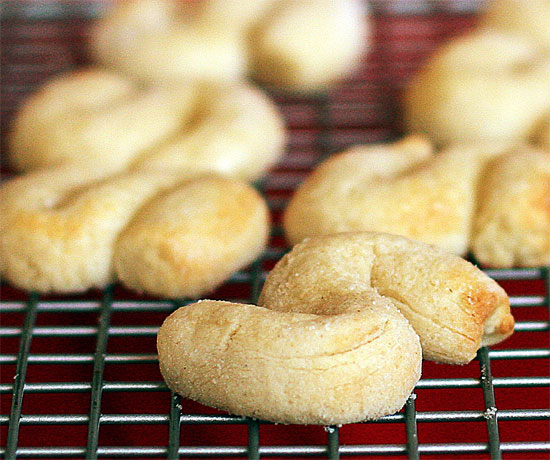
For dessert, we all ate some Ancient Roman biscuits that I had baked last night with my Mum. They were called ‘serpette’ and they used honey instead of sugar. We sprinkled sugar on the top instead of sesame seeds because we thought they would be tastier that way. Unfortunately, the Romans didn’t have sugar, so that bit wouldn’t have been invented in Roman times. We made them into ‘S’ shapes like the serpette biscuits that are made today in the Castelli Romani near Rome.
My friends said that the biscuits were really delicious. They asked me how I had made them into ‘S’ shapes. I told them that we rolled some of the dough into a sausage shape and then we curled it around so that it looked like an ‘S’.
Ancient Roman Honey Serpette
12 1/2 oz plain flour
1 tsp baking powder (which the Romans didn’t have – sorry!)
1/8 teaspoon baking soda (as above … sorry!)
1/2 teaspoon salt
4 oz unsalted butter, room temperature
6 oz honey
2 eggs
1 egg white and castor sugar to sprinkle (or sesame seeds)
Put the flour, baking powder, baking soda and salt in a mixing bowl and use a whisk to mix them all together.
Use another bowl now. Put the butter and honey into it and beat them together. Add the eggs a bit at a time. Make sure that everything is mixed up very well.
Tip the flour and stuff into the bowl and mix it all together to make a dough.
Cover the dough bowl with cling film and put it into the fridge until the dough is cold and firmer.
Put the oven on to 180 degrees C.
Grease some baking trays and line them with baking parchment.
Sprinkle some flour on the work top. Roll bits of the dough into long sausage shapes. Cut them into shorter lengths and curl them to make an ‘S’ shape. Put the S’s onto the baking trays.
Brush some egg white onto the top of each serpette (this is a bit like glue) and sprinkle the tops with a bit of castor sugar.
Bake the serpette in the oven for about 7 minutes or until they are just turning golden.
Although we don’t have a television, which possibly makes us a slightly unusual family, we do watch a variety of TV programmes via BBC iPlayer and 4OD. Recently, we enjoyed Hugh Fearnly-Whittingstall’s latest River Cottage series in which he gave up eating meat for four months over the summer. The programmes in this series charted his discovery of new vegetarian combinations and dishes, ranging from simple soups and salads to lavish banquets and wedding feasts.
Perhaps the most intriguing creation from the entire series however was Laura Coxeter’s raw chocolate ganache tart. Prepared with a heady mix of pecans, medjool dates, avocados and cacao powder, it really is a work of pure genius.
The idea behind the tart is that it can be served to raw food eaters, vegans and anyone wishing to avoid dairy, gluten and soya in their diet. I don’t know about you, but I wouldn’t normally associate such a recipe with something that turns out to be richly chocolately and sinfully sumptuous. But Laura really did appear to have pulled it off, judging by the velvet gooiness of the ganache and the fervent lip-smacking of its tasters. I was inspired to give it a go.
Now, I have to confess that I’m not a raw food eater. Okay, it’s probably not such a huge confession – Laura’s the first raw food eater that I’ve ever come across. I did therefore make a few changes to the tart, which will no doubt have raw foodies shuddering in their graves. In essence, my recipe is more or less true to the original although not an exact replication.
The secret behind the ganache is avocado. Whizzed up in a food processor with cocoa powder and sugar, avocados form the basis of a smooth, luxurious texture that is normally achieved by mixing chocolate and cream. The whole tart is ridiculously easy to make – you just need to make sure that you’ve allowed plenty of time for it to chill and set before serving.
The finished tart got a thumbs-up from my children, and I certainly wouldn’t hesitate to present it as the pièce de résistance at the end of a more grown-up dinner party. All in all, this recipe is just in time for the festive season. Happy Holidays 🙂
No-Bake Chocolate Ganache Tart (adapted from a recipe by Laura Coxeter)
For the base
300g/10 1/2 oz pecans
1 tsp salt
200g/7 oz medjool dates
For the filling
4 medium, ripe avocados
150g/5 1/2 oz rice bran oil
Seeds of 2 whole vanilla pods
200g/7 oz cocoa powder
1/4 tsp salt
300g/10 1/2 oz castor sugar
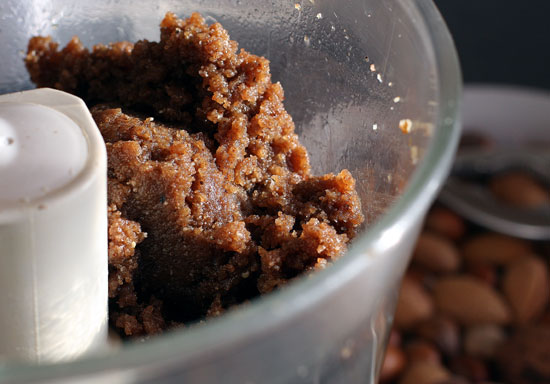
Blend the pecans in a food processor, then add the salt and dates. Whizz them all together until the mixture balls into a dough.
Press the dough into the base of a 9″ springform pan. Chill in the freezer to harden.
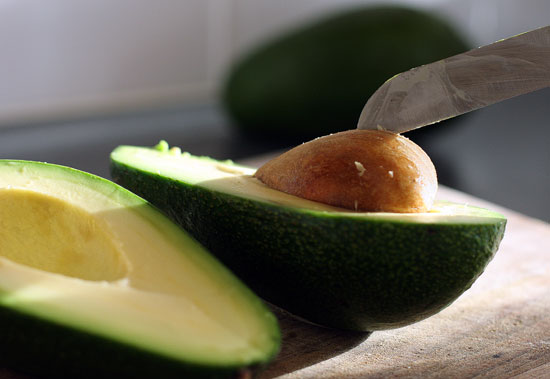
Peel and de-stone the avocados, then blend the pulp in the food processor. Add the oil, vanilla seeds, cocoa, salt and sugar and process until smooth.
Scrape the filling onto the base and spread evenly with a spatula or palette knife.
Set the tart in the freezer for an hour before serving.
I’m lucky – my husband hates chocolate. Unfortunately, my three children all have sweet teeth and I’ve been forced to watch my own share of all our chocolate bars dwindle over the years to become a paltry quarter of what it was in the days before weaning. The only upside to this state of affairs is that I now have an enthusiastic army of homegrown tasters on ever-ready standby from the instant I even begin to think about baking with chocolate.
My experiences with chocolate so far however have revolved mostly around the themes of brownies, chips in cookies and simple dipping projects. Despite spending an enjoyable morning with Zach Townsend at the top of the Tour Montparnasse, I was disappointed to find afterwards that none of his expert chocolatier skill had rubbed off on me when we shook hands. I still tremble at the thought of tempering and steadfastly avoid any form of moulding or modelling. It’s those temperamental sugar crystals that get me – the way they want to clump together at the slightest opportunity. My aversion to working with chocolate goes hand in hand with my fear of boiling sugary syrups. And as for seeding … well really, that’s something for gardeners, isn’t it?
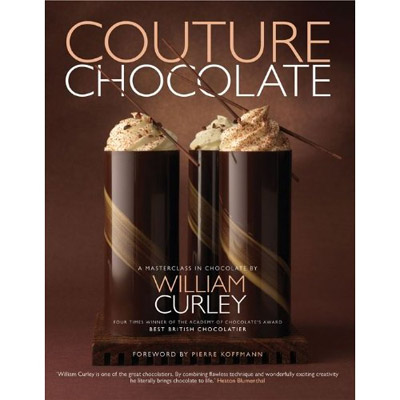
And then I was invited to review William Curley’s new book, Couture Chocolate. I have to confess that I fell in love with this book from the moment I held it in my hands. Not only is it superbly illustrated with mouthwatering photography …. but it smells good too. Honestly, it does! Just bury your nose deep into the binding of the open pages and you’ll see what I mean. But best of all, this book does exactly what it says on the cover – more than just a coffee table book, this really is A Masterclass in Chocolate.
William Curley is uniquely placed to direct this masterclass. Four times winner of the Academy of Chocolate‘s Chocolatier of the Year Award, he trained in some of the world’s finest Michelin-starred kitchens and was the youngest appointed Chef Patissier at The Savoy. From the opening chapters on the history and production of chocolate, through clear instructions on techniques for tempering and decorating, and with exquisite recipes for truffles, couture chocolates, bars, bouchées, cakes, patisserie and ice cream, Curley’s expert guide provides insight into the ideas and inspirations behind his work.
The recipes aren’t quick and simple. Curley uses quality ingredients and an array of specialist equipment that will probably require a trip to Amazon for most home bakers like me. Far from appearing daunting however, the recipes are broken down into manageable chunks throughout and combine practical tips with step-by-step photography. Recipes are included for many of the flavours and chocolate creations on sale in his own William Curley shops in Richmond and Belgravia, such as the Florentine Sablés and Salted Butter and Muscovado Caramel Chocolates (the highest marked chocolate in the Academy of Chocolate Awards 2011).
Curley frequently draws on a Japanese palette of flavours to create new fusions in his work. There are recipes for Matcha and Dark Chocolate Entremet, Chocolate Financiers with Yuzu Ganache, Chestnut and Sesame Brownies, and Green Tea Couture Chocolates. He attributes the inspiration behind these creations to his partnership with Japanese patissier Suzue – they met while they were both working at The Savoy in London and later married and opened their first shop together.
Perhaps the thing that inspires me the most about this book however is the knowledge that the stunning chocolates and intricate patisserie displayed in William Curley’s London shops are created in much the same way as detailed in these recipes. Although Curley’s staff have the advantage of some time-saving bits of machinery, the emphasis is firmly on using craft skills. As Curley points out, “I don’t want to have big cooling tunnels or machines that pump the ganache into shells. I want my team to make the ganache and understand the quality of the ingredients, and for everything to have that hand-made finish.” So … the ultimate implication is that Curley-quality creations are within the reach of every home baker if they take the time and care to follow this masterclass in chocolate.
Well, everyone needs a dream, don’t they?
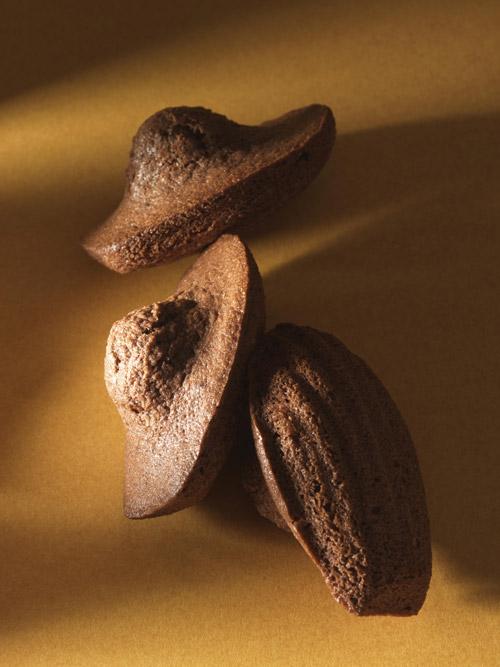
Chocolate Madeleines (reprinted fromCouture Chocolateby William Curley with permission from the publishers)
When I worked for Marco we would bake these little French treats to order for petit fours as they are best eaten fresh as possible.
Makes about 20 cakes
15g (½oz) fine dark (bittersweet) chocolate (70% cocoa solids), roughly chopped
115g (4oz/ 1 stick plus 1 tbsp) unsalted butter, plus a little extra, softened, for greasing the mould
115g (4oz/¾ cup) plain (all-purpose) flour, plus a little extra for dusting the mould
20g (¾oz/1 tbsp) cocoa powder
3g (½ tsp) baking powder
135g (5oz/scant ⅔ cup) caster (superfine) sugar
175g (6oz) egg yolks (about 9 eggs), beaten
Note: You will need a 12-hole madeleine mould.
Grease with butter and lightly flour a 12-hole madeleine mould. Melt the chocolate over a bain-marie (water bath) until it reaches 45°C (113°F) and leave to cool. Melt the butter in a saucepan and also leave to cool. Sift the flour, cocoa powder and baking powder into a bowl and then mix in the sugar. Add the dry ingredients to the beaten egg yolks in a large bowl and mix with a wooden spoon until smooth. Gradually add the melted butter, being careful not to beat in air. Then mix in the melted chocolate. Cover the bowl with cling film (plastic wrap) and leave to rest for at least 30 minutes in a cool place.
When you are ready to cook the madeleines, preheat the oven to 220°C (400°F/Gas 6). Pipe or spoon the mixture into the prepared mould and bake in the preheated oven for about 12-15 minutes until risen and the cakes spring back when pressed.
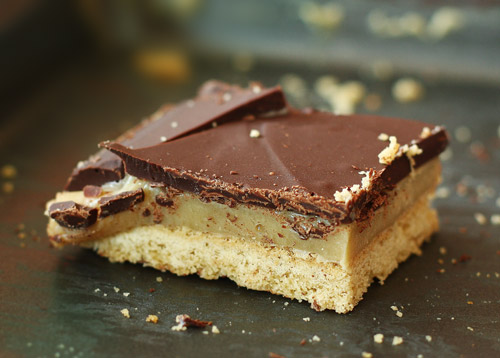
You’re looking at the final slice, the very last square of that single most delectable confection that has ever tortured your sweet-toothed craving heart.
Buttery shortbread.
Oozing caramel.
Smooth, dark chocolate.
Perhaps you can’t see the beauty in this sticky, gooey slice. After all, I’m posting this on an Easter Sunday already replete with chocolate gifts in all shapes and sizes. Although L’s chocolate feast was delayed by her chorister duties at the Cathedral this morning, the choristers all made up for this by clutching armfuls of chocolate eggs as they emerged from the vestry after Mattins. By that time however, her younger sister and brother had already consumed an entire chocolate bunny each for breakfast. Things have been going downhill since then …
But when you’ve emerged from the nausea of the chocolate-induced hangover, do give this recipe a try. It didn’t hang around for too long in our fridge and I had to be quick off the mark to snap even this very last slice for you. A moment later, there was nothing more than a few lonely crumbs on an otherwise empty baking tray.
Chocolate Caramel Shortbread
Shortbread
2 oz light muscovado sugar
4 oz butter
5 1/2 oz self-raising flour
Caramel
3 oz light muscovado sugar
4 oz butter
2 tbsp golden syrup
1 x 14 oz tin condensed milk (NB not evaporated milk)
Chocolate
7 oz plain chocolate (or a mix of milk and plain)
Shortbread: Preheat the oven to 180 degrees C. Grease and base-line a 7″ x 11″ baking tray. Cream the butter and the sugar. Stir in the flour to make a smooth dough. Press into the base of the baking tray and bake in the centre of the oven for 10 to 15 minutes until golden.
Caramel: Place all the ingredients in a saucepan and stir over low heat until melted and combined. bring to a slow boil, stirring continuously to prevent burning. Simmer whilst stirring for 10 minutes until the caramel becomes a rich toffee colour and thickens. Pour onto the shortbread base, spread evenly and allow to cool thoroughly.
Chocolate: Melt then spread over caramel layer. Leave to cool, then cut into squares. Can be stored in the fridge for several days (if it hangs around for that long).
It’s probably best to cut it into squares before the chocolate becomes too firmly set. I left the whole tray for too long in the fridge before attempting to cut it into squares, hence the cracked chocolate layer. It’s certainly not a disaster – more of an aesthetic problem than a taste one!










 amerrierworld.com