The Best-Ever Apple Cake Recipe

Perhaps I should qualify this before the lawyers come knocking on my door. I’m going to give you the best-ever apple cake recipe, the only recipe you’ll ever want to use from now on, the recipe that beats all other apple cake recipes hands down … according to my husband.
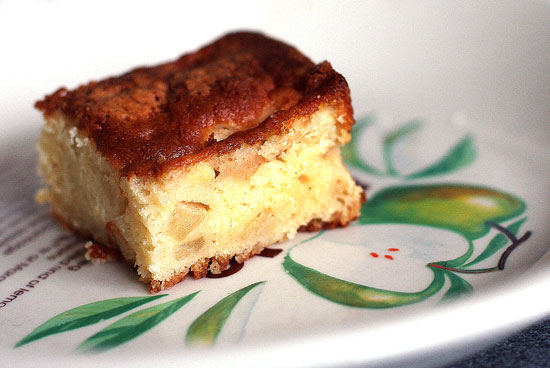
I’ve written before about my husband’s peculiar lack of a sweet tooth, so the fact that he endorses this recipe wholeheartedly should be merit in itself. It wasn’t a snap decision on his part, either – this recipe is the result of many failed and not-quite-right trials over the course of several years of trying to match my apple cakes to his specific expectations. It had to be moist and taste of apples rather than spices. Not too sweet. No faffy crumbly topping stuff. No sultanas or raisins. Noticeable apple chunks – none of that puréed muck. And it didn’t stop there. Nothing baked in a round cake pan – he wanted his slices to be square.

Not demanding in the slightest then, huh?

Anyway, I’d given up. And then we moved to a house with an orchard at the bottom of its garden.
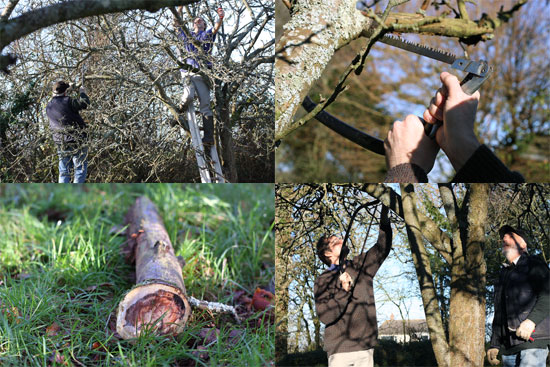
As autumn turned into winter, I sent my three children out to collect the windfalls in T’s little red wagon. Seven truckloads later, I faced a showdown situation. If I couldn’t create that perfect apple cake recipe with such an abundance of readily-available fruit, then I would have failed forever as a loving, doting wife and homemaker. Well, whatever – you get the picture.

The pressure wasn’t entirely self-induced. O did point out that his birthday was coming up and please, could I bake an apple cake for him to take into work …?

So I stayed up late, burnt the midnight oil, sweated and slaved, worked day and night …

Actually, I hit on the bright idea of mixing a few appple chunks into my favourite yellow cake recipe, tossing it all into a rectangular cake pan and slamming it into the oven for 40 minutes or so to see what happened.
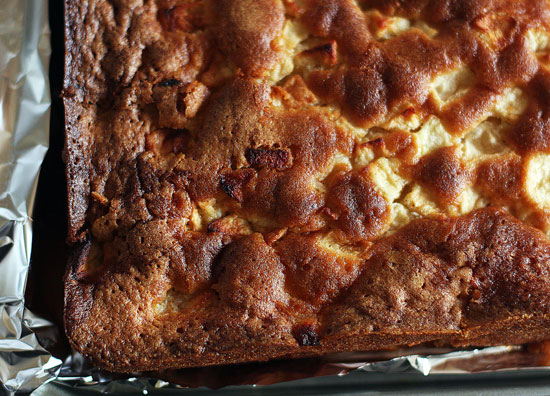
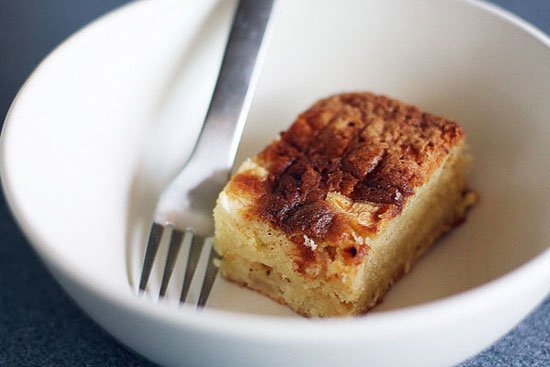
What happened was the best apple cake ever … according to my husband.

PS – Chris from Green Valley Cyder said that he’d eaten many apple cakes but that this was “one of the best.” So you don’t have to take just my husband’s word for it.
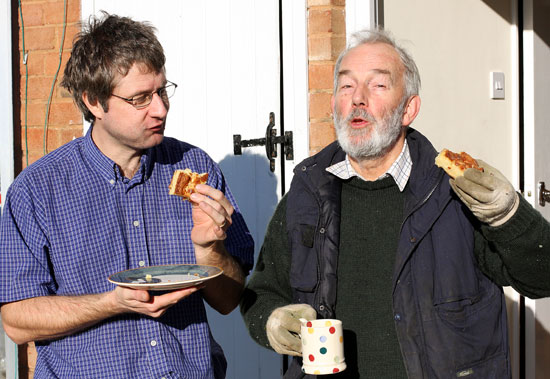
The Best-Ever Apple Cake (by me and according to my husband)

13 1/4 oz peeled, cored and diced Bramley apples
2 tbsp lemon juice
1/4 to 1/2 tsp ground cinnamon
1/4 to 1/2 tsp mace (or grated nutmeg)
7 oz unsalted butter, room temperature
13 1/4 oz castor sugar
5 1/4 oz eggs (weighed without shells), room temperature
2 3/4 oz egg yolks (weighed without shells), room temperature
1 tbsp vanilla extract
8 oz plain flour
2 1/2 tsp baking powder
1 tsp sea salt
160 ml whole milk, room temperature

Preheat the oven to 175 degrees C (165 degrees C for a fan-assisted oven).

Grease and base-line a 9″ x 13″ rectangular cake pan.

Peel, core and dice the apples (c. 4 largeish Bramleys). Toss in the lemon juice, cinnamon and mace (add as much or as little of these spices to suit your own taste). Set aside.

Cream the butter and sugar in a large mixing bowl until they are very light and fluffy (start to beat slowly and then gradually increase the speed – this allows air bubbles to be incorporated and expanded without popping).

Combine the whole eggs, egg yolks and vanilla in another bowl. Mix with a fork, then add gradually to the creamed butter and sugar, beating well to combine after each addition.

Whisk the dry ingredients together in yet another bowl. Beat 1/3 of the dry ingredients into the batter, then 1/2 of the milk. Repeat and then add the final 1/3 of the dry ingredients (ie. dry/wet/dry/wet/dry).

Combine half of the apples with the batter, mixing gently to distribute evenly. Scrape the batter into the prepared cake pan and smooth the top with a spatula. Scatter the remaining apple pieces over the top of the batter.

Bake for 40 to 50 minutes until the cake is golden and springy, and a tester comes out clean (unless you’ve speared an apple, that is).

Cool in the pan for 10 minutes, then turn the cake out of the pan and cool on a wire rack. Trim the sides and cut into squares.
No-Bake Chocolate Ganache Tart

Although we don’t have a television, which possibly makes us a slightly unusual family, we do watch a variety of TV programmes via BBC iPlayer and 4OD. Recently, we enjoyed Hugh Fearnly-Whittingstall’s latest River Cottage series in which he gave up eating meat for four months over the summer. The programmes in this series charted his discovery of new vegetarian combinations and dishes, ranging from simple soups and salads to lavish banquets and wedding feasts.

Perhaps the most intriguing creation from the entire series however was Laura Coxeter’s raw chocolate ganache tart. Prepared with a heady mix of pecans, medjool dates, avocados and cacao powder, it really is a work of pure genius.

The idea behind the tart is that it can be served to raw food eaters, vegans and anyone wishing to avoid dairy, gluten and soya in their diet. I don’t know about you, but I wouldn’t normally associate such a recipe with something that turns out to be richly chocolately and sinfully sumptuous. But Laura really did appear to have pulled it off, judging by the velvet gooiness of the ganache and the fervent lip-smacking of its tasters. I was inspired to give it a go.

Now, I have to confess that I’m not a raw food eater. Okay, it’s probably not such a huge confession – Laura’s the first raw food eater that I’ve ever come across. I did therefore make a few changes to the tart, which will no doubt have raw foodies shuddering in their graves. In essence, my recipe is more or less true to the original although not an exact replication.

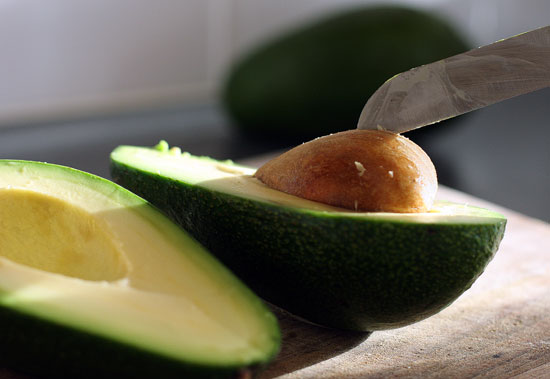
The secret behind the ganache is avocado. Whizzed up in a food processor with cocoa powder and sugar, avocados form the basis of a smooth, luxurious texture that is normally achieved by mixing chocolate and cream. The whole tart is ridiculously easy to make – you just need to make sure that you’ve allowed plenty of time for it to chill and set before serving.

The finished tart got a thumbs-up from my children, and I certainly wouldn’t hesitate to present it as the pièce de résistance at the end of a more grown-up dinner party. All in all, this recipe is just in time for the festive season. Happy Holidays 🙂

No-Bake Chocolate Ganache Tart (adapted from a recipe by Laura Coxeter)

For the base
300g/10 1/2 oz pecans
1 tsp salt
200g/7 oz medjool dates

For the filling
4 medium, ripe avocados
150g/5 1/2 oz rice bran oil
Seeds of 2 whole vanilla pods
200g/7 oz cocoa powder
1/4 tsp salt
300g/10 1/2 oz castor sugar

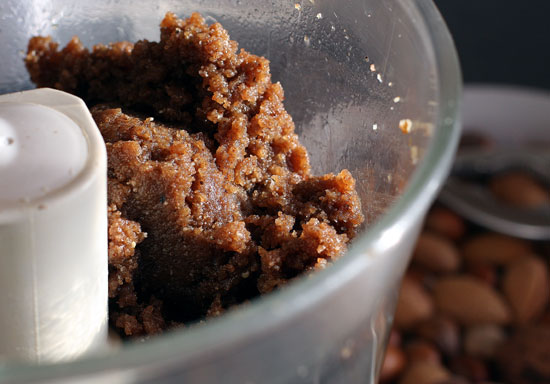
Blend the pecans in a food processor, then add the salt and dates. Whizz them all together until the mixture balls into a dough.

Press the dough into the base of a 9″ springform pan. Chill in the freezer to harden.

Peel and de-stone the avocados, then blend the pulp in the food processor. Add the oil, vanilla seeds, cocoa, salt and sugar and process until smooth.

Scrape the filling onto the base and spread evenly with a spatula or palette knife.

Set the tart in the freezer for an hour before serving.

First Bake

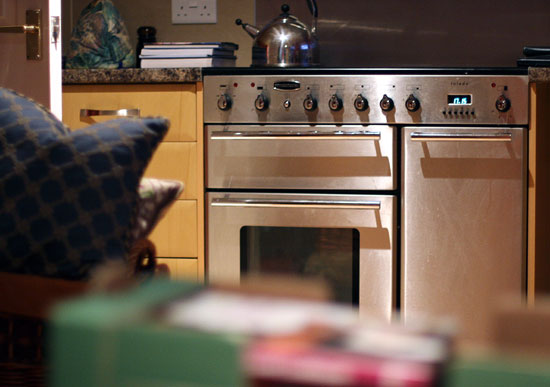
One of the consequences of moving house last week is that I’ve had to say goodbye to my Rangemaster induction cooker.

While its new owner gets to grip with cast iron saucepans, I’ve returned to cooking on a standard Belling ceramic halogen hob with a rather fierce electric fan oven. Although it seems to be handling fish fingers and chips fairly well, I’ve been putting off the moment of baking anything less straightforward for fear that everything would crumble under the intensity of the fan.

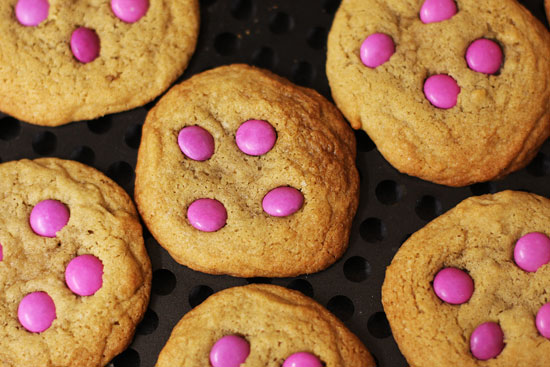
Yeterday however, my children returned home with the intention to bake spotty cookies for their school cake sale today to raise money for Children in Need. I ventured into the garden shed with a torch to find the baking trays and wire cooling racks we needed. With the torch batteries failing, I dug down through the piles and piles of boxes. Naturally, I’d packed the baking trays at the very bottom of a very large box full of cake pans and mixing bowls, and I still have no clue at all about where I stored the wire cooling racks. Now completely in the dark, I eventually gave up the search and pulled out instead a couple of pizza trays with circular holes in the base – not quite as aerated as a cooling rack, but I thought I could turn them upside down and perhaps the cookies wouldn’t end up too soggy-bottomed if they cooled there rather than on their hot trays.

And so at 7pm yesterday evening we set about baking our first batch of cookies in our new oven in our new house.

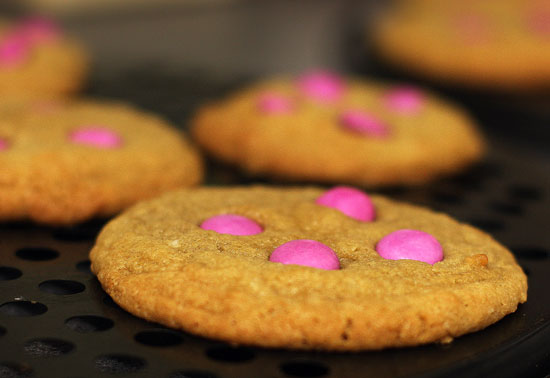
We used our go-to cookie dough recipe, then pressed some pink Smarties (the ones that support the National Breast Cancer Campaign) into the top of each cookie before they cooled and set to make them ‘spotty’ (“Show your spots, let’s raise lots“).

It turned out that I needn’t have worried at all about baking in my new oven. I reduced the temperature by 10 degrees C and the cookies baked evenly and completely as expected. Perhaps I’ll try baking a cake again sometime soon …


A Soul Cake

Our Hallowe’en celebrations yesterday were different from those of recent years. Quite apart from everything else, we are in the middle of moving house and have to contend with the disruptive upheaval and emotional turbulence that this creates. Instead of our usual wild witching party with friends, we held a more subdued family coven meeting in the kitchen where various spells were chanted and slimy slugs and snails were shaped from a bubbling cauldron of bread dough.

Despite the general sense of ghoulish revelry that prevailed throughout the evening, Hallowe’en is very much a seasonal festival for me and a time to reflect on the transition from summer into winter. This association reaches back in time to pre-Christian Europe when people’s lives were closely tied to the food production cycle. The end of the summer months initiated a period of the year when livestock were rounded up and culled, crops were stored and fishing boats were repaired in preparation for the coming winter. The night we know as Hallowe’en was more commonly described then in Gaelic as Samhain, or Summer’s End. Festivities on the eve of November 1st marked the end of the harvest and the beginning of the darker half of the year.

The evening of the day before a new season was believed to be a significant boundary in the Celtic world. Boundaries were important to the Celts, not least because they separated the dead from the living. Boundaries and thresholds in both time and space were regarded as protection for the living against the supernatural inhabitants of the Otherworld. The transition between the old and new years at Samhain was therefore a particularly unsettling time for the Celts as they firmly believed that it was on this eve that the boundary between the worlds dissolved and the barrier between the living and the dead became permeable. Not only could supernatural spirits pass more easily into our world, but humans also could be tricked into passing through to the other side and then trapped there, unable to return to their living families.

Many Samhain traditions can be understood as an attempt either to frighten away malevolent spirits or to welcome home dead relatives. Hideous faces carved into jack-o-lantern turnips kept evil spirits away from the door whilst food would often be left outside as offerings to appease the dead.

The modern-day custom of trick-or-treating also has its roots in Celtic tradition. Bonfires blazed at Samhain, both to signify the dying of the sun god and to banish the ill-intentioned.  Small cakes or biscuits would be baked and scattered around the bonfires, possibly to propitiate spirits trapped in animal form. Although the Christian calendar introduced the names of All Souls’ Eve and All Souls’ Day for Samhain in an attempt to supplant the pagan festival of the dead, the old ways persisted. Sweet and steaming small cakes would be piled onto plates to welcome night visitors on All Souls’ Eve in the Dark Ages.

The same small cakes had been assimilated into Christian symbolism by the eighth century, when they would be used to pay visiting beggars on All Souls’ Eve for their promises of prayers for departed family members. By the nineteenth century, children from poor families would go into the streets to beg for these ‘soul cakes.’ The practice came to be known as ‘souling’ and would often be accompanied by a simple souling song.

Soul, Soul, a soul cake!
I pray thee, good missus, a soul cake!
One for Peter, two for Paul,
Three for Him what made us all!
Soul Cake, soul cake, please good missus, a soul cake.
An apple, a pear, a plum, or a cherry, any good thing to make us all merry.
One for Peter, two for Paul, and three for Him who made us all.

I have to include this version of a traditional souling song by Sting, not for any special musical considerations but purely because it was filmed inside Durham Cathedral (where I was married).

This year, I wanted to make my own soul cakes to share with family and friends. Variously described as sweet bread, biscuits or cakes and ranging in shape from square to round to oval, it proved to be impossible to track down any one definitive recipe. Some sources cited wholegrain flour and dried fruits as common ingredients, while others suggested saffron, ginger or lemon as primary flavours. Many testers of handed-down, folk recipes complained that the cakes they made were hard and dry, things I wanted to avoid in my own soul cakes.

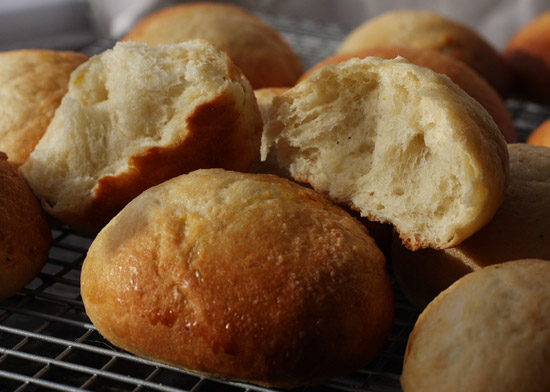
I liked the idea of baking small, sweet bread buns – something akin to an iced bun with an enriched dough and a light, fluffy crumb. I chose to include saffron and lemon for their bursts of bright sun yellow, and nutmeg for its warmth (and because it’s one of my favourite spices – my other favourite being cardamom, which I didn’t think would go so well). The recipe I came up with appears to have been a success – my Nan enjoyed hers at lunchtime today and L pilfered and ate three straight off this afternoon (which is why she couldn’t finish her dinner).

Soul Cakes

15 oz strong white bread flour
1 1/2 tsp fast action dried yeast
3 tbsp castor sugar
2 tsp sea salt
2 large eggs
3 oz unsalted butter
generous pinch of saffron
1/4 tsp grated nutmeg
grated zest of 1 lemon
200 ml milk

Glaze
1 egg, beaten with 1 tbsp milk
castor sugar to sprinkle

Put all the ingredients for the dough in a large bowl and mix to combine. Knead for 7-8 minutes in a mixer with a dough hook attachment. The dough should clear the sides of the bowl but stick to the bottom – add enough flour or milk to achieve this.

Scrape the dough out onto a floured surface. Sprinkle with flour and then pat to remove the excess. Fold the top third down and the lower third up (a business-letter type of fold). Cover with clingfilm and leave to rise for 1 hour.

Spread the dough out gently into a rectangle by pushing with your fingers, then 3-fold it again, cover with clingfilm and leave to rise for a further 30 minutes.

Repeat this spreading, folding and covering. Leave to rise for a further 30 minutes.

Preheat the oven to 180 degrees C.

Cut the dough into equal pieces of about 1 oz in weight. Shape these into a ball, then flatten with the heel of your hand. Place each disk onto a baking tray lined with parchment, allowing room for the dough to expand.

Brush the tops with the glaze and sprinkle with castor sugar. Leave to rise for 30 minutes, then bake for 10 to 12 minutes until golden. Remove to a wire rack to cool.

Makes c 22 soul cakes.

Couture Chocolate

I’m lucky – my husband hates chocolate. Unfortunately, my three children all have sweet teeth and I’ve been forced to watch my own share of all our chocolate bars dwindle over the years to become a paltry quarter of what it was in the days before weaning. The only upside to this state of affairs is that I now have an enthusiastic army of homegrown tasters on ever-ready standby from the instant I even begin to think about baking with chocolate.

My experiences with chocolate so far however have revolved mostly around the themes of brownies, chips in cookies and simple dipping projects. Despite spending an enjoyable morning with Zach Townsend at the top of the Tour Montparnasse, I was disappointed to find afterwards that none of his expert chocolatier skill had rubbed off on me when we shook hands. I still tremble at the thought of tempering and steadfastly avoid any form of moulding or modelling. It’s those temperamental sugar crystals that get me – the way they want to clump together at the slightest opportunity. My aversion to working with chocolate goes hand in hand with my fear of boiling sugary syrups. And as for seeding … well really, that’s something for gardeners, isn’t it?

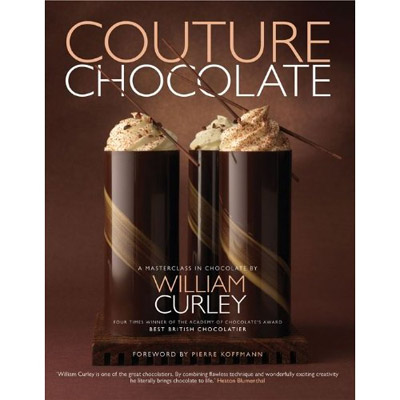
And then I was invited to review William Curley’s new book, Couture Chocolate. I have to confess that I fell in love with this book from the moment I held it in my hands. Not only is it superbly illustrated with mouthwatering photography …. but it smells good too. Honestly, it does! Just bury your nose deep into the binding of the open pages and you’ll see what I mean. But best of all, this book does exactly what it says on the cover – more than just a coffee table book, this really is A Masterclass in Chocolate.

William Curley is uniquely placed to direct this masterclass. Four times winner of the Academy of Chocolate‘s Chocolatier of the Year Award, he trained in some of the world’s finest Michelin-starred kitchens and was the youngest appointed Chef Patissier at The Savoy. From the opening chapters on the history and production of chocolate, through clear instructions on techniques for tempering and decorating, and with exquisite recipes for truffles, couture chocolates, bars, bouchées, cakes, patisserie and ice cream, Curley’s expert guide provides insight into the ideas and inspirations behind his work.

The recipes aren’t quick and simple. Curley uses quality ingredients and an array of specialist equipment that will probably require a trip to Amazon for most home bakers like me. Far from appearing daunting however, the recipes are broken down into manageable chunks throughout and combine practical tips with step-by-step photography. Recipes are included for many of the flavours and chocolate creations on sale in his own William Curley shops in Richmond and Belgravia, such as the Florentine Sablés and Salted Butter and Muscovado Caramel Chocolates (the highest marked chocolate in the Academy of Chocolate Awards 2011).

Curley frequently draws on a Japanese palette of flavours to create new fusions in his work. There are recipes for Matcha and Dark Chocolate Entremet, Chocolate Financiers with Yuzu Ganache, Chestnut and Sesame Brownies, and Green Tea Couture Chocolates. He attributes the inspiration behind these creations to his partnership with Japanese patissier Suzue – they met while they were both working at The Savoy in London and later married and opened their first shop together.

Perhaps the thing that inspires me the most about this book however is the knowledge that the stunning chocolates and intricate patisserie displayed in William Curley’s London shops are created in much the same way as detailed in these recipes. Although Curley’s staff have the advantage of some time-saving bits of machinery, the emphasis is firmly on using craft skills. As Curley points out, “I don’t want to have big cooling tunnels or machines that pump the ganache into shells. I want my team to make the ganache and understand the quality of the ingredients, and for everything to have that hand-made finish.” So … the ultimate implication is that Curley-quality creations are within the reach of every home baker if they take the time and care to follow this masterclass in chocolate.

Well, everyone needs a dream, don’t they?

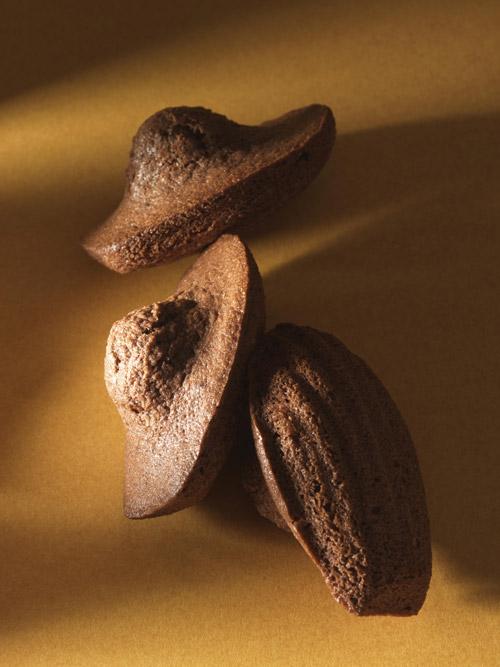
Chocolate Madeleines (reprinted from Couture Chocolate by William Curley with permission from the publishers)

When I worked for Marco we would bake these little French treats to order for petit fours as they are best eaten fresh as possible.

Makes about 20 cakes
15g (½oz) fine dark (bittersweet) chocolate (70% cocoa solids), roughly chopped
115g (4oz/ 1 stick plus 1 tbsp) unsalted butter, plus a little extra, softened, for greasing the mould
115g (4oz/¾ cup) plain (all-purpose) flour, plus a little extra for dusting the mould
20g (¾oz/1 tbsp) cocoa powder
3g (½ tsp) baking powder
135g (5oz/scant ⅔ cup) caster (superfine) sugar
175g (6oz) egg yolks (about 9 eggs), beaten

Note: You will need a 12-hole madeleine mould.

Grease with butter and lightly flour a 12-hole madeleine mould. Melt the chocolate over a bain-marie (water bath) until it reaches 45°C (113°F) and leave to cool. Melt the butter in a saucepan and also leave to cool. Sift the flour, cocoa powder and baking powder into a bowl and then mix in the sugar. Add the dry ingredients to the beaten egg yolks in a large bowl and mix with a wooden spoon until smooth. Gradually add the melted butter, being careful not to beat in air. Then mix in the melted chocolate. Cover the bowl with cling film (plastic wrap) and leave to rest for at least 30 minutes in a cool place.

When you are ready to cook the madeleines, preheat the oven to 220°C (400°F/Gas 6). Pipe or spoon the mixture into the prepared mould and bake in the preheated oven for about 12-15 minutes until risen and the cakes spring back when pressed.

  • Enter your email address to subscribe to this blog and receive notifications of new posts by email.

    Join 289 other subscribers
  • Seasonal Recipes

    candied peel

    baileys chocolate truffles

    gingerbread men

    mince pies

    fudge

    smarties cookies

  • Freshly Made

  • Categories

  • Favourite Feasts

  • Awards

    DMBLGIT Award
  • Archives

  • wordpress visitor counter
  • Adventures in food by Kate Coldrick from Woodbury in Devon.