I’ve been asked that question many times over the last several months as I’ve struggled with the twin demons of anorexia and bipolar disorder. And my answer has always been, “My family. My children.”
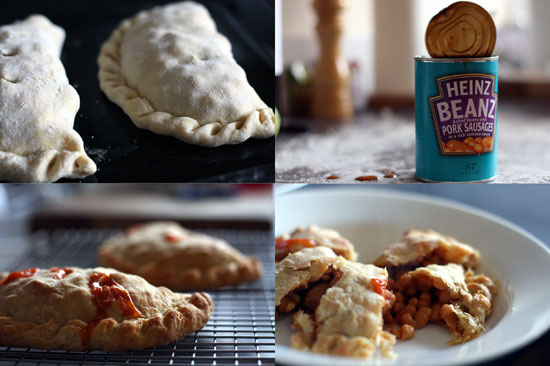
Take yesterday, for example. There we were, in the middle of a busy supermarket – my three children and me (always an expensive way to do the shopping) – deciding what to cook for their dinner. Surrounded by so many tasty options on the shelves in every aisle, M nevertheless said, “Baked bean and sausage pasties – the ones that you make.”
So that was what we did.
Times like this are what keep me going.
Baked Bean and Sausage Pasties
7 oz bread flour (I know, an unusual choice of flour for pastry – but it needs to be strong enough to hold the filling)
3 oz butter
water
2 tins of baked beans and sausages
Rub the butter into the flour and stir in just enough water to form a dough. Wrap in cling film and leave to rest in the fridge for 30 mins or so.
Preheat the oven to 180 degrees C.
Divide the pastry into four pieces. Roll out each piece into a circle.
Empty the cans of baked beans into a sieve to strain out most of the runny tomato sauce (otherwise the pasties disintegrate into a soggy mush. Trust me – I’ve tried it).
Spoon four mini sausages (assuming there are 8 in each tin. Can you tell I know my Heinz baked beans …?) and a quarter of the baked beans into the centre of each pastry circle. Brush the edges with water and stretch the lower half of the circle up and over the filling. Seal the edges and crimp. Snip two or three slits in the top of each pasty to let out the steam (and sauce!).
Place each pasty on a baking tray and bake in the oven for 25 to 30 mins until the pastry is golden and cooked.
After L’s successful guest post in October, my younger daughter told me today that she also wanted to write a guest post for A Merrier World (not that there’s ever a hint of sibling rivalry between them, of course …) So, here is M – she is six years old and has been having a lot of fun at school this term …
We have been learning about the Ancient Romans at school. A Roman centurion came in to help us learn about them. We made shields and then we had a battle with the Year Ones. We used balls instead of cannons and swords. The Year Ones (who were supposed to be the Celts) kept on running away, so we won. The centurion also brought in some fish sauce that smelled disgusting!
Anyway, on Friday the 23rd we did a Roman presentation. I was in the Roman banquet scene. My line was, “The Romans loved holding feasts. One of the things they loved was… peacock brains!” Somebody else in the Roman banquet said they also liked surprises in their food such as doves flying out of the stomach cavity of a roasted suckling pig. We discovered that the Romans lay down to eat and that they made themselves sick so that they could eat more (but that was only in fancy banquets).
Today we had a Roman banquet in our classroom. Everyone dressed up as Romans. I was a slave who opened the door. Here’s an interesting fact – the slaves who opened the doors had to look fancy so everyone knew that the person who owned the house was rich.
Our teachers had researched lots of Ancient Roman recipes. Some of the recipes were in the cookery book that I took into school for them. At our banquet, we tasted lots of food that the Romans would have eaten. I only liked the grapes and the apple as well as the bread dipped in olive oil. I didn’t like the peacock brains, which were really just mince cooked in the oven. When we were making the peacock brains, we had to put our hands in the mince. I hated the honey cake – it looked like an omelette (and I don’t like them either!). There were some olives as well, but I didn’t try them.
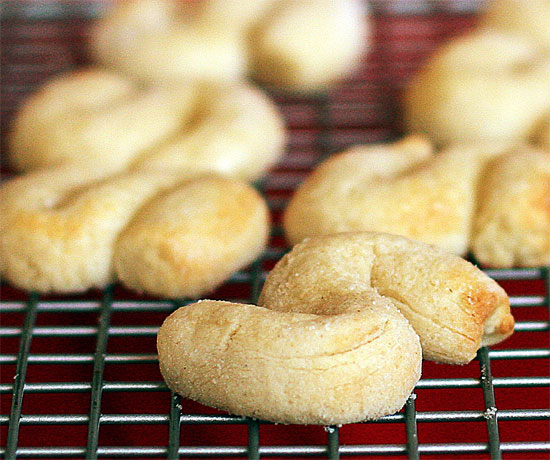
For dessert, we all ate some Ancient Roman biscuits that I had baked last night with my Mum. They were called ‘serpette’ and they used honey instead of sugar. We sprinkled sugar on the top instead of sesame seeds because we thought they would be tastier that way. Unfortunately, the Romans didn’t have sugar, so that bit wouldn’t have been invented in Roman times. We made them into ‘S’ shapes like the serpette biscuits that are made today in the Castelli Romani near Rome.
My friends said that the biscuits were really delicious. They asked me how I had made them into ‘S’ shapes. I told them that we rolled some of the dough into a sausage shape and then we curled it around so that it looked like an ‘S’.
Ancient Roman Honey Serpette
12 1/2 oz plain flour
1 tsp baking powder (which the Romans didn’t have – sorry!)
1/8 teaspoon baking soda (as above … sorry!)
1/2 teaspoon salt
4 oz unsalted butter, room temperature
6 oz honey
2 eggs
1 egg white and castor sugar to sprinkle (or sesame seeds)
Put the flour, baking powder, baking soda and salt in a mixing bowl and use a whisk to mix them all together.
Use another bowl now. Put the butter and honey into it and beat them together. Add the eggs a bit at a time. Make sure that everything is mixed up very well.
Tip the flour and stuff into the bowl and mix it all together to make a dough.
Cover the dough bowl with cling film and put it into the fridge until the dough is cold and firmer.
Put the oven on to 180 degrees C.
Grease some baking trays and line them with baking parchment.
Sprinkle some flour on the work top. Roll bits of the dough into long sausage shapes. Cut them into shorter lengths and curl them to make an ‘S’ shape. Put the S’s onto the baking trays.
Brush some egg white onto the top of each serpette (this is a bit like glue) and sprinkle the tops with a bit of castor sugar.
Bake the serpette in the oven for about 7 minutes or until they are just turning golden.
Spring flowers and lighter evenings – it’s a lovely, hopeful time of year for celebrating motherhood.
My children proudly handed their handmade cards to me on Sunday morning whilst I enjoyed a special Mothering Sunday cup of tea in bed. M had written that she loves me because I’m cosy. T’s card told me that it’s because I make chocolate biscuits.
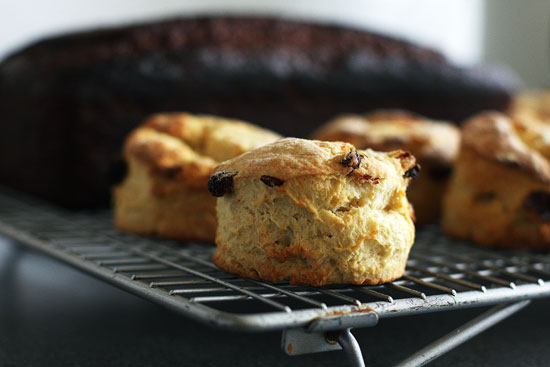
For my own Mum, I baked some fruit scones and gingerbread.
Fruit Scones (adapted from a recipe by Claire Clark)
440g/15 3/4 oz plain flour
50g/1 3/4 oz baking powder
80g/2 3/4 oz caster sugar
a pinch of salt
80g/2 3/4 oz unsalted butter, diced
40g/1 1/2 oz sultanas
150ml/5fl oz double cream
150ml/5fl oz milk
Put the flour, baking powder, sugar and salt into a large mixing bowl and whisk to combine.
Rub the butter into the flour, then stir in the sultanas.
Mix the cream and milk together. Pour onto the flour mixture and mix until the dough starts to come together. Turn out onto a lightly floured surface and knead gently to form a smooth, soft ball. Wrap this in clingfilm and chill in the fridge for 1 hour.
Preheat the oven to 200 degrees C/400 degrees F. Roll out the dough to a 2.5cm/1 inch thickness and use a 5cm/2 inch cutter to cut it into rounds. Transfer these to a baking tray lined with baking parchment.
Bake for 10 minutes until the scones are golden brown.
Despite my somewhat infamous exploits with a microwave, I don’t really go in for much kitchen gadgetry. I weigh my ingredients in pounds and ounces on a set of old sweet-shop scales, I use a rat-tailed tablespoon like the one my Mum used when I was little, and I make my pastry by hand … with an antique rolling pin that I found in a charity shop.
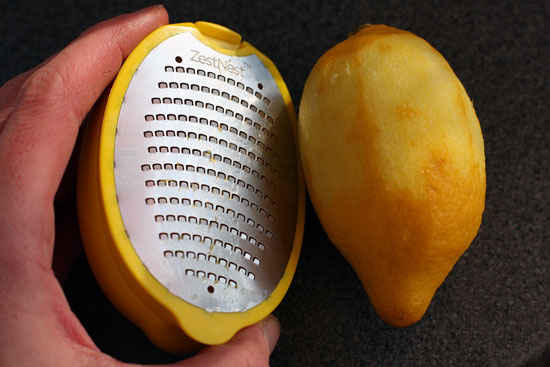
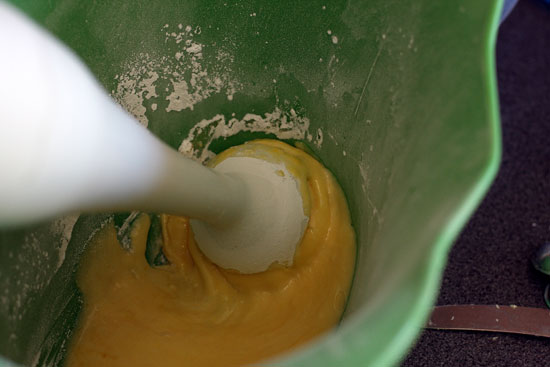
However … when Rose last visited, she generously (and probably in fear of what she already knew to be the rather primitive state of my kitchen cupboards) brought me some goodies from a company called New Metro Design – a beater attachment for my stand mixer, a lemon zester and a mixing bowl (aka the BeaterBlade®, the ZestN’est™ and the MixerMate™Bowl).
The idea behind each of these designs is that they take an irritating culinary conundrum and solve it with the invention of an innovative and efficient tool.
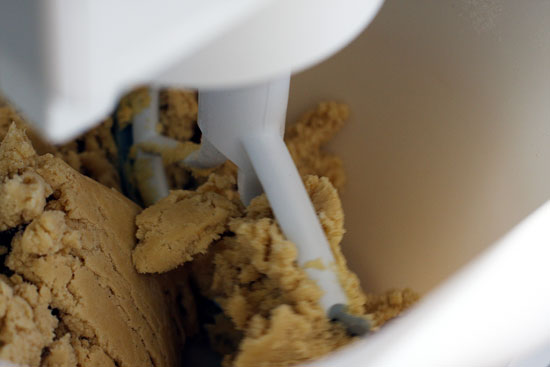
So – the BeaterBlade makes it unecessary to scrape down the sides of the bowl while mixing …
… the ZestN’est eliminates the mess and stress of zesting …
… and the MixerMate Bowl prevents all that splattering you usually get when you try to do anything with a hand-held mixer (or blender, as I was doing here).
After thoroughly trying and testing each design in the process of baking a lemon tart recently, I have to confess – these gadgets are fantastic. Remarkably fantastic.
Even O, who is fiercely opposed to any form of kitchen hokery-pokery, was impressed – so much so that he now uses the zester for pretty much anything that needs grating. He even allows it to have its own space in the top cutlery drawer …
I got in touch with Gary Fallowes, founder of New Metro Design and inventor, designer and developer of BeaterBlade, to find out a little bit more about his products. He kindly agreed to answer my (many!) questions …
Where did the idea for the BeaterBlade come from?
While making cheesecake I was frustrated by how often I needed to stop mixing and scrape the bowl, especially when the batter was cold…it would stick to everything. I soon discovered that even creaming butter and sugar required constant bowl scraping.
What were the first experiments/product types like?
The very first prototype was a soda bottle top, a wire hangar and soft plastic made from an electrical cord product. BeaterBlade® actually started off as a single blade scraper for meringue type batters…but we had issues with food ending up in the next room. The current design took about 2 years to develop. Finding the right plastics took quite some time.
How extensively did you test your invention?
To the extent I was driving my engineers crazy. I was making prototypes with 1mm increment changes just to make sure it would work perfectly. I bought more than 11 mixers and tested each one for hundreds and hundreds of hours while at the same time sending out prototypes to friends, family and folks like Rose to test. I also had Nemko Laboratories do bench tests to make sure the mixers were not getting damaged and the actual BeaterBlade was safe. Safety is my #1 concern, then function.
How did you end up finding an investor?
The project was funded personally and through a mentor / investor.
Why the name ‘New Metro Design’?
In NYC, in the 1930s, my grandfather owned an envelope company called Metro Envelope Corp…I’m carrying on the tradition of his name.
Do you make BeaterBlades for all different models and sizes of stand mixers?
There’s a BeaterBlade for most all KitchenAid® models as well as Cuisinart®, Viking®, DeLonghi™ & certain Kenwood® model mixers. We have a license agreement with Breville, which makes a BeaterBlade for their mixers under NewMetro’s name. We also make a large aluminium H-20 BeaterBlade for the Hobart 20-Quart mixers…that’s really fun to watch.
How easy is it to buy a BeaterBlade?
BeaterBlade is currently in about 3,500 brick & mortar stores such as Bed Bath and Beyond, BonTon, Kitchen Collections; online at Amazon, Solutions Magazine, CHEFs Catalog. We have distribution in 10 countries. You can find USA stores by zip code here.
How much does the BeaterBlade cost? Is it more expensive than just buying a regular beater attachment, for example?
Prices range from $24.95 to $40. It’s a bit more expensive than traditional flat beaters but it also accomplishes much more.
… and where is it manufactured?
Southern California!
Isn’t the continuous scraping down of the sides of the bowl going to stress out the motor of my stand mixer?
Not at all, and we have lab reports to prove it. BeaterBlade puts less stress on the mixer than if you were to make a white bread with the dough hook.
Is the BeaterBlade certified for commercial use?
Yes, it’s listed ANSI / NSF2 with Underwriters Laboratories (UL).
You make other kitchen tools as well as the BeaterBlade … ?
NewMetro designed the ZestN’est™ citrus zester, MixerMate™ Bowl for hand mixers, the H-20 for Hobart mixers and we just launched a citrus juicer called JuiceLab™.
Do the same principles of design underpin all of your products?
I go for safety first, then performance. I want consumers to have a positive experience when using my products.
Have you won any awards?
We won best product in our category at the Gourmet Housewares Show in 2009, and we placed runner up in IDEA magazine’s product of the year 2010. Some others as well.
What does the future of New Metro Design look like …?
We’re partnering with Rose Levy Beranbaum, bringing together her incredible accuracy and talent with NewMetro’s design capabilities and attention to detail. We have lots of exciting products in R&D. We love how accessible Rose is to baking enthusiasts via her very popular blog. She takes the time to carefully answer questions and wants people to be successful, just like I do.
Can you give us your original cheesecake recipe … the one that started everything …?
375g (x3 boxes) Cadbury’s Chocolate Fingers
225g pitted dates
300g Green and Black’s 72% cook’s chocolate
300g Green and Black’s white chocolate
200g butter
100g mini marshmallows
115g Rice Krispies
Line a 20x30cm cake pan with baking parchment, leaving flappy bits hanging over the sides to use as handles for pulling the cake out of the pan.
Chop fingers into small, bite-sized pieces (the Cadbury’s chocolate fingers that is – not your own).
Whizz the dates in a food processor until they turn into a smooth paste.
Melt the chocolates and butter in a bowl set over a pan of warm water.
Stir in the dates and mix until combined.
Add the chopped fingers, marshmallows and crispies. Stir to incorporate evenly.
Scrape into the prepared cake pan and spread with a spatula. Leave the cake to set in the fridge for an hour or so, or for as long as you can put off eating it (whichever comes sooner).






 Where did the idea for the BeaterBlade come from?




 amerrierworld.com