Sue told me that I was in for a treat when she nominated Cynthia from Tastes Like Home to be my next participant in this Edible Lives series of conversations. She described how Cynthia would give me a window into many cuisines and retell fascinating stories about her travels and experiences of food in the Caribbean. And once again, Sue was completely, utterly right 🙂 .

All images (except where noted) courtesy of Cynthia
Throughout my conversation with Cynthia, her warm and open personality spoke directly to me as we probed deeper and deeper into the layers of meaning behind a ‘taste like home’. I have not only been treated to a mouth-watering introduction to the wide variety of cuisines in the Caribbean, I have also gained an understanding of how the interplay between our food and our social lives is at the very heart of our sense of community and belonging.
Here, then, is the story of Tastes Like Home …

You wrote in your column for Guyana’s Stabroek News that you started Tastes Like Home because you missed the food of your homelife. What led up to your having this idea for starting a blog?
The blog is an extension of the column, an avenue for readers to give feedback in the form of sharing their own food memories of home, and here I’m speaking primarily about Caribbean people. I also thought that it was a good way to introduce a wider, non-Caribbean audience to real Caribbean food, the food that we cook and eat regularly, not just the stereotypical things that are advertised such as coconut shrimp.

Hassar Curry
It was my best friend Susan (no, not FN Musings Sue :)) that insisted I start a blog.
Did you make any plans at the start about how frequently you would post and how you would establish your ‘blogger’s’ voice?
The blog started the same time that the column started – January 2007. I decided that I was going to post weekly to coincide with the publication of the column.
I always figured that my “voice” blogger or as a writer would be unique for a variety of reasons depending on the audience: I’m from the Caribbean. I was born in the only English-speaking country in South America. I come from a bi-racial family: Dad: Black and Mom East Indian.
That’s quite a balancing act, to start a new column and a new food blog at the same time! With such a wealth of backgrounds to draw from, how did you choose the specific things you would write about each week, and how did you parcel them up between blog posts and your newspaper column?
Yes, it is indeed quite a balancing act as I did and still do all amidst my day job – I teach Mass Communication (Media Studies) at the Barbados Community College.
Like other writers I have many note books that I accumulate my ideas into. Given that the premise of the column was a taste like home, setting out to cook and recreate the food I missed from my birth-country (Guyana) and having moved to Barbados where many of those ingredients were not available or not readily available, it was not difficult to come up with ideas. The real challenge was sourcing the things to cook but things have definitely changed on the food scene here in Barbados. That’s the subject of one of my upcoming columns. The whole concept behind “tastes like home” has changed also, I am in the process of formulating and writing what that change is.

Pumpkin Pudding
I did not parcel the topics between the blog and the column; you will notice that I link the two where I give people the option to read more at the column so it’s a tie-in. The trick is to do two things with the intro – make the lead really attention getting on the blog so that people feel the urge to click through to read the column. At the same time, it is to make the lead for the blog post interesting and complete enough so that if someone does not have the time to read the column, they can still feel satisfied from just reading the blog post.
I am not too fussy if blog readers (I understand busy) do not have the time to read the column because the primary audience is in Guyana where the paper is published and also the large Caribbean online readers.
I understand and appreciate that my fellow bloggers may not have the time, though I know that many of them do read the column.
I know first-hand how even moving from the North to the South of England can displace you with regards to food and culture. My husband and I still disagree about whether something is a swede or a turnip! What did you find specifically about the food in Barbados that motivated you to write about the food of Guyana?
Home for many of us living abroad is a merged space that is made up of Guyana and the country we now live in. We’ve combined the two spaces and made them our own unique home. We enjoy all the trappings, sights, sounds and activity that go with the country we live in but inside of our homes we conduct ourselves as if we were in Guyana by the foods we cook, eat and share, and by the traditions and customs we uphold.
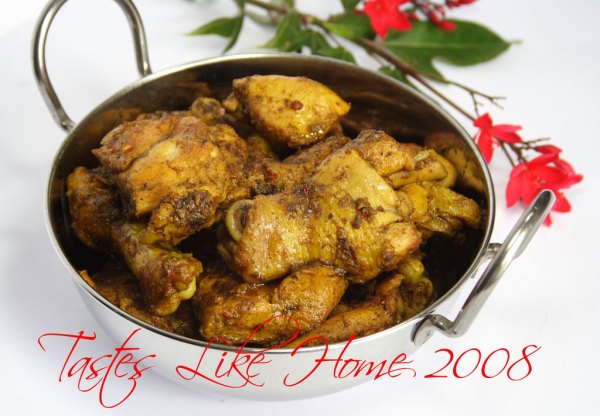
Chicken Curry
When I was growing up there was a clear distinction between weekday food and weekend food. In my home, weekday food referred to the simple fare one would eat during the week. It was simple for a number of reasons – less time to spend in the kitchen, economics and the need for a different kind of sustenance when at work and school. During the week we always ate vegetables and seafood – shrimp or fish.
Weekend meals were plenty-ingredients; fancy-dancy dressed up dishes that one created when there was more time to cook, to experiment, to entertain and to take delight in after a hard week at work or school. That’s when we’d make Spanish rice, potato salad, fried rice, baked chicken, macaroni pie, duck curry, dhal puri, roast pork, pot roast etc.

Dhal Puri
Even the beverages we had were different. During the week, my mother insisted that we drink water although there would be juices in the fridge. On the weekend, we got to have sweet drinks – homemade fruit juices; no bottled drinks for us. Homemade meant that mommy knew exactly what was going into the drink, and it was a smart way to monitor the amount of sugar we consumed.
Whenever mommy cooked something that was considered a weekend food during the week it was like a treat. I remember being totally elated one afternoon when I opened the karahi and found curried chicken, one of my favourites. She used to do this for us every now and then – treat us to weekend food during the week – we loved being surprised by it, and I think that mommy enjoyed the looks of pleasure on our faces as well.
Years later, having moved to Barbados, I had to adjust my food. No longer was there weekday food and weekend food and that’s because, it’s a different place, different food culture and a different way of eating.
For starters, when I had just arrived, the abundance and variety of vegetables to which I was accustomed and familiar with was not readily available and when it was, it was pricey. There was a time when you could not find bora (snake beans, yard-long beans) in Barbados so the first time I walked into one of the supermarkets and saw bora I trembled with excitement, I was momentarily breathless as I caught sight of the long, green vegetable. I stood there admiring the bora for a long time and whispering to myself: oh my gosh, I can’t believe they have bora here, I can’t believe it. I grabbed two bags, I headed for the cashier and dashed for the car to race home and cook the bora. In no time, the bora was cut up. I “fry it up” (sautéed) it with onions, tomatoes and fresh herbs. I did not add any meat, chicken or shrimp because I wanted to taste the bora alone.
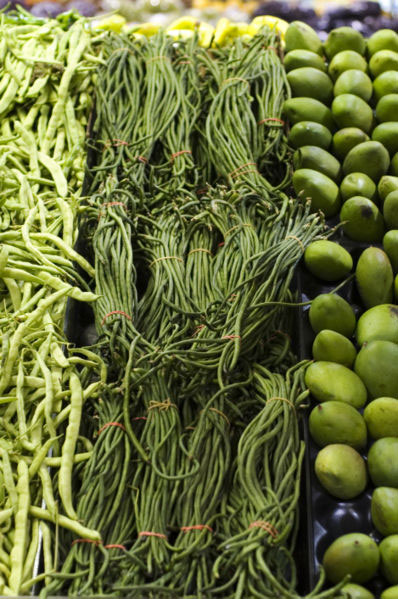
Yardlong Beans by Paul Goyette
Also, the bounty of imported Caribbean seafood that we now get in Barbados was not available when I came here more than a decade ago and so I adjusted. Pork, beef, chicken, lamb and veal became regular weekday food. Vegetables when consumed consisted of carrots, cabbage, cauliflower and broccoli. I quickly learnt that macaroni pie and baked chicken were everyday fare.
Sunday lunch, as it is called here, comprises of all the weekday dishes with the addition of baked pork, and stewed lamb.
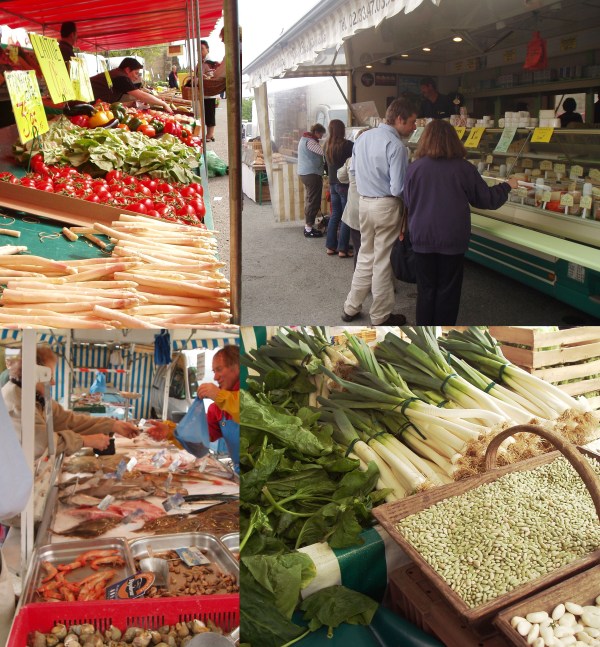
These days, things have changed yet again. With the influx of regional farmers into Barbados, a variety of vegetables are readily available at the weekly markets. Fish and shrimp from other Caribbean neighbours are stocked in the supermarket freezers. However, my weekday cooking has not gone back to the days of my growing up. Yes, there are vegetables everyday but now I have them with beef, chicken, pork, lamb or veal – whichever meat I feel like having on any given day.
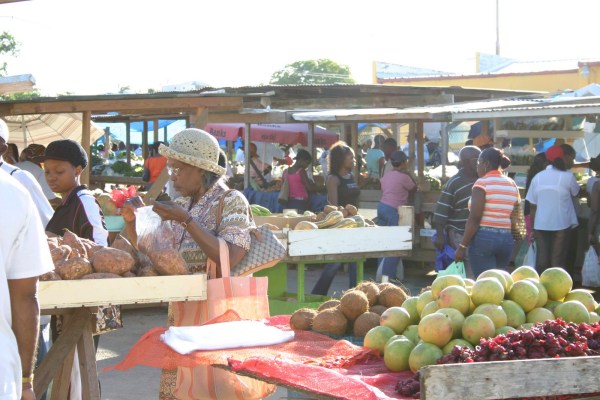
Cheapside Market, Bridgetown, Barbados
When it comes to food, it is impossible to live in a country and not adopt a few of their dishes as your favourites or merge some of them with your own to create one that truly represents the new hybrid home – the home on a plate. The strange thing is that while “home” means many things, the answer, we almost always give when someone asks us: where is home, is Guyana. The reason is simple really – it’s because it is the only home some of us have known; some of us are never really comfortable in our new surroundings; and much of who we are as individuals, our identity, is that of being Guyanese.
How do you think these differences can be reconciled when writing about the food of the Caribbean as a whole?
The food in countries like Guyana, Trinidad, Jamaica and Suriname unlike places like Barbados and the Eastern Caribbean Islands (Dominica, Grenada, St. Lucia, St. Vincent, St. Kitts Nevis, Antigua) is an excellent representation of the diversity of the Caribbean in terms of Portuguese, Indians, Africans, Syrians, Lebanese, Chinese, Javanese, Indigenous peoples. Places like Barbados (though this is changing a little) and the other islands I mentioned, invariably only have a particular influence to their cuisine and that is primarily African with very subtle hints of the other influences. Therefore writing about Caribbean food as a whole was a no-brainer so to speak.
You describe the possible influences on the food you encountered in Barbados as having been largely subsumed by a dominant African cuisine. It strikes me that there is an implication that any attempts to introduce influences from a different food culture would therefore be either difficult or even perhaps actively resisted (and I mean beyond the difficulties you faced in sourcing ingredients). Have you found any truth in this, either through your own experiences or through comments and reactions from readers of your blog?
As with most things, when something new or different is introduced, there is resistance, cause for fear, all due of course out of ignorance in some cases and the presumption of “losing what is ours”. As with new things also, some people quickly discard their own or put it aside and jump on the new band wagon, and this is where the second part of the fear come in, of “losing what is ours”. Wherever you go in the world you will find people who refuse to eat or try new foods or dishes. That is not something new and it certainly was and is no different here in Barbados or elsewhere. Take curry for example, I’ve seen my students turn up their noses and talk about curry as if it is the most disgusting thing in the world. I had another student tell me that soon everyone will be eating curry and roti instead of baked chicken and macaroni pie (2 staples in the Barbadian diet).
If I have to be frank much of this sort of resistance has to do with a racial group that is growing in Barbados (Indians). There has been considerably less resistance to the influx of the Italian cuisine because (as I will write in one of my coming columns), Barbadians are big into anything with pasta. I even had a friend tell me when I asked about Barbados’ national dishes, that pasta is one of their national dishes! (It is not).
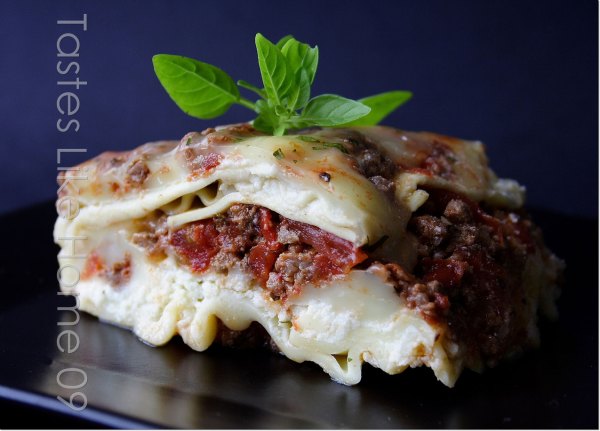
Lasagne Bolognese
The food scene in Barbados and elsewhere is changing though and has changed (again, another column I’m working on). Things I can find here now – both at the farmers market and supermarket – I could not find in 1998 when I first moved here. There has been a huge influx of Chinese into Barbados as well and you can see quite a few Chinese restaurants. There is also Thai and more recently a Korean restaurant has opened up. There are many restaurants and bistros that cook English food, there are French Restaurants as well and yep, there are fine-dining Japanese restaurants. As Barbadians travel, they are willing to try new things but there is still a hard-core that refuses to budge.
Many of the foods made in Barbados are already made in Guyana given the diverse make-up, though they were/are slight variations. Yes, Guyanese are more than likely to try the Barbadian food but soon there is the longing for the diversity of cuisine for which Guyana is known.
Have you found that the process of writing ‘Tastes Like Home’ has helped you to cushion any feelings of homesickness or general displacement you may have felt following your move from Guyana to Barbados?
Yes, yes, yes! I wrote in one of my columns where cooking the foods of Guyana in my home has not only been comforting but I’ve also felt protected by it, away from the outside (meaning Barbados) which can sometimes be unwelcoming and accepting. The other part to this also is, (as you can tell by my blog and the foods I make) that I am one of those people open to trying and experiencing new tastes and flavours for I firmly believe that each dish has its own story, its own history and I want to understand that, I want to part-take in it because it is going to enrich my life. Therefore, embracing and making Barbadian food was always a part of my plan for Barbados was now home also. But this had its drawbacks as well in that I’d excitedly tell my friends about the Barbadian dishes I’d make and they’d shrug with that “yeah, right” answer. In other words, I may attempt to make it but I could never truly make their food, not to their standards. So, even making Barbadian food and eating it within the confines of my home became comforting and protective from the unwelcoming outside.
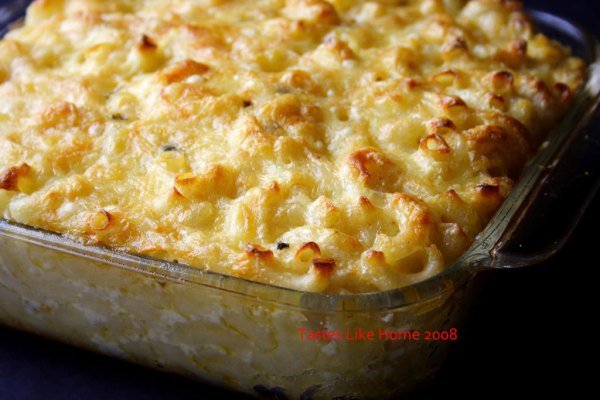
Macaroni Pie
The irony to this is that these days I get a lot of emails from Barbadians living abroad asking for the recipes of the Barbadian dishes I have written about and that are on my blog. Life is something else, isn’t it? 🙂
On a practical note, I can imagine that your background as a teacher and journalist prepared you well for the writing aspect of keeping a blog. Have you learned any new skills through your blogging experiences?
While I always had an interest in photography, I only really got into it when I started blogging. Blogging has also led to an increase in my cooking skills and confidence and my education about food on the whole.
What part did your blog play in the inspiration for your book, My Caribbean Cookbook: Tastes Like Home?
Often when I think of my blog, I think of it as a part of my column. It is through the interactive nature of the blog (comments and emails) that I got many requests not just for recipes but people wanting the work in a collection, in a body that they can call their own and share with their friends and families (and here I am speaking about Caribbean people living abroad and their spouses … actually most people who felt some sort of connection to the region, even visitors).

What’s your own favourite recipe out of those that you’ve posted on your blog, and what’s your most popular post?
Hmmmm, let me see. I’d have to say that my favourite is the post with the roast breadfruit. It is something I was introduced to in Barbados and I fell completely in love with it.
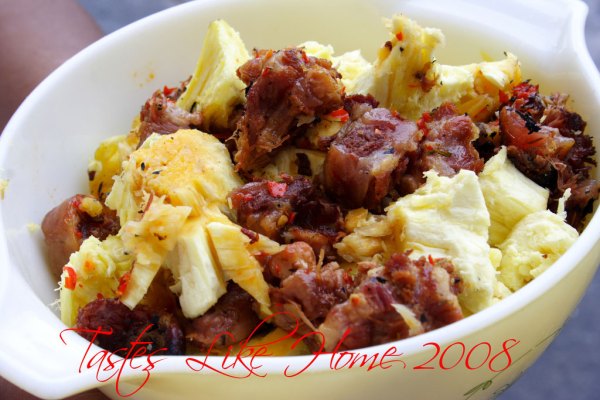
Roast Breadfruit
I’ll measure the popular post based on the fact that I first wrote and posted about dhal puri in June 2007 and to date I still get requests for the recipe! It is also one of the things many people come in search of through search engines and these requests are wide, not just from Caribbean people but a lot of the requests come from people in Australia, Europe etc who have been in the Mauritius and had dhal puri. Dhal puri is a spiced-split pea stuffed flat bread (roti).
And finally, who do you nominate to be the next person I invite to talk to me about their food blog, and why?
Farida of Farida’s Azerbaijani Cookbook . The reason is very simple, her food is different and yet through this cuisine we can see how there are similarities in some dishes such as her Pirojki . Each time I visit, I learn something new.
Thank you for sharing your stories and reflections with me, Cynthia 🙂 . I’ve thoroughly enjoyed talking to you and I’m looking forward to tasting the recipes you’ve described with such passion in my own home!




















 amerrierworld.com