A Soul Cake

Our Hallowe’en celebrations yesterday were different from those of recent years. Quite apart from everything else, we are in the middle of moving house and have to contend with the disruptive upheaval and emotional turbulence that this creates. Instead of our usual wild witching party with friends, we held a more subdued family coven meeting in the kitchen where various spells were chanted and slimy slugs and snails were shaped from a bubbling cauldron of bread dough.

Despite the general sense of ghoulish revelry that prevailed throughout the evening, Hallowe’en is very much a seasonal festival for me and a time to reflect on the transition from summer into winter. This association reaches back in time to pre-Christian Europe when people’s lives were closely tied to the food production cycle. The end of the summer months initiated a period of the year when livestock were rounded up and culled, crops were stored and fishing boats were repaired in preparation for the coming winter. The night we know as Hallowe’en was more commonly described then in Gaelic as Samhain, or Summer’s End. Festivities on the eve of November 1st marked the end of the harvest and the beginning of the darker half of the year.

The evening of the day before a new season was believed to be a significant boundary in the Celtic world. Boundaries were important to the Celts, not least because they separated the dead from the living. Boundaries and thresholds in both time and space were regarded as protection for the living against the supernatural inhabitants of the Otherworld. The transition between the old and new years at Samhain was therefore a particularly unsettling time for the Celts as they firmly believed that it was on this eve that the boundary between the worlds dissolved and the barrier between the living and the dead became permeable. Not only could supernatural spirits pass more easily into our world, but humans also could be tricked into passing through to the other side and then trapped there, unable to return to their living families.

Many Samhain traditions can be understood as an attempt either to frighten away malevolent spirits or to welcome home dead relatives. Hideous faces carved into jack-o-lantern turnips kept evil spirits away from the door whilst food would often be left outside as offerings to appease the dead.

The modern-day custom of trick-or-treating also has its roots in Celtic tradition. Bonfires blazed at Samhain, both to signify the dying of the sun god and to banish the ill-intentioned.  Small cakes or biscuits would be baked and scattered around the bonfires, possibly to propitiate spirits trapped in animal form. Although the Christian calendar introduced the names of All Souls’ Eve and All Souls’ Day for Samhain in an attempt to supplant the pagan festival of the dead, the old ways persisted. Sweet and steaming small cakes would be piled onto plates to welcome night visitors on All Souls’ Eve in the Dark Ages.
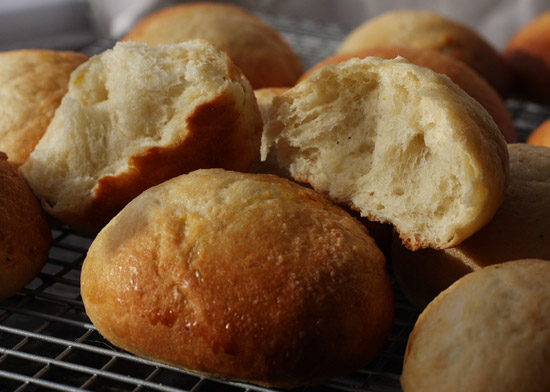
The same small cakes had been assimilated into Christian symbolism by the eighth century, when they would be used to pay visiting beggars on All Souls’ Eve for their promises of prayers for departed family members. By the nineteenth century, children from poor families would go into the streets to beg for these ‘soul cakes.’ The practice came to be known as ‘souling’ and would often be accompanied by a simple souling song.

Soul, Soul, a soul cake!
I pray thee, good missus, a soul cake!
One for Peter, two for Paul,
Three for Him what made us all!
Soul Cake, soul cake, please good missus, a soul cake.
An apple, a pear, a plum, or a cherry, any good thing to make us all merry.
One for Peter, two for Paul, and three for Him who made us all.

I have to include this version of a traditional souling song by Sting, not for any special musical considerations but purely because it was filmed inside Durham Cathedral (where I was married).

http://www.youtube.com/watch?v=A2XetM7W1QI

This year, I wanted to make my own soul cakes to share with family and friends. Variously described as sweet bread, biscuits or cakes and ranging in shape from square to round to oval, it proved to be impossible to track down any one definitive recipe. Some sources cited wholegrain flour and dried fruits as common ingredients, while others suggested saffron, ginger or lemon as primary flavours. Many testers of handed-down, folk recipes complained that the cakes they made were hard and dry, things I wanted to avoid in my own soul cakes.

I liked the idea of baking small, sweet bread buns – something akin to an iced bun with an enriched dough and a light, fluffy crumb. I chose to include saffron and lemon for their bursts of bright sun yellow, and nutmeg for its warmth (and because it’s one of my favourite spices – my other favourite being cardamom, which I didn’t think would go so well). The recipe I came up with appears to have been a success – my Nan enjoyed hers at lunchtime today and L pilfered and ate three straight off this afternoon (which is why she couldn’t finish her dinner).

Soul Cakes

15 oz strong white bread flour
1 1/2 tsp fast action dried yeast
3 tbsp castor sugar
2 tsp sea salt
2 large eggs
3 oz unsalted butter
generous pinch of saffron
1/4 tsp grated nutmeg
grated zest of 1 lemon
200 ml milk

Glaze
1 egg, beaten with 1 tbsp milk
castor sugar to sprinkle

Put all the ingredients for the dough in a large bowl and mix to combine. Knead for 7-8 minutes in a mixer with a dough hook attachment. The dough should clear the sides of the bowl but stick to the bottom – add enough flour or milk to achieve this.

Scrape the dough out onto a floured surface. Sprinkle with flour and then pat to remove the excess. Fold the top third down and the lower third up (a business-letter type of fold). Cover with clingfilm and leave to rise for 1 hour.

Spread the dough out gently into a rectangle by pushing with your fingers, then 3-fold it again, cover with clingfilm and leave to rise for a further 30 minutes.

Repeat this spreading, folding and covering. Leave to rise for a further 30 minutes.

Preheat the oven to 180 degrees C.

Cut the dough into equal pieces of about 1 oz in weight. Shape these into a ball, then flatten with the heel of your hand. Place each disk onto a baking tray lined with parchment, allowing room for the dough to expand.

Brush the tops with the glaze and sprinkle with castor sugar. Leave to rise for 30 minutes, then bake for 10 to 12 minutes until golden. Remove to a wire rack to cool.

Makes c 22 soul cakes.

Couture Chocolate

I’m lucky – my husband hates chocolate. Unfortunately, my three children all have sweet teeth and I’ve been forced to watch my own share of all our chocolate bars dwindle over the years to become a paltry quarter of what it was in the days before weaning. The only upside to this state of affairs is that I now have an enthusiastic army of homegrown tasters on ever-ready standby from the instant I even begin to think about baking with chocolate.

My experiences with chocolate so far however have revolved mostly around the themes of brownies, chips in cookies and simple dipping projects. Despite spending an enjoyable morning with Zach Townsend at the top of the Tour Montparnasse, I was disappointed to find afterwards that none of his expert chocolatier skill had rubbed off on me when we shook hands. I still tremble at the thought of tempering and steadfastly avoid any form of moulding or modelling. It’s those temperamental sugar crystals that get me – the way they want to clump together at the slightest opportunity. My aversion to working with chocolate goes hand in hand with my fear of boiling sugary syrups. And as for seeding … well really, that’s something for gardeners, isn’t it?

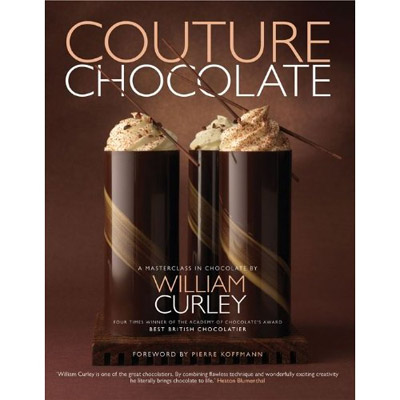
And then I was invited to review William Curley’s new book, Couture Chocolate. I have to confess that I fell in love with this book from the moment I held it in my hands. Not only is it superbly illustrated with mouthwatering photography …. but it smells good too. Honestly, it does! Just bury your nose deep into the binding of the open pages and you’ll see what I mean. But best of all, this book does exactly what it says on the cover – more than just a coffee table book, this really is A Masterclass in Chocolate.

William Curley is uniquely placed to direct this masterclass. Four times winner of the Academy of Chocolate‘s Chocolatier of the Year Award, he trained in some of the world’s finest Michelin-starred kitchens and was the youngest appointed Chef Patissier at The Savoy. From the opening chapters on the history and production of chocolate, through clear instructions on techniques for tempering and decorating, and with exquisite recipes for truffles, couture chocolates, bars, bouchées, cakes, patisserie and ice cream, Curley’s expert guide provides insight into the ideas and inspirations behind his work.

The recipes aren’t quick and simple. Curley uses quality ingredients and an array of specialist equipment that will probably require a trip to Amazon for most home bakers like me. Far from appearing daunting however, the recipes are broken down into manageable chunks throughout and combine practical tips with step-by-step photography. Recipes are included for many of the flavours and chocolate creations on sale in his own William Curley shops in Richmond and Belgravia, such as the Florentine Sablés and Salted Butter and Muscovado Caramel Chocolates (the highest marked chocolate in the Academy of Chocolate Awards 2011).

Curley frequently draws on a Japanese palette of flavours to create new fusions in his work. There are recipes for Matcha and Dark Chocolate Entremet, Chocolate Financiers with Yuzu Ganache, Chestnut and Sesame Brownies, and Green Tea Couture Chocolates. He attributes the inspiration behind these creations to his partnership with Japanese patissier Suzue – they met while they were both working at The Savoy in London and later married and opened their first shop together.

Perhaps the thing that inspires me the most about this book however is the knowledge that the stunning chocolates and intricate patisserie displayed in William Curley’s London shops are created in much the same way as detailed in these recipes. Although Curley’s staff have the advantage of some time-saving bits of machinery, the emphasis is firmly on using craft skills. As Curley points out, “I don’t want to have big cooling tunnels or machines that pump the ganache into shells. I want my team to make the ganache and understand the quality of the ingredients, and for everything to have that hand-made finish.” So … the ultimate implication is that Curley-quality creations are within the reach of every home baker if they take the time and care to follow this masterclass in chocolate.

Well, everyone needs a dream, don’t they?

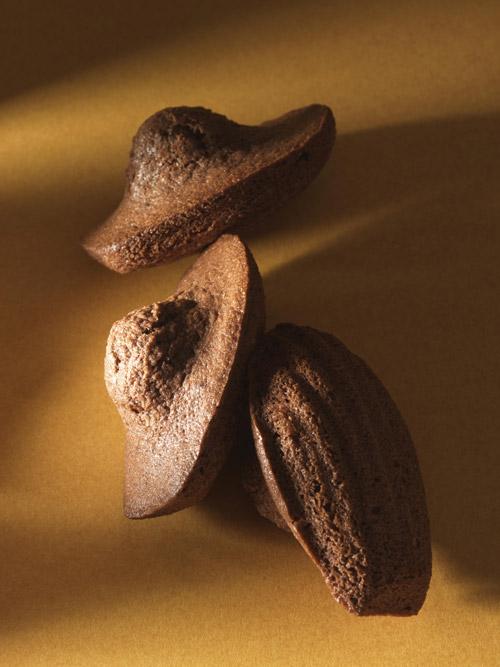
Chocolate Madeleines (reprinted from Couture Chocolate by William Curley with permission from the publishers)

When I worked for Marco we would bake these little French treats to order for petit fours as they are best eaten fresh as possible.

Makes about 20 cakes
15g (½oz) fine dark (bittersweet) chocolate (70% cocoa solids), roughly chopped
115g (4oz/ 1 stick plus 1 tbsp) unsalted butter, plus a little extra, softened, for greasing the mould
115g (4oz/¾ cup) plain (all-purpose) flour, plus a little extra for dusting the mould
20g (¾oz/1 tbsp) cocoa powder
3g (½ tsp) baking powder
135g (5oz/scant ⅔ cup) caster (superfine) sugar
175g (6oz) egg yolks (about 9 eggs), beaten

Note: You will need a 12-hole madeleine mould.

Grease with butter and lightly flour a 12-hole madeleine mould. Melt the chocolate over a bain-marie (water bath) until it reaches 45°C (113°F) and leave to cool. Melt the butter in a saucepan and also leave to cool. Sift the flour, cocoa powder and baking powder into a bowl and then mix in the sugar. Add the dry ingredients to the beaten egg yolks in a large bowl and mix with a wooden spoon until smooth. Gradually add the melted butter, being careful not to beat in air. Then mix in the melted chocolate. Cover the bowl with cling film (plastic wrap) and leave to rest for at least 30 minutes in a cool place.

When you are ready to cook the madeleines, preheat the oven to 220°C (400°F/Gas 6). Pipe or spoon the mixture into the prepared mould and bake in the preheated oven for about 12-15 minutes until risen and the cakes spring back when pressed.

Mum’s Random Bread Recipe

I’d like to introduce L, my nine-year-old daughter, who has convinced me to let her write a guest post this month as part of a homework assignment she was set for the weekend …

Uh-oh Mum’s let me loose on her blog. Not a good move, Mum. I’ll try not to crash the computer but I can’t promise anything.

Anyway, I have this RS homework to do. We have to make some bread and write out the recipe for it. I’m not sure why we have to do this for RS, but I really hope I don’t have to feed 5000 people in my next lesson.

I wasn’t thinking about this homework when Mum was dragging me around the supermarket this morning. I have far more important things to be thinking about in a supermarket (like sweets). So, I forgot to remind Mum to buy any white bread flour. That’s why I couldn’t use any recipes in Mum’s baking books. It’s much more fun to go off the beaten tracks anyway (according to Mum).

Luckily, Mum did have some odd bits of flour I could use in her cupboard and there was some leftover pizza dough still in the fridge too. If you’ve ever seen Mum’s baking cupboard, you’ll know that her odd bits of flour can be very odd indeed. Then Mum just made up a recipe for all of these odd bits as we went along. That’s how my RS homework got to be called ‘Mum’s Random Bread Recipe’.

And here it is … ta-daaaaaaaaaaaaaaaaaaa. (That magic trick was very tricky.)

Mum’s Random Bread Recipe (by Mum)

12 oz dough starter (this was the leftover pizza dough from the fridge)
9 ¼ oz Malthouse bread flour (from Dove’s Farm)
5 ¾ oz plain white spelt flour
1 ½ tsp fast action yeast
1 tbsp coarse sea salt
1 ½ tsp honey
½ pint beer

Cut up the old dough into pieces with some scissors and put them in a large mixing bowl.

Add the flours, yeast, salt and honey to the bowl and stir it all together with a wooden spoon.

Pour the beer in and stir it so that it all sticks together.

Pour a little bit of olive oil onto the worktop and spread it about a bit with your hands. Scrape the dough out onto the oily surface and knead it for 10 minutes until it is smooth and stretchy.

Put it in a large oiled bowl, cover with clingfilm and leave it to rise until it has doubled in size (1 ½ to 2 hours).

Line a large baking sheet with parchment.

Shape the dough into a ball by stretching the surface around the outside and pinching the dough together on the bottom of the ball. Place it on the lined baking tray. Cover it with a large container or a tent of oiled aluminium foil. Leave it to rise until it has almost doubled in size (1 to 1 ½ hours).

Preheat the oven to 220 degrees C.

Just before you put the dough in the oven, use a sharp knife to make 4 or 5 slashes in the top of the dough (Mum did a lantern slash). Bake for 10 minutes. Lower the temperature to 190 degrees C and continue baking for 15 to 20 minutes.

Take the bread out of the oven and put it on a wire rack to cool.

Brownie Heaven

Before I write about Rose and Woody’s recent stay with us in Devon, I’ve promised this recipe to so many people now that I thought I’d better get my act together and post it here for them.  There’s no shortage of recipes for brownies on A Merrier World – in fact, I even started this blog when I was in the middle of a brownie-baking spree. But I haven’t yet written about this particular recipe, which has evolved to become our favourite-ever recipe for chocolate brownies and the one we turn to by default.

I’m not sure how this recipe started out in life. I have a collection of about seventy different brownie recipes (honestly!) that I baked, analysed and compared back in my brownie-obsession days of 2007. [Checking that date just now, I’ve realised that I completely missed my blog’s 4th birthday last month – sorry, blog!] Somewhere between then and now, a list of ingredients and a specific way of mixing the batter to create the sort of brownie we discovered we liked the most began to emerge from the chaos of notes and eventually took shape in the form of a tentative recipe scribbled in green ink on the back of an A5 envelope in 2009.

Since then, the recipe has been tweaked, baked in different-sized pans, doubled, halved again and generally refined until it reached its current incarnation.

I can’t promise that this will become anyone else’s favourite-absolute-best-ever recipe for chocolate brownies, but it certainly produces my children’s idea of brownie heaven.

Brownie Heaven Chocolate Brownies (by me and according to my children)

5 1/4 oz unsalted butter
7 1/2 oz castor sugar
5 1/4 oz light muscovado sugar
9 oz plain chocolate*
3 tbsp golden syrup
2 tsp vanilla extract
3 large eggs (7 oz without shells)
5 1/4 oz plain flour**
3/4 tsp baking powder
3/4 tsp salt***
3 tbsp cocoa powder

* I use Green & Black’s organic 72% cook’s chocolate
** I use plain white spelt flour from Sharpham Park
*** I use Fleur de sel de Guérande

Preheat the oven to 170 degrees C.

Grease and line a 9″ square pan (it’s helpful to leave a bit of parchment sticking up at two opposite ends as you can use these as handles to lift the brownie out of the pan when it’s cool).

Put the butter, sugars, chocolate, golden syrup and vanilla extract in a bowl and heat gently until melted and smooth, either in the microwave (stirring frequently to prevent burning) or in a double-boiler.

Break the eggs into a separate bowl and whisk until bubbly and frothy.

Put the flour, baking powder, salt and cocoa powder in another separate, large bowl and whisk to combine.

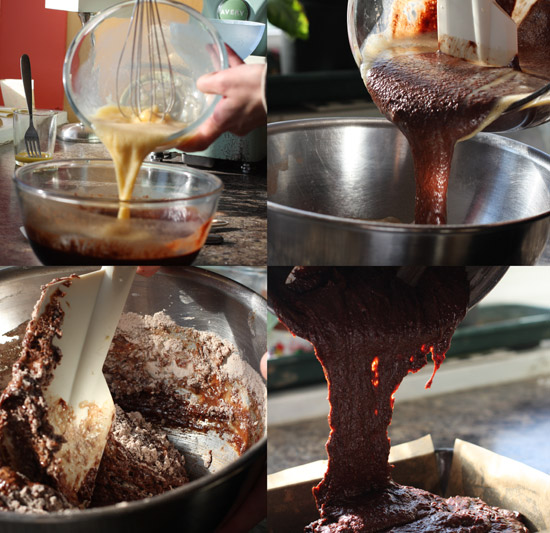
(I’m not sure why this next bit works, but it does – I tried just dumping everything together any old way once and the brownies didn’t turn out half so well. If you’re not subject to such kitchen witchery as I am, feel free to just dump everything together)  Pour the eggs onto the melted chocolate mixture, but don’t stir them in. Scrape this chocolate-with-the-eggs-sitting-on-top mixture onto the dry ingredients and fold everything together with a spatula until well combined and there are no floury pockets remaining.

Scrape into the prepared pan and bake in the centre of the oven for 25 to 30 mins (28 mins is best in my oven). Don’t bake it until a tester comes out clean – it’s a leap of faith, but the top will be crusty and the centre will be only just set when you need to take the thing out of the oven. If you bake it for too long, the brownies will be dry and yuk. If you don’t bake it for long enough, the brownies will be runny and yuk. This is probably the most important part of the whole brownie-heaven process.

Leave to cool in the pan, then lift out using those neat little handles you created and slice into squares (I make 25).

Which Cake is Which?

Back in June, a reader (yes, I do have one!) emailed me to ask whether I thought it would be okay to treat large batches of flour at a time since her microwave would be big enough to accommodate this. I replied that I thought it would be fine as long as the depth of the bed of flour remained the same as for a smaller batch. She tried it and it worked – which means less time overall doing all that standing and stirring.

But it’s easy to forget how exciting that first “It worked!” actually is. Catherine has kindly allowed me to post her photo of the results of her own treated vs. untreated flour experiment, along with extracts from her email to me. I can identify so well with her astonishment on taking the cakes out of the oven. It really doesn’t seem possible that something so simple as heating up the flour beforehand could make such an outstanding difference.

Hi Kate,

Thanks for your prompt reply!  Yesterday evening after emailing you … I baked 2 test cakes, identical in all things other than the heat-treatment of the flour, and was quite astounded at the difference in results. In both cases the flour was comprised of 1/8 by weight cornflour to give cake flour following your recommendations.

I’m attaching a photo to confirm what you already know!  No prizes for guessing which cake is which.  I was sure you were right but there’s nothing quite like seeing the evidence in the flesh…

Best wishes,
Catherine

I’m happy to say that I’m very much looking forward to finally meeting Catherine when she comes to have lunch with Rose, Woody and me next week 🙂


  • Enter your email address to subscribe to this blog and receive notifications of new posts by email.

    Join 289 other subscribers
  • Seasonal Recipes

    candied peel

    baileys chocolate truffles

    gingerbread men

    mince pies

    fudge

    smarties cookies

  • Freshly Made

  • Categories

  • Favourite Feasts

  • Awards

    DMBLGIT Award
  • Archives

  • wordpress visitor counter
  • Adventures in food by Kate Coldrick from Woodbury in Devon.