Nearly one year on, my Rainbow Cake and Unicorns post about M’s birthday party is still one of the most popular posts at A Merrier World. I have received several emails and comments since that time, most recently from Rupa, asking for information about the games we played and the treats I prepared for M’s little guests. Hopefully, this post will answer many of these queries and provide further inspiration for anyone planning a similar unicorn-themed party for a young child.
I drew my own inspiration for M’s party from a number of sources on the internet as well as from my own imagination. I will provide references where possible and I’m sorry if I miss any attributions – the exact details are a little hazy after so many months. Please let me know in the comments if you can fill in any blanks 🙂 .
All good parties start with an invitation. I kept M’s invitations deliberately simple, leaving a large space where she could write in the name of each friend she wished to invite. I set the scene of the party by describing an enchanted forest and added an image of a unicorn (hand-drawn and then scanned). Looking at the invitation again, perhaps I could have included an RSVP …
Having planted expectations of an enchanted forest in the minds of M’s guests, I felt that I should actually make some attempts to create an enchanted forest. In the week before the party therefore, my three little helpers and two of their friends painted large trees, butterflies and flowers that I cut out and used to decorate the house on the morning of M’s birthday.
Also decorating the house were several long, sellotape-handled streamers made from rainbow-coloured strips of crêpe paper – one strip each in red, orange, yellow, green, blue, pink and purple. These were to be waved up and down by the children in a rainbow dance during the party, but I used them in the first instance to decorate the front windows of our house by hanging them from the curtain poles.
To complete the rainbow enchantment, O pinned up a large parachute over the entrance to our magical forest so that the guests arrived under a canopy of colours.
As the children were arriving at the start of the party, I collected them all together at our kitchen table by providing unicorn colouring pages for them to complete with colouring pencils, stickers, glitter and glue. We also made a unicorn horn for each child by rolling a sheet of sparkly cardboard into a cone and stapling an elastic strap onto the sides to hold it in place on their forehead.
Once everyone had arrived and sticky, glittery hands had been washed, I gathered the children into a huddle at the door leading through to the forest clearing where the unicorns lived. I explained that unicorns are very shy creatures, but you can tell where they have been by the magical blue pebbles their hooves leave behind when they stand still for long enough. I then gave each child a shimmering drawstring purse which they could use to collect any of the unicorn treasures they found in the enchanted forest (each child’s purse had their name written on a tag to save any arguments later).
Whispering excitedly, the children crept through the hallway to our living room where I had hidden enough blue glass decorative gems for even the most timid child to be assured of finding a good handful to put in her organza gift bag.
To accompany the fervent unicorn hunting, I played the Unicorn Song on our laptop and blew bubbles (a guaranteed success!).
Magical gems safely stashed away, I then handed each child one of the rainbow streamers that were hanging above the window. All little girls seem to have innate knowledge of the connection between unicorns and rainbows, and our guests danced enthusiastically to the Rainbow Colours song by Nancy Stewart.
After all that activity, we sat down for a game of Pass the Parcel (centre prize a plastic rainbow bracelet) …
… followed by a game of Pin-the-Horn-on-the-Unicorn (after nearly a year, the drawing is still stuck on the back of our living room door!).
There was only just enough time left after this for a quick game of Musical Unicorn Bumps before returning to the kitchen for the party tea.
I kept the party food simple – cheese and ham sandwiches, carrot sticks, apples, unicorn horns (twirly crisps) and cocktail sausages. The unicorn plates, cups and napkins I used have since been discontinued, but others are available from online party suppliers.
Each guest left the party clutching their organza purse of unicorn gems, a rainbow streamer, a slice of magical rainbow cake and a unicorn horn (ice cream cone) filled with jelly beans and popcorn.
As the sun set over the enchanted forest, one very happy 4-year-old drifted cozily into sleep whilst her exhausted parents sipped a well-earned glass of wine!
I was invited to join the worldwide celebration of a man named Arthur and a beer named Guinness just before St Patrick’s day a few weeks ago.
Even as an intermittent food blogger, I regularly receive emails from PR companies asking me to post their latest press releases or promote the newest kitchen gadgets on my blog. Unfortunately for them, my blog is a very personal space that I keep deliberately free from paid advertising and ‘freebie’ giveaways. I dislike reading the same official spiel repeated across countless food blogs and find boredom setting in very quickly when I find yet another incredulously rave declaration of the generosity of such-and-such a brand in providing the free samples that inevitably form the basis of an ensuing favourable blog review (the ubiquity of posts on a certain pomegranate juice comes to mind …).
Additionally, I often find that the emails I receive from PRs are impersonal and demanding – “Write this text, post this image, post by this deadline!” – as well as poorly matched to my interests in food blogging. I know that it’s all part of wider, on-going relationship misunderstandings between PRs and food bloggers, as each are confronted by the hitherto unknown workings of the other, so I don’t take offense. I just don’t usually find much to inspire me in these PR emails, that’s all.
However, I try to keep an open mind on these things and I’ve never yet deleted a PR email without having read it through first. So when I received an email from Stephanie about an official Guinness cookbook, I was genuinely interested.
I already have several treasured recipes that include Guinness among their list of ingredients. There’s a sticky gingerbread cake, Rose’s beer bread, a beef stew … Would I like to learn more about the cookbook, Guinness ®: An Official Celebration of 250 Remarkable Years? Well, yes actually – I would!
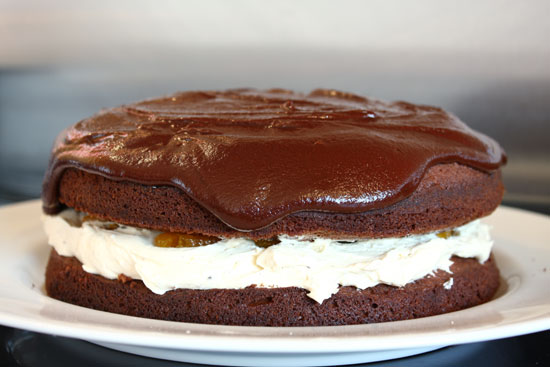
Stephanie forwarded two recipes from the book for me to try at home – Steak and Guinness Burgers and an Iced Chocolate, Guinness and Orange Cake (recipes below) – and explained that the book had been published to celebrate the 250th anniversary of the founding of Arthur Guinness’ brewery in Dublin. I also contacted Paul Hartley, the author of the recipes in the book, and he kindly agreed to answer a few of my questions about their development.
This post was supposed to happen on St Patrick’s day (or at least in the week following March 17th), but it obviously didn’t. I was planning to bake the cake on the same day that I made the burgers to enjoy the recipes as a two-course Guinness extravaganza, but the slight issue of 173 cupcakes got in the way (more about that story another day). I therefore had to wait until Easter Sunday before finally being able to complete my plans.
The verdict?
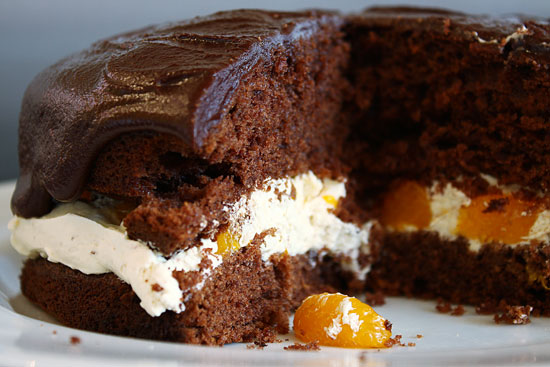
Everybody loved the cake at dinnertime on Easter Sunday. In fact, it was even a real success with O, who my regular reader [sic] will know generally dislikes anything sweeter than a pint of beer. I have to confess that I sandwiched the cake layers together with a white chocolate buttercream rather than whipped cream, but that was purely because the major cake-eaters in my family dislike cream with a vengeance. I’m sure any cream lovers out there would find it beautiful with lashings of whipped cream, too.
The burgers had a smaller audience than the cake but were also unanimously declared to be tasty. We found that we needed to cook them for longer than stated in the recipe, but I usually cook meat slightly on the longer side when I’m serving it to kids anyway. Or perhaps our burgers were over-generously sized …
Here’s my conversation with Paul Hartley about the book and his recipes in general …
First of all, how many of your recipes are included in this book?
18 different recipes – some sweet, some savoury.
Are the recipes traditionally Irish in any way (apart from the inclusion of Guinness, that is!)?
Yes, Galway Oyster Bisque. Have you ever been to the Galway oyster festival? I haven’t but am planning to go. Sausages with Guinness gravy and colcannon (which is traditional Irish potato cakes). Beef and Guinness pie is a very traditional Irish dish.
Did you use Guinness in any of your cooking before you developed these recipes?
I’ve cooked with Guinness for years – whenever a recipe called for stout I would reach for the Guinness. Having already been a great fan of cooking with Guinness made this book a real treat for me.
What aspects of Guinness did you have in mind when you set out to develop these recipes?
Cooking savoury dishes was always my favourite so this was a chance to develop sweet Guinness creations in our kitchen.
How does Guinness work in the recipes to create something that is more than just a plain old chocolate cake, for example – does it truly make a difference or is it just there as a gimmick for the anniversary?
Certainly no gimmick – these dishes are definitely taste enhanced by adding Guinness. For as long as recipes were written, Guinness has been used to add depth of flavour to rich fruitcakes, and a heartiness to rich meat stews. Guinness added to batter produces a light and crisp result.
Which do you believe is the most successful recipe?
Steak & Guinness burgers with rosemary & garlic butter.
Did you try anything that really didn’t work out at all?
Whenever you are pushing the culinary boundaries there will always be dishes that just don’t work. Luckily these were few.
How many pints of Guinness did you get through while you were working on these recipes for the book?
Lots, just didn’t keep count…
And finally, do you now cook any of these recipes regularly at home?
I am a partner in Hartleys Café Bistro in Somerset and we regularly include one of the Guinness book recipes on our menu. As for cooking at home, yes sometimes but I’m currently writing the Horlicks cookbook so that’s the cut and thrust of most home cooking right now.
Minced beef is marinated overnight in Guinness, then mixed with roasted red onions, griddled and served topped with rosemary and garlic butter to make a memorable burger.
Preparation time 20 minutes, plus marinating, chilling & freezing
Cooking time 10 minutes
Makes 6 burgers
500 g (1 lb) top-quality lean minced beef, ideally from grass-fed Irish beef
150 ml (¼ pint) draught Guinness
1 large red onion, finely diced
olive oil, for drizzling and oiling
3 smoked streaky bacon rashers, finely diced
1 teaspoon creamed horseradish
1 free-range egg, beaten
½ teaspoon paprika
2 heaped tablespoons plain flour
1 rosemary sprig
75 g (3 oz) butter, softened
1 garlic clove, finely chopped
salt and pepper
step 1 Lay the minced beef out in a shallow dish and cover with the Guinness. Using your hands, massage the Guinness into the meat, cover with clingfilm and leave to marinate in the bottom of the refrigerator for at least 12 hours.
step 2 When ready to make the burgers, spread the onion out in a baking dish, sprinkle lightly with salt and drizzle with oil. Scatter the bacon on top. Roast in a preheated oven, 150°C (300°F), Gas Mark 2, for 15 minutes. Leave to cool.
step 3 Lift the beef out of its marinade, gently squeeze out any excess liquid and put the beef in a large bowl. Add the roasted onion and bacon, the horseradish, egg and paprika, season with pepper and sprinkle the flour over. Using your hands, mix together well. Divide the mixture into 6 equal portions and form into round patties about 2.5 cm (1 inch) thick. Carefully lay the patties on a baking sheet lined with greaseproof paper, cover with a second sheet of greaseproof paper and chill in the refrigerator for at least 1 hour and up to 6 hours to firm up.
step 4 Meanwhile, pluck the rosemary leaves from the stem and plunge into boiling water for 30 seconds. Drain, then chop as finely as possible. Add to the softened butter and garlic in a small bowl and beat together well. Lay a piece of clingfilm on a flat surface, form the butter into a sausage about 3.5 cm (1½ inches) in diameter and roll up in the clingfilm. Freeze for 20 minutes until set.
step 5 Lightly oil a griddle pan. Heat until just beginning to smoke, add the burgers and cook over a high heat for about 5 minutes on each side, or until well browned on the outside and just pink inside. Serve immediately, each burger topped with a slice of the rosemary and garlic butter.
This sumptuous cake is perfect for a special occasion. The recipe may seem a little involved, but it’s easy to accomplish if tackled stage by stage.
Preparation time 45 minutes
Cooking time 1 hour
Serves 8
2 large oranges
250 g (8 oz) caster sugar
175 g (6 oz) unsalted butter, plus extra for greasing
150 g (5 oz) self-raising flour
25 g (1 oz) cocoa powder
2 teaspoons baking powder
3 free-range eggs, beaten
25 g (1 oz) ground almonds
5 tablespoons draught Guinness
150 ml (¼ pint) double cream
Icing
20 g (¾ oz) unsalted butter
50 g (2 oz) caster sugar
3 tablespoons draught Guinness
100 g (3½ oz) plain dark chocolate (70% cocoa solids), finely chopped
step 1 Peel one orange. Finely grate the zest of the other orange and set aside. Using a sharp knife, pare away the pith from both oranges. Cut the oranges into 5 mm (¼ inch) slices. Put them in a small saucepan and just cover with cold water. Bring to the boil, then reduce the heat and simmer for 10 minutes. Add 50 g (2 oz) of the sugar and continue to simmer until all the liquid has boiled away, watching carefully to ensure that the oranges don’t burn. Leave to cool.
step 2 Beat together the butter and the remaining sugar for the cake in a large bowl until very pale and fluffy. Sift together the flour, cocoa and baking powder, then beat into the butter mixture alternately with the eggs. Add the ground almonds, reserved grated orange zest and Guinness and beat for 3–4 minutes until you have a soft dropping consistency.
step 3 Grease and line the base and sides of 2 x 20 cm (8 inch) round cake tins, then divide the cake mixture equally between the tins, smoothing the surface. Bake the cakes in a preheated oven, 190°C (375°F), Gas Mark 5, for 25 minutes until risen and firm to the touch. Leave to cool in the tins for 5 minutes before carefully turning out on to a wire rack to cool completely.
step 4 Whip the cream in a bowl until soft peaks form, then spread over one of the cakes. Arrange the cooled orange pieces over the cream and carefully place the other cake on top.
step 5 To make the icing, put the butter, sugar and Guinness in a small saucepan. Stir over a gentle heat until the sugar has dissolved, then bring to the boil. Remove from the heat and add the chocolate. Leave to soften, then beat gently with a wooden spoon. Leave to cool and thicken. While still warm but not too runny, pour the icing over the cake and use the back of a spoon or a palette knife to spread it evenly.
Sometimes she likes to join up with her Amy friends in single lines like this:
And sometimes she likes to join up with them in branched lines like this:
Now before you start calling for the little men in their white coats to take me away, let me explain what I’m going on about. I’m not a chemist or a biotechnologist (or even an artist, as you can tell from my doodles above!), but when I read Rose’s description of her recent tests to improve the performance of unbleached flour without resorting to nuking it in the microwave, I wondered why potato starch was so much more effective than cornstarch at eliminating dipping in cakes baked with unbleached all-purpose flour.
The key seemed to be in starch gelatinization.
Starch gelatinization is important to the structure of all cakes. When starch gelatinizes, its structure breaks down so that the granules dissolve in liquid. This creates a kind of gel that sets as it cooks and provides structural support to the cake.
When you put a cake in the oven, the starch granules begin to swell and absorb the liquid in the batter. However, gluten proteins in the batter are also absorbing this liquid. This means that there is not enough liquid available for the starch granules to fully gelatinize at this stage.
As the gluten proteins absorb liquid, they are able to stretch around the expanding gas bubbles that are sticking to the starch molecules in the creamed fat. The gluten structure stretches and stretches until it pops and becomes semi-rigid. When this happens, the liquid that had been absorbed by the gluten proteins is released into the batter. The starch granules are now able to absorb this liquid until they themselves gelatinize and the batter takes on the shape of the final baked cake.
Starch gelatinization requires more than just water, however. It also requires heat. The starch granules begin swelling at around 50 degrees C (120 degrees F) but gelatinization is usually not complete until the temperature reaches 95 degrees C (200 degrees F), and only then if there is enough time and available water. It follows that a cake’s structure sets earlier when the starch has a lower gelatinization temperature than when the starch has a higher gelatinization temperature.
A scientific paper in the Journal of European Food Research and Technology describes how cakes formulated with cornstarch collapsed because of insufficient starch gelatinization. This supports an earlier observation that the gummy centres and uncooked appearances of cakes prepared with a cornstarch batter were due to incomplete starch gelatinization resulting from a failure to reach setting temperature in the baking time.
Cake flour is more acidic than normal flour. Since acids promote faster setting, this means the starch will gelatinize sooner in the oven, reducing baking time and keeping the cake moister.
As Rose explained, potato starch gelatinizes at a lower temperature than cornstarch. So … I now wondered what exactly it was about potato starch that allowed it to gelatinize at this lower temperature and give the improved results that Rose observed when she used it in her unbleached flour cakes. Perhaps other sources of starch might have this same property …?
This is the part where Amy makes an appearance. Say “Hello,” Amy 🙂
Plants store energy as starch in the form of particles, or granules. These starch granules differ between plants in their size and shape. For example, some starch granules may be large and oval whilst others may be polygonal or elongated. Each starch granule is made up of two different types of molecules (polysaccharides) that consist of repeating units of glucose.
Now, imagine our friend Amy is a glucose unit. If you remember, sometimes she likes to link up with her Amy (glucose) friends in a single line. When she does this, the resulting molecule is called ‘amylose’.
At other times, Amy (glucose) likes to link up in branched lines. When she does this, the resulting molecule is called ‘amylopectin’.
As well as differing between plants in terms of their size and shape, starch granules also differ between plants in terms of the relative amounts of amylose and amylopectin their granules contain:
wheat starch, rice starch and cornstarch typically contain 25% amylose;
sorghum starch contains 24% amylose;
cassava flour contains 20-22% amylose;
potato starch contains 20% amylose;
arrowroot starch contains 18-20% amylose;
tapioca starch contains 15-18% amylose.
You probably remember doing the classic potato and iodine experiment at school -the one where you always end up staining your fingers deep purple. If you didn’t have that pleasure, then just rest assured that iodine is used by chemists as an indicator of starch. This photo shows how iodine stains the starch in potato cells a typically dark blue. This is because amylose has a high iodine-binding capacity.
However, there is a group of plants whose starch does not stain such a dark, deep purple when it comes into contact with iodine. These plants are referred to as ‘waxy’ or low-amylose plants. Iodine merely stains the ‘waxy’ starch of these plants a red or a brown colour. This is because their starch consists almost entirely of amylopectin, which has a low iodine-binding capacity. Glutinous rice is an example of such a waxy plant. The starch of glutinous rice has no or negligible amounts of amylose.
So, what does all this mean for starch gelatinization?
Well, it appears that amylose content is linked to the temperature of gelatinization in different sources of starch. Essentially, the higher the amylose content, the higher the gelatinization temperature. This is because it takes more energy to break the bonds between amylose molecules than it does between amylopectin molecules.
It follows that potato starch gelatinizes at a lower temperature than cornstarch, that tapioca starch gelatinizes at a lower temperature than sorghum starch, and so on. Because the amylose content is so reduced, glutinous rice starch gelatinizes at a much lower temperature than most alternative natural sources of starch.
If a cake’s structure sets earlier when the starch has a lower gelatinization temperature and if this is a key factor in reducing dipping and maintaining moisture in cakes baked with unbleached flour, then it could be predicted that starches with a lower amylose content will be more effective than starches with a higher amylose content as a substitution for part of the flour in a recipe.
I was curious to discover whether these predictions would translate into tangible results when applied to the question of improving the quality of cakes made with unbleached flour. I decided to bake five separate cakes to test the differences between four different sources of starch as a substitution for 15% of the flour in Rose’s Yellow Butter Cake recipe from The Cake Bible:
100% unbleached McDougall’s ’00’ plain flour
85% McD’s flour + 15% cornflour (cornstarch)
85% McD’s flour + 15% potato starch
85% McD’s flour + 15% arrowroot starch
85% McD’s flour + 15% glutinous rice starch
I made my own glutinous rice starch by whizzing some Thai Glutinous Rice (found in a local Continental Foodstore) in a food processor and sieving it multiple times until I obtained a fine powder. I did discover an online source of ready-milled glutinous rice flour, but the shipping costs seemed a bit extravagant for the minute quantity I needed!
The glutionous rice starch certainly behaved differently from the other starches. Perhaps unsurprisingly (it is called ‘sticky rice’, after all), it readily absorbed the liquid in the recipe and left me with a dense lump of dough after the first stage of mixing. To produce a cake with this flour, I increased the amount of milk to achieve a more regular batter consistency – completely unscientific, but I wanted to have my cake and eat it too! The extra-milk-glutinous-starch cake was so successful in terms of crumb and volume that I went ahead and baked a sixth cake to see what would happen when I used this thirsty starch in conjunction with heat-treated, kate flour.
Here are the cakes laid out neatly for you on my dissection table …
… and here are their vital statistics:
The starches with a progressively lower amylose content produced cakes with progressively more volume and a correspondingly softer crumb. Cakes made either entirely with unbleached flour or with unbleached flour + cornflour dipped in the centre. Cakes made with starches that had an amylose content of 20% or lower did not dip in the centre.
I didn’t have a long-enough ruler to show you the measurements of all cakes in one go, so I borrowed a ruler from L and shot a couple of close-ups for you. The letters refer to the same flours and starches as before.
Cakes made with potato starch and arrowroot had no discernible (to me and my little testers, at any rate!) off-flavour. The cakes made with glutinous rice tasted distinctly ‘ricey’, but in quite a delicious way. In fact, my fussiest little T couldn’t yum up enough of these cakes whilst turning up his nose at the others. If my food-processor is up to the task (it takes quite a lot of effort to grind down that sticky rice), I can see that I’ll be making more of these cakes in the very near future.
Just for comparison, here are the two Sticky Rice Cakes: the cake on the left was made with untreated flour plus glutinous rice starch; the cake on the right was made with heat-treated flour plus glutinous rice starch.
The cake on the right is how T’s tummy looked after he’d eaten the cake on the left 😉 .
Goblins and ghosts are one thing at Hallowe’en, but a full-page glossy photo of Rose’s Great Pumpkin Cake is in quite a separate realm of terror. If you plan to make it, that is. Or, more specifically, if you’ve rashly promised to take that very cake to a Hallowe’en party in full knowledge of the fact that you have never before made either a caramel crème anglaise or an Italian meringue, and that these very tasks now lie between you and the burnt orange silk meringue buttercream that covers this cake so smoothly and so beautifully in that horrifyingly daunting photo on page 127 of Rose’s Heavenly Cakes.
Not only did I promise this cake to my friends and hosts for Hallowe’en this year, but I felt doubly bound to attempt this cake in gratitude to Rose for having very kindly lugged the pumpkin-shaped cake pan halfway across the world in her baggage for me earlier this year.
“I can’t wait to see the look on your children’s faces when they see this cake,” she told me. What she didn’t tell me was that I would be required to boil a supersaturated sugar solution not only once but twice during the process of making the cake’s burnt orange silk meringue buttercream.
Well, there wouldn’t be much for my children to look at unless I somehow managed to overcome my fear of boiling sugary syrups.
When broken apart and concentrated in a supersaturated solution, sugar molecules are unstable. They want to come back together again at any chance to return to their previous crystalline structure. An unclean pot, any jarring or stirring of the supersaturated solution at the wrong time, can send them back to their original crystalline pattern and dry state, crystallizing the mixture and ruining the whole candy batch. (From Baking 911)
I am in awe of anyone who can successfully make fudge and toffee in their home kitchen. When I phoned my Mum several months ago for a bit of motherly sympathy after yet another batch of my fudge crystallized and crumbled, she helpfully told me about the wonderfully shiny, brittle toffees and smooth, creamy fudges she remembers her Gran making for her when she was a little girl. Thanks, Mum! Grrrr.
Perhaps I have the wrong sort of sugar. My sugar has either overly-friendly or pathologically co-dependent molecules that stubbornly stick together regardless of the care I take to keep them apart. I must have sticky sugar. Yes, that’s it – I definitely have the wrong sort of sugar.
Or perhaps I have the wrong sort of weather …
It was procrastination rather than thoroughness that led me to read and re-read Rose’s instructions multiple times through on Saturday morning. The cake itself had baked beautifully the day before and I even tried to convince myself that it would look fine just sandwiched together with a bit of marmalade. After all, once it was covered in buttercream, you wouldn’t be able to see those lovely pumpkin grooves anymore.
In my heart of hearts though, I knew what I had to do. With trembling fingers, I carefully placed my super-sensitive sugar into the centre of a saucepan and poured the water around it. I drew an ‘X’ through the sugar and ensured that not even one single crystal dared to venture stickily towards the edges of the pan. I stirred as the sugar dissolved, I held my breath as the solution boiled … and I watched helplessly as the caramel crystallized.
Some kindly spirit must have had the worms’ best interests at heart because the whole thing wasn’t quite such a disaster the second time around and I was finally able to set aside my burnt sugar crème anglaise and turn to the Italian meringue.
This time, I managed to snatch defeat from the jaws of victory by knocking the saucepan as my super-clear, supersaturated solution was boiling. Despite being so depressingly frustrating, it was actually quite a mesmerising sight watching the crystals starting to form so insidiously in one section of the pan, then rising and falling on the boiling crest of the sugary bubbles as they linked hands with increasingly more of their crusty friends.
How time flies when you’re boiling sugar. I had donned my apron that morning at 10.30 am. It had only taken me five hours to successfully get my burnt orange silk meringue buttercream ready for slapping on the cake!
As I painstakingly applied lines of darker orange to mark the segments of the pumpkin’s outer skin, M watched me thoughtfully.
“Is it supposed to look like a pumpkin, Mummy?” she eventually queried. I think she must have inherited her knack for saying the right thing at the right time from her Granny 😉 .
I only had a short time left now before the witching hour, which was when I risked having my pumpkin turn back into a coach if it was still unfinished (magic can be a tricky thing at Hallowe’en). My twirling cocoa tendrils and garish, green marzipan leaves were still a little floppy, but I arranged them artlessly on top of the cake before jumping into my witch’s dress and cape. I grabbed hold of my broomstick, a couple of little witches and an even smaller warlock, and we all set off together down the street with the Great Pumpkin Cake in tow.
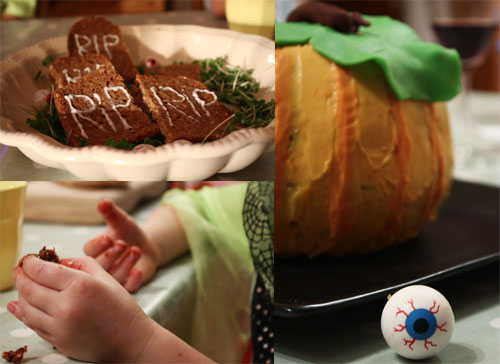
No Hallowe’en party would be complete without an unearthly danse macabre …
… and a suitably ghoulish feast.
And the Great Pumpkin cake?
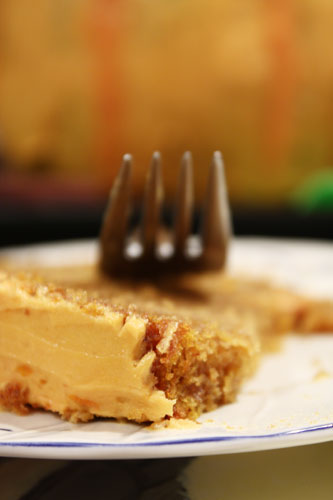
It was delicious – moist, subtly spiced and perfectly complemented by the smoothest buttercream I have ever had the pleasure of rolling around my tongue. Every forkful was savoured with relish …
… right down to the last crumbs.
Although Melinda and I are self-confessed Fallen Angel Bakers, you can see further renditions of the Great Pumpkin Cake by members of the Heavenly Cake Bakers group this month as they work their way through all of the cakes in Rose’s book. My thanks go to Marie for steering the project – it was certainly encouraging to know that I wasn’t alone in my buttercream trepidation!
And the wind sprang up and the sky grew dark … and it rained …
and rained …
and rained …
and rained …
and rained.
But small children never seem to mind the rain. They eagerly pull on their welly boots and rush outside to splash and jump in muddy puddles. Soaked through and dripping, they are unconcerned by such grown-up worries as colds and coughs and sneezes, and are unburdened by the practicalities of ensuring they have a dry change of clothing packed safely away in rucksacks on every outing.
Which is perhaps just as well, since our visit to the annual Apple Day hosted by the Royal Horticultural Society gardens at Rosemoor last weekend was certainly a wet one.
I had only been to Rosemoor once before, nearly five years ago when we first moved to Devon. Back then, we were a family of three, although we were only a few months away from becoming a family of four. In my heavily pregnant state, I waddled around the gardens one afternoon with L while O was busy in his new job. There was little to see – it was March and the beauty of the gardens was still deep in its winter sleep. Only the name tags marking places in the soil gave a hint of what the gardens would become in the Spring.
On that visit, I was particularly intrigued by the fruit and vegetable gardens. Although they were seemingly populated by nothing more than empty, dead twigs, my imagination was kindled by the sheer variety of fruits that were planted there. With each step I took, I discovered apples and pears with magical, evocative names that never appear on the supermarket shelves. Barnack Beauty, Shenandoah, Lady Sudeley, Yellow Ingestrie.
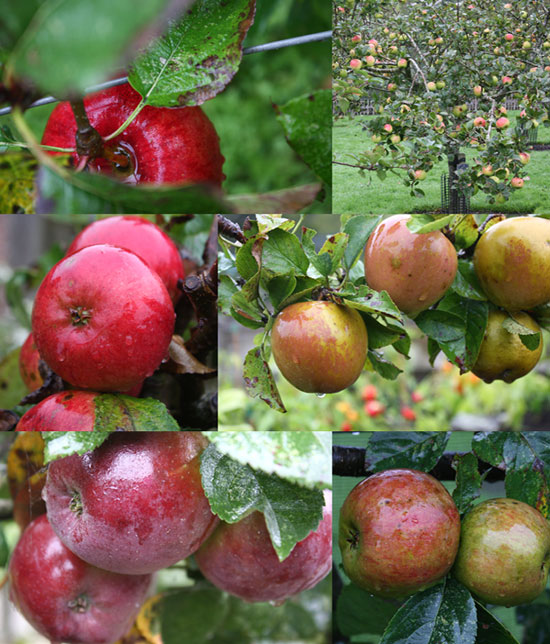
Last weekend, I finally had an opportunity not only to see these fruits growing at Rosemoor, but also to taste them. Despite the steady rain that poured persistently throughout the day, we joined the damp, waterproofed crowds at the garden’s annual Apple Day. Inside a large, dry marquee, tables were stacked high with a myriad of different varieties of apple. Slices for tasting were laid out on paper plates alongside tasting notes and harvesting information. Some apples were soft and sweet while others were crisp and tart. Each variety left a different aftertaste, from nutty to aniseed.
There were dessert apples, cooking apples, juicing apples and apples for making cider. Stalls around the sides of the marquee provided a platform for producers and artists from Devon to show their apple-related products. At one stall, rivers of the purest apple juice gushed from a noisy mulching machine.
“Four parts Cox to one part Bramley,” the producer proudly told us. Whatever the secret, this was the most glorious apple juice I have ever tasted. Its sweetly crisp aromas filled my senses with apple even as the juice was being sloshed from the jug into my glass. It was as if I’d buried my nose deep into the apple blossom and drunk from the very essence of the fragrant fruit.
And then out into the rain to the orchards where the bare patches of soil of my last visit were now bursting abundantly with redolent apples of all varieties.
That evening as the geese flew overhead on their journey out to sea, I made a spiced autumnal apple cake in celebration of this rainy Apple Day.
Apple Day Cake
3 ounces seedless sultanas
100 milliliters dark rum
2 ounces unsalted butter
5 ounces castor sugar
2 ounces light muscovado sugar
7 ounces peeled, cored and diced apple (1 medium Bramley apple)
1 tablespoon grated orange zest
1 teaspoon vanilla extract
6 ounces eggs, weighed without shells (3 medium eggs)
5 ounces plain (all purpose) flour
1/4 teaspoon baking powder
1/2 teaspoon bicarbonate of soda (baking soda)
1/2 teaspoon salt
1/2 teaspoon ground cinnamon
Put the sultanas in a small bowl and cover with the rum. Leave to soak for at least 30 minutes.
Preheat the oven to 180 degrees C / 350 degrees F / gas mark 4 with a rack set in the centre of the oven.
Grease and base-line a 20 cm (8 inch) round cake pan.
Melt the butter and sugars together in a small saucepan (or in the microwave, stirring frequently) until smooth and runny.
Place the melted butter and sugars together with the apple, grated orange zest and vanilla in a large bowl. Beat to combine.
Add the eggs gradually, beating after each addition to incorporate. Scrape down the sides of the bowl.
Place the flour, baking powder, baking soda, salt and cinnamon in a separate bowl and whisk to combine thoroughly. Add the dry ingredients to the wet ingredients and stir until well incorporated.
Drain the sultanas well and reserve the rum (set aside). Add the sultanas to the apple mixture and stir to combine.
Pour the mixture into the prepared pan. Bake in the centre of the preheated oven for 45 to 50 minutes. A tester inserted into the centre of the cake should have few crumbs attached when removed (it is a moist cake, so the tester will not be completely clean). Remove from the oven.
Let the cake stand in the pan for 10 minutes before removing from the pan and placing on a wire rack.
Brush the top of the cake with a small amount of the reserved rum. Cool on the wire rack before slicing and serving.























 amerrierworld.com