Parmesan Thyme Shortbread

Today is the last day of term for L and M. It is also their last day at the village school as they will be moving to a specialist music school in September.

Standing in the playground for the final time this morning, they clutched presents for their teachers and received gifts from friends they have known for most of their young lives. It was a particularly poignant moment tempered only by the knowledge that whilst their classmates may be changing, their long-standing friends at home in the village will still be around for after-school play dates.

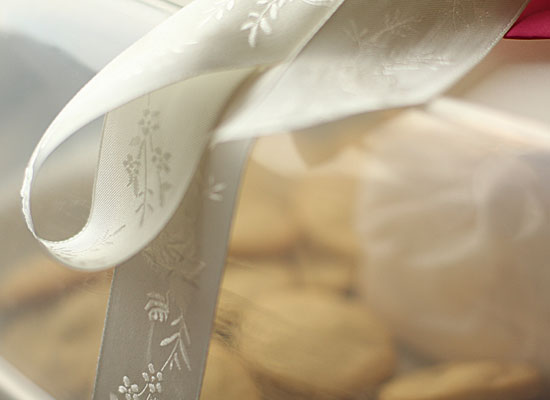
To thank all of the staff at the school for their hard work and dedicated teaching, I made a batch of savoury shortbreads flavoured with Parmesan, thyme and pepper. I arranged these around a block of perhaps the creamiest, tastiest Cheddar cheese ever –Barbers 1833.

Hopefully, these nibbles will provide an antidote to the many sweet, chocolatey treats that I am sure are now filling the staffroom!

Parmesan and Thyme Shortbread

8 oz unsalted butter at room temperature
7 oz Parmesan, freshly grated
1 1/2 tsp dried thyme
1 tsp sea salt
1 tsp freshly ground black pepper
9 1/4 oz plain flour
2 1/4 oz potato starch

Preheat the oven to 180 degrees C.

Beat the softened butter until it is creamy and billowy.

Stir in the grated Parmesan, thyme, salt and pepper, mixing at low speed until combined.

Add the flour and potato starch. Continue to mix at a low speed for about a minute until the dough holds together in clumps.

Press the dough together with your hands and place on a floured surface.

Roll out to about 1/4″ thickness (it helps to place a piece of clingfilm/plastic wrap on top of the dough whilst rolling).

Cut circles using a round biscuit cutter (1 5/8″ diameter). Place on ungreased baking trays and bake in the oven for 10 minutes until slightly puffed and golden.

Transfer to a wire rack to cool.

Makes enough for a staffroom of Primary schoolteachers (about 60 to 70 biscuits … I’m afraid I lost count).

His Hat Was Made of Good Cream Cheese

It is unusual for O to request a dessert. He’s more of a meat-and-two-veg sort of person really. By some quirk of genetic fate, none of his teeth are of the sweet variety.

I tend to forget this fact when planning a menu for guests and invariably end up asking him, “What should we have for dessert?” His disgusted expression as he then contemplates the various sugary options makes me wonder if perhaps I’d just asked him to choose from a range of particularly gruesome and bloody death scenarios by mistake.

“Should we torture our guests with a red hot poker or serve up their severed heads on the silver platters?”

“Don’t we need the silver platters for the fish course, darling? Perhaps the red hot pokers would save on the washing-up.”

Last weekend however, O surprised me. We were standing in the kitchen discussing the popular choices of pizza toppings in preparation for a dinner with family and friends when I inevitably forgot and asked THE question, “What should we have for dessert?”

“Cheesecake,” he replied.

I was stunned. Here was an endorsement more compelling than that of any celebrity chef. O had just requested cheesecake!

This is how we came to discover Rose’s superb No-Bake Whipped Cream Cheesecake from her latest book, Rose’s Heavenly Cakes.
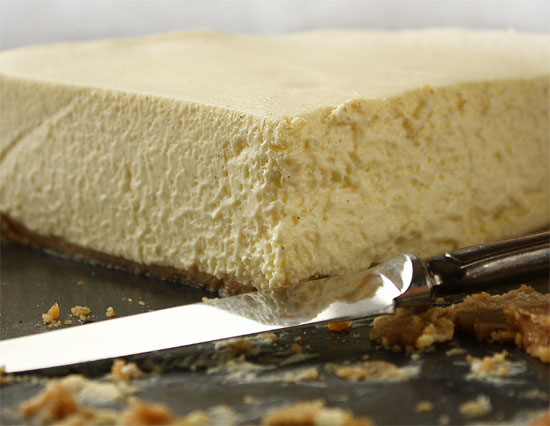
When I was little and it was the 1970s, cheesecakes were apparently in fashion at dinner parties. I can remember standing on tiptoe to spot the berry-topped creations among the Black Forest Gateaux and cans of squirty cream adorning the dining room table.  Seeing the shining cherries and blackcurrants that smothered the entire surface of every cheesecake I saw back then, I naturally assumed these berries were an inescapable part of the tasting experience. I had an intense dislike of forest fruits and therefore refused to sample even the tiniest morsel of a cheesecake.

Then came that fateful dinner party when the hostess, disturbed at the thought of letting a small child go without dessert, remarked that there were some plain cheesecakes still waiting in the kitchen for their toppings. Would I like to try a slice of one of those, without the berries?

I didn’t try just one slice. Falling instantly in love with the smoothness of the filling and the saltiness of the biscuit-crumb base, I ate so many slices that I promptly felt very sick indeed.

My love affair with the cheesecake was swift and cruel. Unable to forget my self-induced nausea, I couldn’t bring myself to eat cheesecake again for at least another ten years.

Perhaps these memories saved me from a similar fate last weekend, for I would certainly have been far less restrained otherwise when serving myself extra slices of Rose’s no-bake cheesecake. A sublime lightness and creaminess elevate this cheesecake way beyond the sum of its parts. And when I tell you that those parts include a crème anglaise made with crème fraîche and an italian meringue laced with fresh lemon juice, you will know how serious I am about this cheesecake.

Of course, O hasn’t become a newly-converted, sweet-toothed fan of all things sugary following his uncharacteristic request. My hidden chocolate bars are still safe unless my secret hideaway is rumbled by my children. Whilst O certainly enjoyed his slice of cheesecake and appreciated its superior qualities, he’s a die-hard lover of cheese in its purest form at heart.

With three wild children and a long-haired cat running through the rooms, our house makes an unlikely dairy for cheesemaking. Scrupulously clean, we are not.

There is one form of cheese that is within our grasp however, and that is ricotta.

Creamy, rich and tangy, ricotta is traditionally made in Italy from the leftover whey after the process of cheesemaking. A simpler option for those with only a kitchen stove at hand is to heat a mixture of whole milk and acid gently until the curds separate from the whey. These can then be easily removed with nothing more technical than a colander and cheesecloth. Indeed, the most challenging part of the whole procedure is in resisting eating all of the warm, milky ricotta within a few minutes of its production.

I don’t think that I left the whey to drain from the curds for quite long enough this time though, which is a shame because I used whole goat’s milk for this ricotta and O was particularly looking forward to it. It was still quite delicious in a runny rather than fluffy sort of way, but you had to catch it quickly before it dribbled over the edges of the oatcakes!

O says that he’d prefer “more goat, less cream” next time, so the challenge has been set. I’ll try not to bore you too  much with news of my quest to produce a goat’s milk cheese that satisfies my husband’s exacting standards, but I do feel that I owe it to him as a reward for pushing me towards discovering my new favourite cheesecake recipe.

And his hat was made of good cream cheese …

Creamy Goat’s Milk Ricotta (adapted from a recipe by Julia Moskin)

1 litre whole goat’s milk
250ml double cream
190ml buttermilk
3/4 teaspoon salt

Prepare a sieve or colander lined with a cheesecloth or muslin (folded if necessary) over a large bowl.

Place all the ingredients in a large, heavy-bottomed, non-reactive (stainless steel or enameled – something that won’t react with acid or brine) pot and heat slowly to between 80 and 90 degrees C (175 to 200 degrees F). Stir frequently as the liquid warms but stop stirring once the curds have started separating from the whey.

Remove from the heat and pour into the cheesecloth-lined sieve.

Gather together the ends of the cheesecloth and twist to bring the curds together. Do not squeeze.

Allow to drain for 15 to 30 minutes more and then spoon the ricotta into airtight containers. Refrigerate and use within a week.

Don’t discard the whey! It can be used in many recipes (e.g. pancakes, muffins, sauces) in place of buttermilk or sour cream and will keep for up to a week in the fridge.

Oatcakes (adapted from ‘Scots Cooking‘ by Sue Lawrence)

175g/6oz medium oatmeal
50g/20z pinhead oatmeal
1/2 teaspoon salt
1/4 teaspoon baking powder
25g/10z butter, melted
about 50-75ml/2-3fl oz boiling water

Preheat the oven to 170 degrees C  (325 degrees F).

Combine all the ingredients together in a mixing bowl. Add the melted butter and enough boiling water to form a stiff dough when stirred.

Sprinkle some medium oatmeal over a board. Roll out the mixture gently to about 1/4 inch thickness (depending on how thin/thick you like your oatcakes). Use a biscuit cutter to cut out circles of the dough.

Use a spatula to transfer the rounds carefully to a buttered baking tray.

Bake in the oven until just firm (10 to 20 minutes depending on the size of your circles).

Transfer carefully to a wire cooling rack.

Store in an airtight container when completely cooled (you can keep them crisp by storing them buried in porridge oats).

Easter White Chocolate Nests

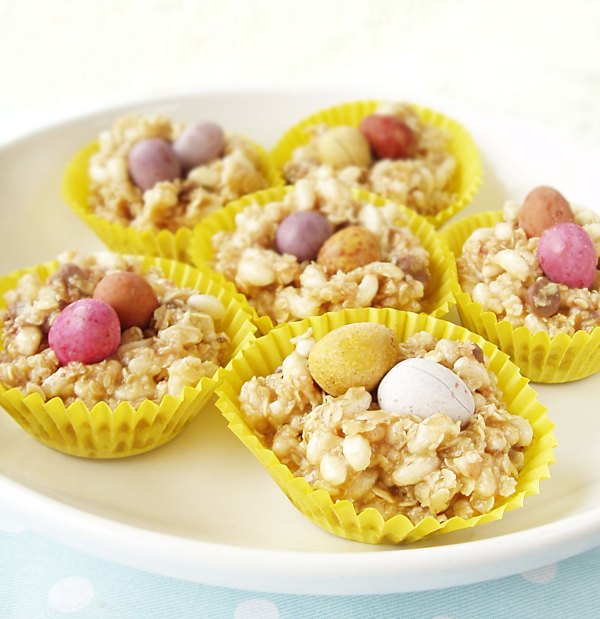
I know, I know, Easter was last weekend and I missed it with these Easter nests. But it’s a season for springtime festivals after the darkness and hibernation of the winter months, so perhaps I’m not too late after all. My children certainly don’t seem to mind that we made Easter goodies after the event! Time is more flexible when you’re as young as they are, I guess.

So yes, the Easter bunny hopped by our house earlier today and caught us in the act of creating sticky, gooey nests for the chocolate eggs he laid on Sunday.

Funnily enough, it seems that people did once believe that bunnies were laying eggs at this time of the year. The story goes that they would mistakenly connect their lucky discoveries of clutches of eggs hidden among the hedgerows with the mad March hares they saw bouncing around in the fields. In reality, the hidden treasure had actually been laid by the unconfined hens of those days as they roamed freely in the meadows. It’s a shame such child-like logic had to be disillusioned, in some ways – I rather like the picture of frantically fertile bunnies stopping every now and then in their frenzied hopping to deposit a few eggs in unexpected places.

Although we were too late for Easter, I’m hoping that we’ll still be in time to offer our nests to Julia of A Slice of Cherry Pie for her Easter Cake Bake 2009. I’m a little hazy about days and dates right now (a side-effect of school holidays, I find), but I’m pretty sure we haven’t yet had the 20th April!

Easter nests

Easter White Chocolate Nests

10 oz rolled oats
4 oz Rice Krispies
4 oz milk chocolate chips
8 oz unsalted butter
7 oz golden syrup
6 oz white chocolate
1/2 tsp fleur de sel
60 mini chocolate eggs

Makes 30 nests.

Mix together the oats, Rice Krispies and chocolate chips in a large bowl.

Melt the butter, golden syrup and white chocolate together in a saucepan over a low heat. Stir in the fleur de sel, then pour the mixture over the dry ingredients in the big bowl.

Get several children to take turns stirring with a big wooden spoon until all the dry ingredients are moistened (it’s okay to do it yourself if you can’t find any little people to help, but it won’t taste as good).

Use an ice-cream scoop to dollop the sticky mess into paper cupcake liners. Press a couple of mini eggs into the top of each nest.

Leave to set if you can resist them for long enough.

Strawberries and Rhubarb

It’s the beginning of the school Easter holidays and Spring is well underway here in Devon. We have watched the furry-covered magnolia buds bursting into full blossom in the gardens at the University where O works, and L and M have collected the fallen ‘fairy blankets’ from the ground beneath the trees. We have blue skies at last, too!

magnolias

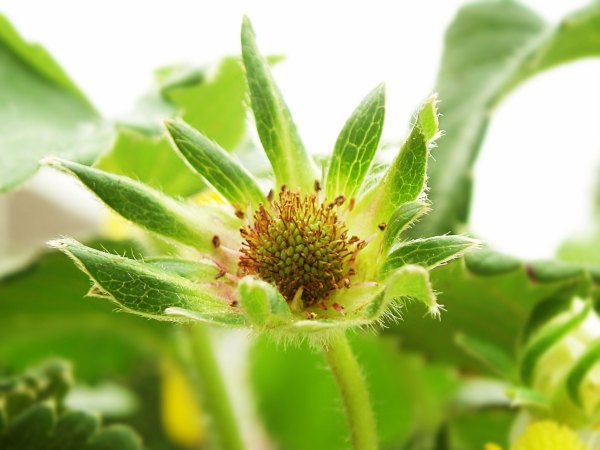
Back at home, our garden is picking itself up after being cruelly assaulted by winter’s frosts and builders’ footsteps. Whilst I generally throw in a few suggestions of things I’d like for my kitchen pots, the main planting and sprouting of any fruit and vegetables in our garden is O’s province. However, O is in Cambridge taking exams this week, so I’ve been left in charge of the nursery. And it’s a very different kind of nursery from the one that has been my own domain for the past seven years. Instead of changing nappies and spreading cream on sore baby bottoms, I’ve found myself piling soil around newly sprouting potato plants and making sure the strawberries have just the right amount of water to drink.

spring strawberry

Come back soon, O – having sole responsibility for these babies is terrifying me!

strawberry and flower

Although it will be a while before our strawberries are ripe and juicy-red, this time of year brings an abundant supply of strikingly rosy forced and blanched rhubarb. Not a fruit as such, it still bridges the period between autumnal apples and sweet summer berries when it comes to puddings and desserts. It may not be truly seasonal, but the warm, dark conditions in which forced rhubarb is grown produce a stem that is more tender and less stringy than the outdoor variety of later months. And the rhubarb is also an almost disconcertingly vivid pink.

rhubarb

I have fond memories of rhubarb from my childhood in the North-East of England. There are photos of my sister and me hiding under our gigantic umbrellas of rhubarb leaves whilst playing in our parents’ garden (I must note here that the leaves are toxic if consumed due to overconcentration of oxalic acid – fortunately, we never felt in the remotest way inclined to munch on a rhubarb leaf when we were little). I do remember biting into the raw stem however, dipping it into a bowl of sugar to take away the tartness of its taste. It might have been relatively unfashionable until recently in the South of England, but I wouldn’t mind betting that rhubarb never lost its popularity during those years in the allotments and gardens of the North.

So when I encountered this season’s first homegrown rhubarb yesterday at Dart’s Farm, I just couldn’t resist buying a bunch. One thing led to another … the children wanted to bake cookies, they clamoured for gingersnaps, ginger is a classic flavouring for rhubarb …

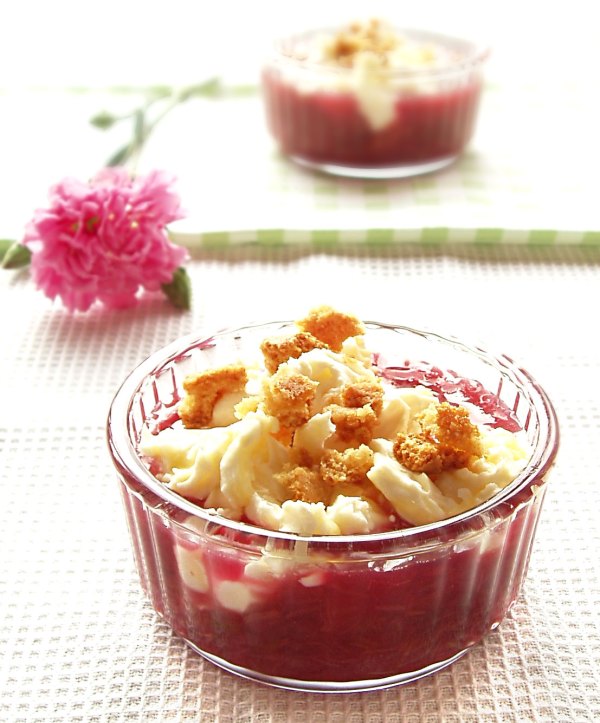
Our rhubarb pudding was inspired by a recipe from Wicked Desserts (Delicious) for simple roasted rhubarb and lemon curd pots. We made our own gingersnaps for the topping and poached rather than roasted the rhubarb pieces.

rhubarb poaching

Although orange and rhubarb are a match made in heaven, I prefer the sublime combination of rhubarb, pomegranate juice and rosewater. Divine. So that’s what I used.

rhubarb lemon mascarpone

Rhubarb and Lemon Curd Pots

7 oz caster sugar
200 ml pomegranate juice
200 ml water
3 tbsp rosewater
1 lb forced rhubarb, cut diagonally into thin slices
1/2 oz butter
6 tbsps lemon curd
250g tub of mascarpone
4 gingersnaps (recipe here)

Place the sugar, pomegranate juice, water and rosewater in a large pan and bring to the boil. Add the rhubarb and simmer for 10 to 15 minutes to reduce. Stir in the butter. Leave to cool.

Swirl the lemon curd into the mascarpone with a knife.

Divide the poached rhubarb between 6 serving pots. Spoon the lemony mascarpone on top.

Crush the gingersnap biscuits and sprinkle the crumbs over the mascarpone.

This post is my entry to CLICK: Spring/Autumn.

Red Velvet Madeleines

The school playground this morning was full of red noses. Not the usual sore, runny kind that go hand-in-hand with childhood during the winter months, but red noses with glasses, smiley faces and various bits of tape or string added at home to hold them in place on such very small faces. Being too grown-up, L had declined to wear her own red nose for the event. She said there wasn’t any point as it kept falling off anyway and then she’d just lose it. She was probably right – this child does seem to be quite capable of losing just about anything in the most peculiar of places (I won’t talk about purple bunny just yet – we still have hopes that he’s hiding somewhere in the house).

The playground this morning also appeared to be full to the brim with fairycakes (or cupcakes, depending on your side of the Atlantic). Now here, the maths just doesn’t quite add up. To raise money for Red Nose Day 2009, everyone was asked to bring in some cakes that could be sold during the day. And so, there they were this morning, standing dutifully in line, each child clutching the requested batch of 12 or so cupcakes in one hand … and in their other hand, their 20 pence coin with which they would be able to buy one cake at the cake sale. Hmmm. That’s an awful lot of excess cupcakage. These teachers must really love cake!

For our part, we contributed a shiny platter of red velvet madeleines (which gave me a perfect excuse for using the beautiful madeleine moulds that my Mum brought back from a holiday for me some time ago now).

madeleine tray

Maybe I’ve just been somewhere else, but I’ve honestly never before seen or tasted a red velvet cake. I only came across the notion when I started reading other people’s food blogs a few years ago. I’m sure I would have remembered if I’d ever been served such a gloriously red thing as this.

red velvet cake

The name sounds so very dreamy and luxurious that I was taken by surprise by the sheer amount of food colouring a red velvet cake seems to contain. I think I must have confused it with Devil’s food cake somewhere in my reading as I was expecting the red colour to arise from an interaction between the baking soda and cocoa powder. But then, dear old Wikipedia tells me that the two names for the cakes have a long history of being used interchangeably, so I at least feel in good company in my confusion.

I hesitated about the red dye. Some chefs use colouring from beetroots instead, but the effect is not quite as traffic-light red. And it is Red Nose Day and not ‘Mahogany’ or ‘Brown-with-a-Reddish-Hue’ Day, after all. Would I be a really bad mother if I made my one-time-only-for-a-special-event madeleines red with food colouring …?

My conscience was finally silenced by this lovely quote from an article in the New York Times:

Perfect Endings bakes the excellent red velvet cake that Williams-Sonoma featured in its catalog for the first time at Christmas. Mr. Godfrey said he uses a recipe he learned to bake with his grandmother, a native of Little Rock, Ark. “But for the bakery I couldn’t bring myself to offer a cake using red food coloring,” he said. “I tried cherries and beets, but it wasn’t right. Then I decided to honor my grandmother, so I went ahead with the food coloring.”

And the madeleines would be small and gone in a couple of even very child-sized mouthfuls … and I wouldn’t be sticking any candies or sugary frosting on the top … and they would be ever so wonderfully the perfect colour for the day.

Here then, in honour of Red Nose Day 2009 (and Mr Godfrey’s grandmother), are our extremely red velvet madeleines (based on a recipe by Pinch My Salt, except I converted her measurements into weights and used the batter to make about 40 madeleines).

red velvet madeleines

Red Velvet Madeleines

8 3/4 oz cake flour (or kate flour)
1 teaspoon baking powder
1 teaspoon salt
2 tablespoons unsweetened cocoa powder
2 oz (5 tbsp) red food colouring
4 oz unsalted butter, softened
10 1/2 oz caster sugar
2 eggs
1 teaspoon vanilla extract
8 1/2 oz buttermilk
1 teaspoon white wine vinegar
1 teaspoon baking soda

Preheat the oven to 350 degrees F/180 degrees C. Lightly oil the madeleine moulds.

Place the cake/kate flour, baking powder and salt in a medium bowl and whisk to combine. Set aside.

Mix the food colouring (yes, all of it) and the cocoa powder together in a small bowl (I bet you can’t do this without getting your hands red … if you give it to a small child to mix, be prepared for a red-splattered kitchen, too). Stir until the paste is smooth and without lumps. Set aside (don’t you think this recipe is beginning to sound a lot like an EU farming policy?).

Cream the butter and sugar together in a large bowl until fluffy (about 3 mins). Add the eggs gradually, beating well to combine. Scrape down the sides of the bowl.

Add the vanilla and red cocoa paste. Beat then scrape down the sides of the bowl again.

Sift in one-third of the flour mix and beat to combine. Then beat in half of the buttermilk. Scrape.

Sift and beat in another third of the flour mix, then the rest of the buttermilk. Scrape.

Finally, sift and beat in the remaining third of the flour mix. Scrape.

In an egg cup or small bowl, mix together the vinegar and baking soda (fizzzzz – T liked this part!). Add the fizzy potion to the cake batter and beat to combine thoroughly.

Fill each madeleine mould with the batter until about 3/4 full. Bake for 8 to 10 minutes in the centre of the oven. Leave for 2 minutes in the pan before releasing each madeleine with a palette knife and transferring them to a wire rack to cool.

  • Enter your email address to subscribe to this blog and receive notifications of new posts by email.

    Join 289 other subscribers
  • Seasonal Recipes

    candied peel

    baileys chocolate truffles

    gingerbread men

    mince pies

    fudge

    smarties cookies

  • Freshly Made

  • Categories

  • Favourite Feasts

  • Awards

    DMBLGIT Award
  • Archives

  • wordpress visitor counter
  • Adventures in food by Kate Coldrick from Woodbury in Devon.