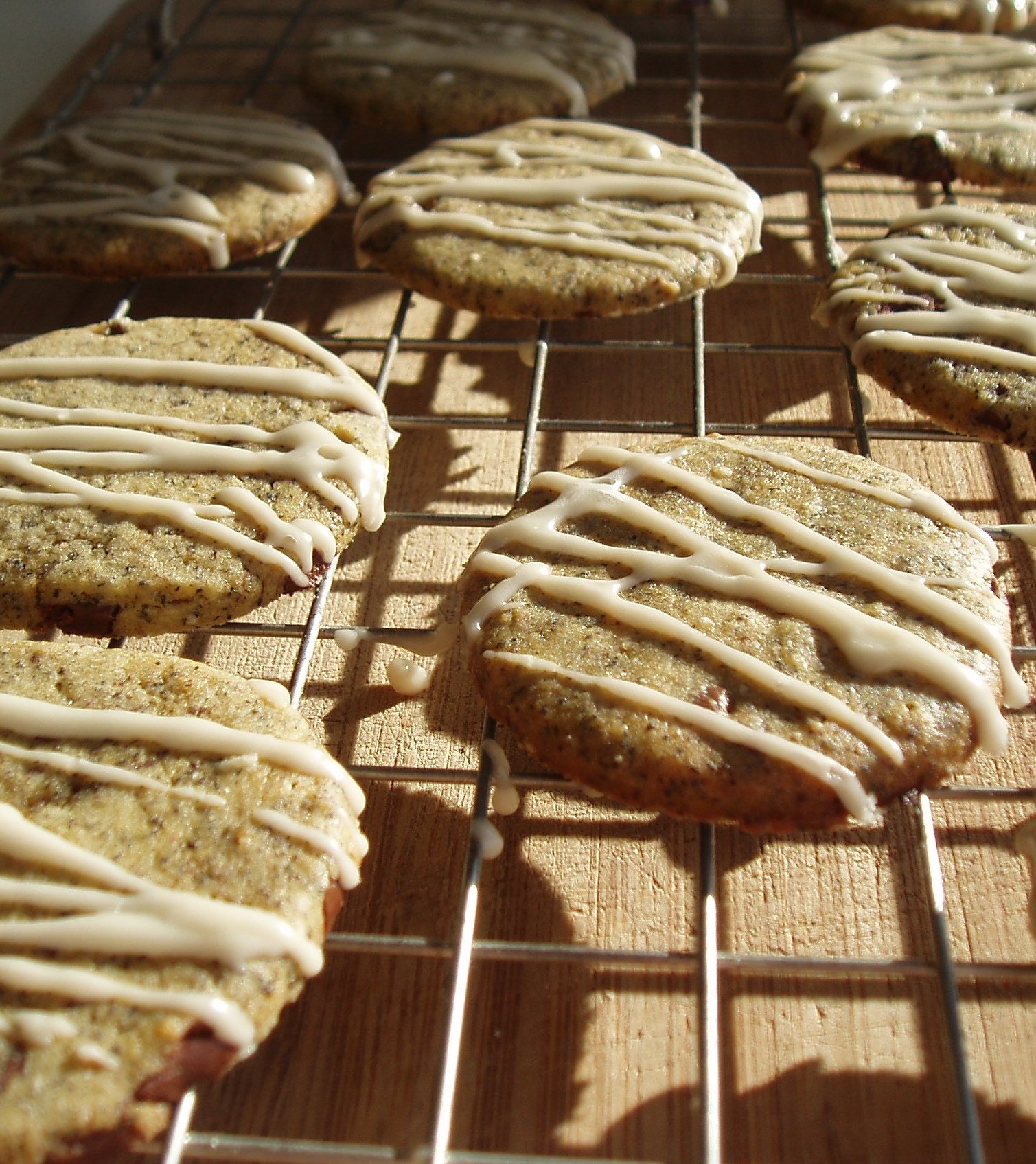
Chai Chilli Biscuits

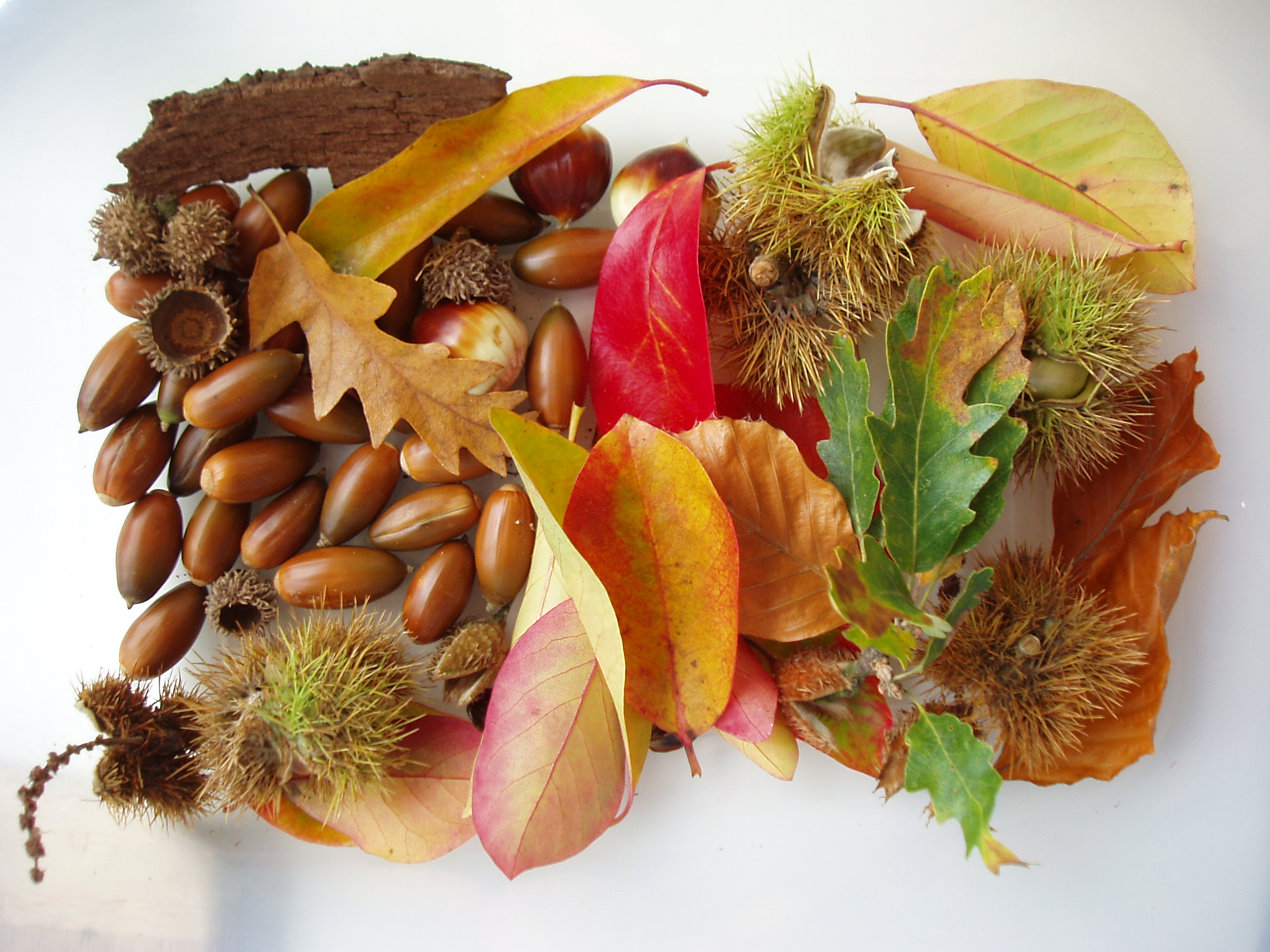
I discovered the theme for this month’s Sugar High Friday on the same day as I visited Bicton Park with O and the children last week. The gardens were gloriously awash with autumal colours that day and although we suffered the inevitable attraction of an indoor play area (complete with ball pool), L, M and T also returned home after having had a wonderful time collecting this assortment of nuts and leaves. M carried them proudly into her Preschool the next morning.

Despite having absolutely no spare time at the moment (it’s half-term this week, O is working hard and T is 18 months, which means endless cupboard-opening, escapeeism, finger-trapping and pebble-gathering), I couldn’t miss an opportunity to celebrate Autumn with a warming, spiced recipe … the theme chosen by Anita of Dessert First.

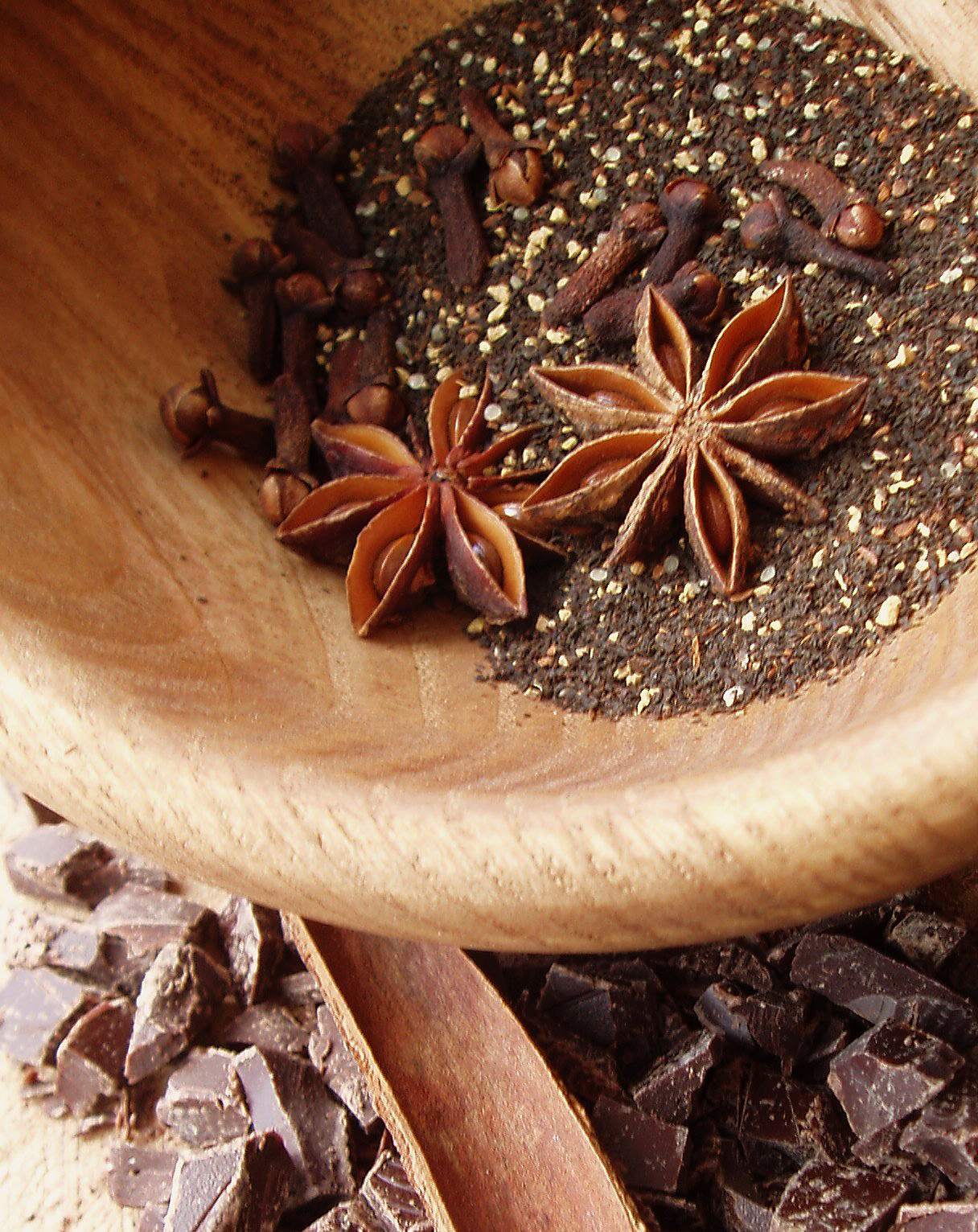
I particularly wanted to use some chilli chocolate made locally by the South Devon Chilli Farm. I have also wanted to try a recipe I noticed a while ago that uses tea leaves to add flavour to biscuits. Although this particular recipe suggested using Lady Grey, I wanted something slightly more heady and aromatic for this time of year and chose Masala Chai instead. With its mix of cardamom, cinnamon, star anise and cloves, I hoped that this tea would combine with the chilli chocolate to create a warming autumnal treat.

So here is my offering for SHF #48 (was it really a whole year ago that I last submitted an entry?) – some biscuits that will hopefully ‘spice up your life!’

Chai Chilli Biscuits (adapted from a recipe by BBC Good Food)

5 oz butter, softened
4 oz light brown muscovado sugar
2 tbsp Masala Chai tea leaves
2 oz Chilli chocolate, chopped finely
1 large egg
7 oz plain flour

FOR THE ICING
5 oz icing sugar
2 tbsp Masala Chai, strongly brewed

Cream the butter and sugar, then beat in the tea leaves, chocolate chips and egg. Fold in the flour and gently combine to a soft dough. Roll into a ball, flatten into a disc and wrap in cling-film. Chill in the fridge for about 30 minutes.

Preheat the oven to 180 degrees C. Lightly grease a baking tray.

Roll out the dough (use a lightly-floured, opened-up freezer bag on top of the dough to stop it sticking to the rolling pin) to about 1/4 inch thickness. Use a round biscuit cutter (about 2 1/4 inch diameter) to cut out circles. Place on the baking tray, allowing a little space between each.

Bake for 8 to 10 minutes until lightly browned. Transfer to a wire rack to cool.

To make the icing, sift the icing sugar into a bowl. Gradually beat in the tea until the icing is smooth and not too thick. Drizzle over the biscuits and leave to set.

Turn Back the Clocks

I have been reading a lovely book by Brenda Crowe called Play is a Feeling. As the first National Advisor to the Pre-School Playgroups Association, she was well placed to ask groups of parents to explore their earliest play memories. Although her book was written more than twenty years ago in 1983, many of her discoveries ring true today. Through stimulating discussion and sensitive investigation, she observed clearly how memories triggered by the feel of the word play lead towards a deeper understanding of the world of childhood. Above all, she found that “play wasn’t something apart, it was life itself, a positive and creative way of living.”

I particularly enjoyed reading a chapter about ‘The Feel of Things’. Here, she describes how parents’ memories of events, places and objects from their childhood triggered strong personal associations with tastes, sounds, smells and emotions. She believes that these associations are critical in the development of children’s understanding of the world. Indeed, she claims that these sensory experiences underlie a child’s later use of words and language to convey and share findings and feelings, deepen relationships and extend thinking. In this passage, the importance of smell, touch and taste in childhood is vividly evoked:

“Older people recall individual smells with relish – paraffin lamps, the carbolic soap in the kitchen, camphorated oil in the medicine chest, pickles being made, fresh chrysanthemums brought in from the allotment, sausage and mash and bacon, hardware shops with their smell of oil, creosote and open boxes of nails, wash-days with hot soapy suds, stables, garages and breweries. And the memories bring back the ‘feel’ of the surroundings and relationships associated with each one.

But now there are extractor fans over cookers, furniture shines without the natural smell of beeswax and turpentine, aerosol sprays render rooms impersonal, deodorants perhaps make us impersonal too, modern roses are beautiful, but not many of them have the scent of the old-fashioned deep crimson velvety ones. New heavy-cropping tomatoes lack the scent and flavour of those that used to be grown for their flavour, school dinners are delivered in containers from far-away kitchens. Bread is pre-wrapped and few bakehouse smells waft out on hot air from shops these days – and even in homes there is often no time for home baking. So many distinctive smells that children could read like a book, connecting them with people, homes and seasons, have been removed or replaced by synthetics. The clock can’t be put back. But it doesn’t have to be accelerated – and, if we are aware of what is happening, we can exercise at least some degree of choice.”

Although I have only just recently come across Brenda Crowe’s urge to parents to provide real sensory experiences for their children, I have nevertheless always unconsciously assumed the same philosophy in bringing up my own children. An important part of this has been my choice to actively engage them in the kitchen. Home baking is an eagerly-anticipated daily event for my three. And for most of the time, the boundaries between play and work are blurred – while we are all immersed in play, we are equally absorbed in real work and my children recognise themselves as an important part of the family team.
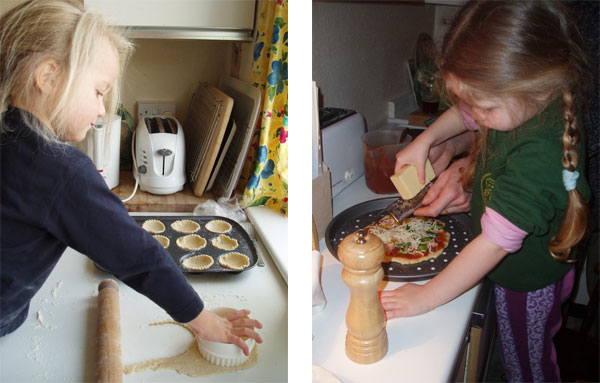
It is interesting to note that Brenda Crowe linked a disappearance of homebaking to a lack of time – modern families are too busy to bake or cook. It is this perceived lack of time that accounts in part for the popularity of ready-meals, pre-prepared and fast food on the supermarket shelves. However, there is more at stake than time when we hand over the responsibility for the food we eat to profit-making enterprises. As Elisabeth Winkler points out, many packaged foodstuffs are subjected to processes and chemicals that have little if anything to do with taste or sustenance.

The dark side of all this has been glimpsed slowly but startlingly in the unfolding drama of melamine/cyanuric acid food contamination. Beginning in the pet food industry perhaps as early as 2004, the crisis has spread more recently into the realms of baby food, candies and chocolate. Apparently, the protein content of gluten in a product affects its price and is measured by the level of nitrogen. Melamine has a high nitrogen content and was allegedly used by a firm in China to artificially raise the protein level (and hence the price) of ingredients such as wheat gluten, rice protein concentrate and corn gluten. These contaminated, imported ingredients were then used unwittingly as binders by pet food manufacturers in the United States and South Africa with disastrous consequences. Animals who consumed the products subsequently developed symptoms of kidney failure and many died.

Melamine on its own does not appear to cause too much of a problem. However, it degrades over time to produce cyanuric acid. Although cyanuric acid alone is also not especially toxic, it binds with melamine to produce insoluble crystals. In fact, this is something that was already known to the scientific community before their investigation of the contaminated food products – this patent from 1988 describes how melamine can be added to swimming pool water to remove the cyanuric acid that is regularly used as part of the chlorination process. The resulting crystals are easily removed from the pool by vacuum or filtration.

It seems that swimming pools have superior filtration systems to animals. In the pets who ate the contaminated food, the crystals developed into kidney stones leading to renal failure and death.

Unfortunately, this episode was not enough to prevent melamine being added to milk powder for babies in China earlier this year. This article from September 16th describes how 1253 babies had become seriously ill by that date, whilst this article places the number of affected babies at 50,000 only two weeks later. In the UK, the Food Standards Agency has put in place a new testing regime on all products from China containing more than 15% milk as an ingredient. In China, there are reports that many women are returning to breast-feeding and wet-nursing to avoid the use of contaminated baby formula.

And so we come full circle back to real food … that nourishes as nature intended. As we can see, that nourishment delves deep into the heart of not only our physiological but also our psychological well-being.

I would like to offer this post as my contribution to Elisabeth Winkler’s real food blog competition. She has invited bloggers to write about an ingredient or dish that is usually factory-made and to compare it to the real thing. Although I may be extending the boudaries of the competition rules slightly by writing about homebaking and gluten, I hope she forgives me! For my recipe, I’m offering a real-milk fudge for everyone who wants to rediscover child’s play in an increasingly synthetic adult world.
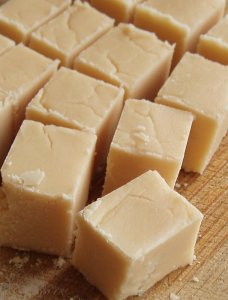
Fudge (adapted from a recipe by Hutton and Bode)

1 lb granulated sugar
1/4 pint milk
1 1/2 oz butter
1 teaspoon liquid glucose
1 teaspoon vanilla extract

In a 4-5 pint heavy saucepan, dissolve the sugar in the milk. Heat only very gently and do not let the mixture boil. This can take quite a long time – be prepared to be patient. Brush any particles of sugar from the sides of the saucepan with a pastry brush dipped in water.

When every single last grain of sugar has dissolved, add the remaining ingredients. Attach a candy thermometer to the side of the pan and boil to 238 degrees F. Stir the mixture occasionally to prevent burning.

Remove the pan from the heat and dip the bottom for a second only into a sink full of cold water. This will stop the temperature rising further.

Leave for ten minutes, then beat the mixture until it thickens. Turn out onto a board and knead until smooth. It will still be quite hot, so I used the backs of two spoons to fold and push the fudge until it was cool enough to touch.

Shape into a cake of about 1/2 to 3/4 inch thickness. Leave until cold and then cut into pieces. The fudge should be stored in an airtight box lined with parchment paper.

Apple Custard Autumn

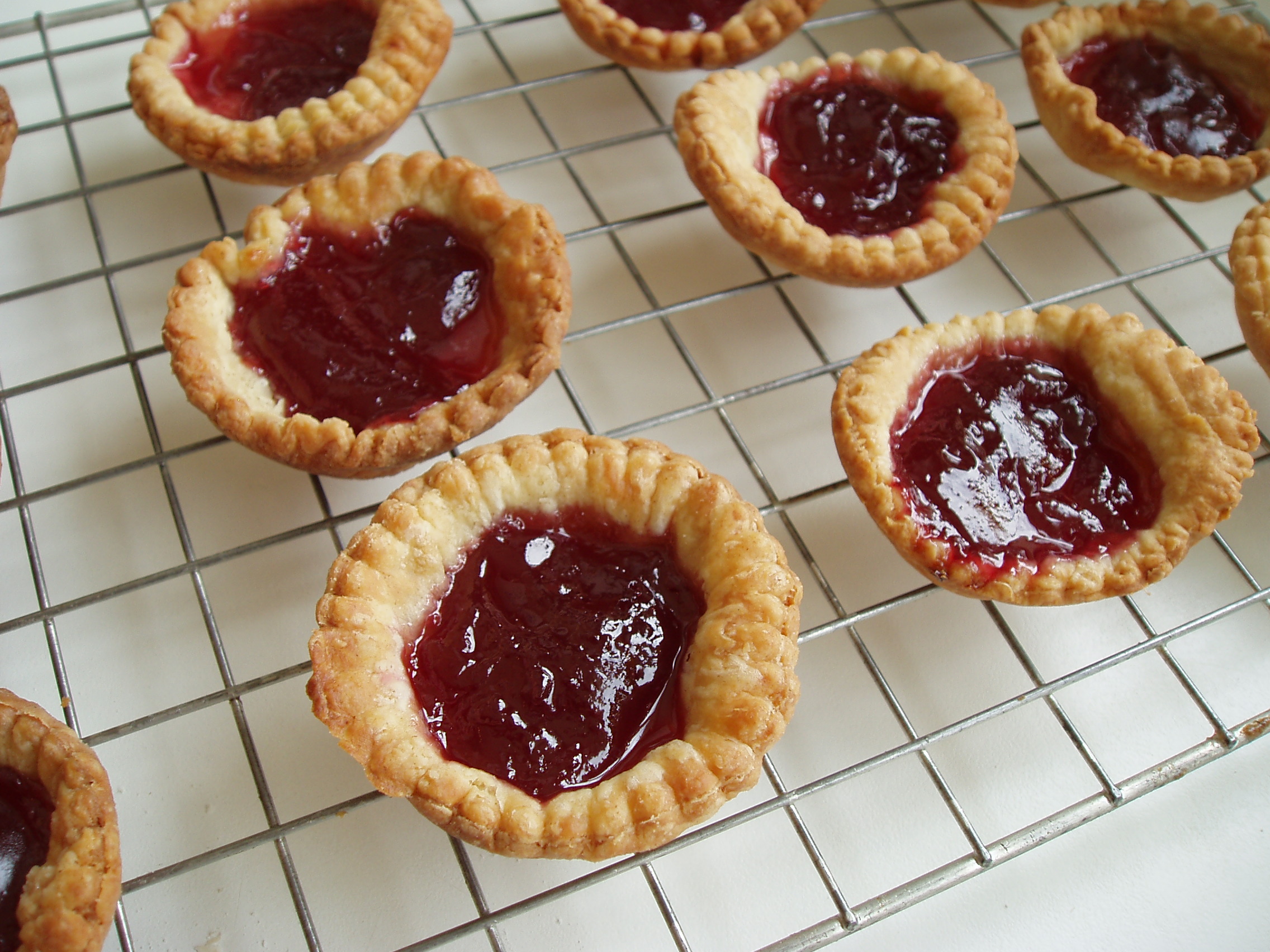
I’ve been even busier than usual recently as O has been away from home taking professional exams in the States. The children have been wonderful in his absence, but they don’t leave many opportunities in the day (or night!) for sitting in front of a computer. On the other hand, M (my 3 yr-old) has developed a passion for baking of all sorts. I have only to look at a wooden spoon or whisk and she’s dragging a chair across the kitchen so that she can climb up beside me and ‘help’. She knows exactly what goes into our bread (“flour, water, salt and east”, as she says!) and can even turn her very own pastry into “jam hearts”.

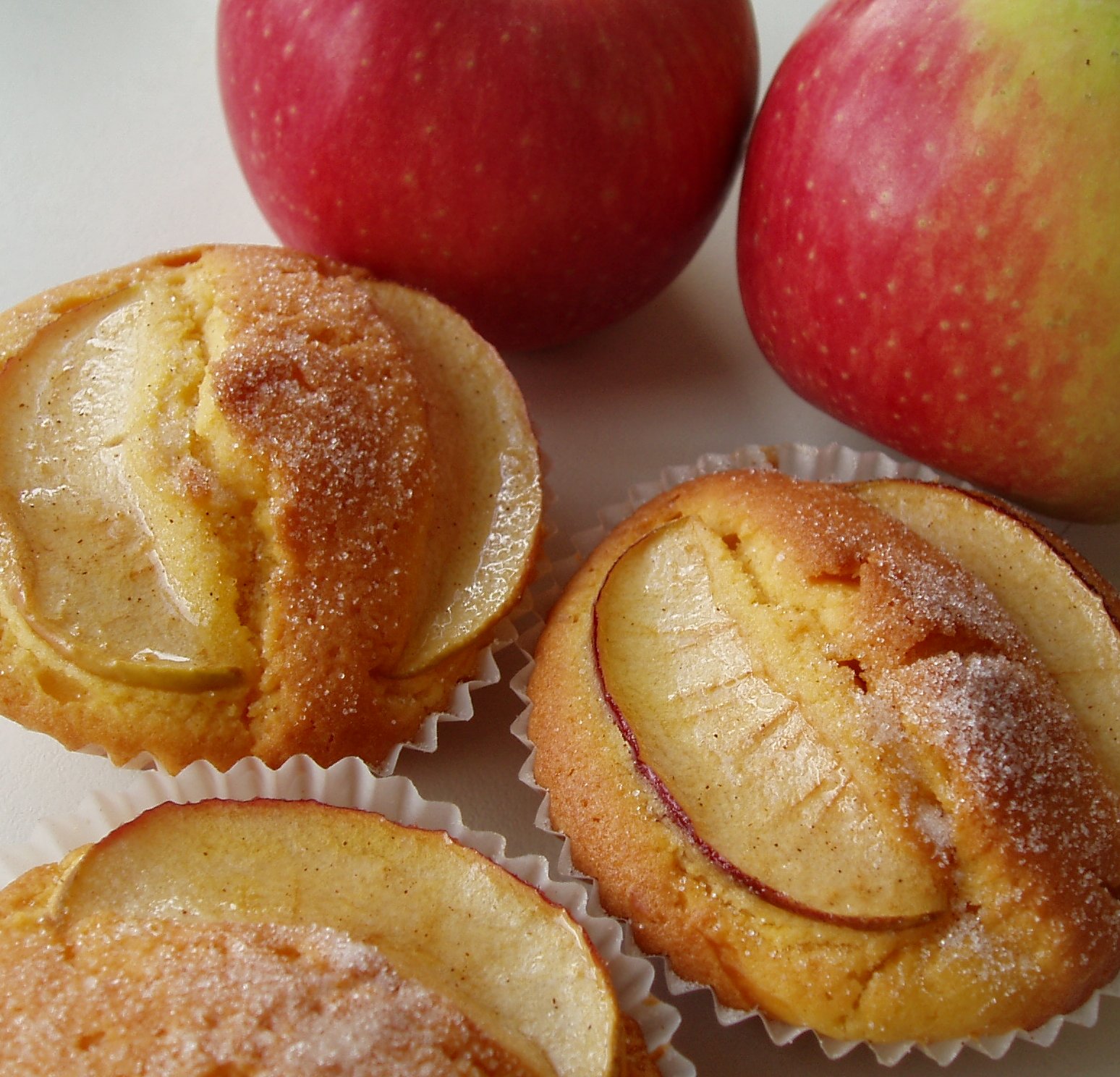
With the start of a new term and thoughts of Christmas in the not-too-distant future (believe me, they are already counting down the sleeps!), my 2 girls have also been very aware of the increasing signs of Autumn since O has been away, especially on our daily morning walks to school when their misty breath hangs in the air. Last year, I wrote about the apples that are in abundance at this time here in Devon and once again, it seemed fitting to turn to the fruit in our baking at home. And so today, M and I made Apple Custard Cupcakes from a recipe that (sshhh … I copied out of a book before sending it to my sister a couple of days ago as a birthday present) … hrmmmm *clears throat noisily.*

If I wasn’t staring at the dwindling possible hours of sleep left to me tonight, I’d post the recipe right now. If my children hadn’t woken me several times every night for this last month, then possibly I’d welcome the thought of staying up beyond their bedtime to write out the recipe. As it is, I’m wimping out and going to bed, leaving you (for now!) with only a photo of our latest baking adventure.

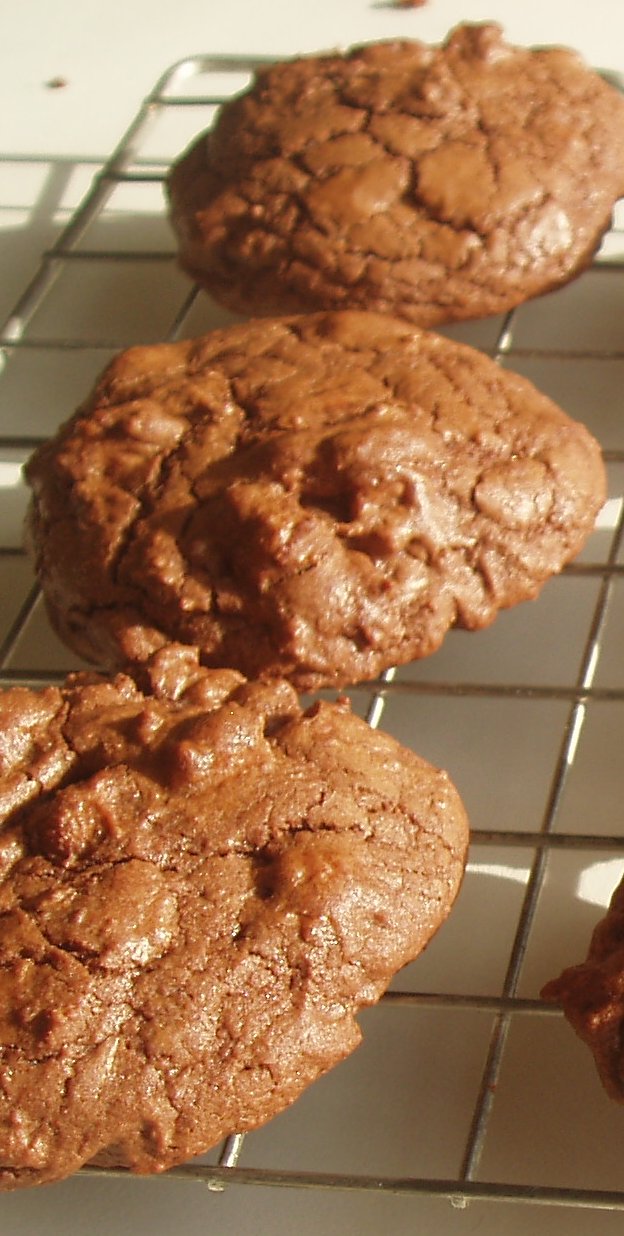
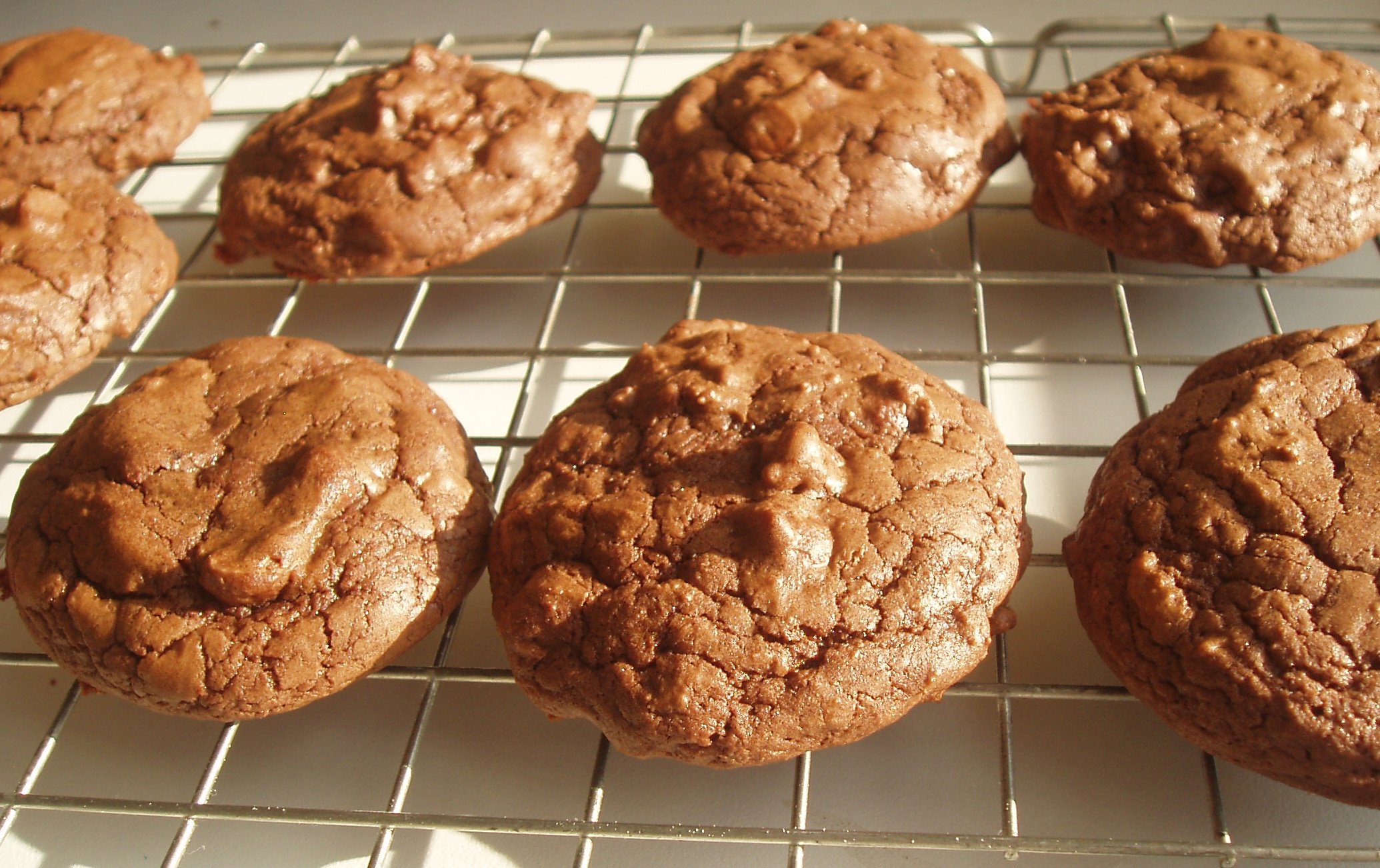
Double Chocolate Chip Cookies

It’s strange to start a post about double chocolate chip cookies by talking about apple pie, but it was the pie that started it all. O and the girls went blackberry-picking this weekend. It’s slightly too early in the season really, but October will be too late (which is when O will return from the States) and he wanted to make some blackberry jam again this year. The jam was not to be (too few blackberries), but they did return from their Expotition with enough fruit for an apple and blackberry pie.

Living in Devon, we have a ready supply of clotted cream and, since we were entertaining relatives, we decided to splash out on some to go with the pie. But I splashed out rather excessively. Once the pie had all been safely tucked away, we were still left with about half of the pot I’d bought of clotted cream.

Now, I’m not sure about the regularity of this, but the girls were clamouring for cookies and I had everything I needed … except butter. I know it’s not the same (weighing in at a fat content of only 55% as opposed to butter’s 81%, among other things), but I remembered using clotted cream in place of butter last year when I made Devon Flats. If it hadn’t been for the clotted cream sitting in fridge, I would probably never have tried this, our very own version of double chocolate chip cookies (based loosely on a recipe for Mocha Truffle cookies that I’d jotted down some time ago in my recipe folder).

All I can say is … yummy!

Oh, before I write out the recipe, I should mention that I made a few flour alterations (is that a surprise?!). I used strong, white bread flour to give a protein content of about 12%. I microwaved 10 oz of this flour until it reached 110 degrees C (cookies are forgiving, after all), then re-hydrated it by shutting it in the oven a few times with a bowl of boiling water. I sieved the flour to remove the lumps before weighing out the 8 oz I needed for the recipe. I can’t say definitively that any of that was absolutely necessary as I haven’t tried this recipe any other way. From past experience however, it gives a more rounded, crunchy-on-the-outside/chewy-in-the-middle result than you get in cookies made with untreated flour.

Double Chocolate Chip Cookies

4 oz clotted cream
3 1/2 oz Divine milk chocolate
1 teaspoon instant coffee granules
8 oz strong, white bread flour
1 1/2 oz cocoa powder
1/2 teaspoon baking powder
1/4 teaspoon salt
5 3/4 oz dark brown muscovado sugar
5 1/4 oz castor sugar
2 large eggs
2 teaspoons vanilla extract
7 oz chocolate chips

Melt the clotted cream, milk chocolate and coffee granules together in a small saucepan. Pour/scrape into a large mixing bowl and leave to cool.

Combine the flour, cocoa, baking powder and salt in a separate bowl. Whisk to mix thoroughly.

Add sugars and eggs to the chocolate/cream mix. Beat to combine.

Add the dry ingredients and stir until incorporated.

Fold in the chocolate chips. The cookie dough will be quite sloppy.

Refrigerate the dough for at least 30 minutes, then drop by the tablespoon onto an ungreased baking tray (I used a silicone liner).

Bake for 10 to 12 minutes at 180 degrees C in the centre of the oven.

One Year On

On Saturday, it will be A Merrier World’s first anniversary. In an ideal world therefore, I’d be making this post on August 9th. However, it’s the middle of the Summer holidays and I have 3 small children for whom I’m full-time entertainer, cook, cleaner, doctor, teacher and chauffeur, not to mention variously worst-enemy/best-friend depending on how their mood takes them. At the risk of completely missing a date on Saturday therefore, I’m getting my celebrations in a few days early!

This time last year, I was in the throes of my quest for the perfect brownie. I remember very clearly the trepidation bordering on writer’s block that accompanied my first post. But the deed was done and I launched myself into a journey of discovery. I didn’t realise then that this adventure would take me into the depths of starch molecules and back out through the worst practices of the broiler chicken industry. Rose Levy Beranbaum was a distant name a year ago … I had yet to come across the Cake Bible!

A year ago, we had builders working on our house. Oh … well, actually … nothing’s changed there, then! We still have builders working on our house! A few days ago, they fitted our wood-burning stove and built a warming brick fireplace. They could probably tell you as much as anyone about my baking experiments this past year – indeed (dare I say it?!), without their willingness to clear away my ‘scientific results’, my freezer may well have become so full of cake that I wouldn’t have been able to continue 😉 . If anyone’s to thank for kate flour, it’s probably Exeter Lofts!

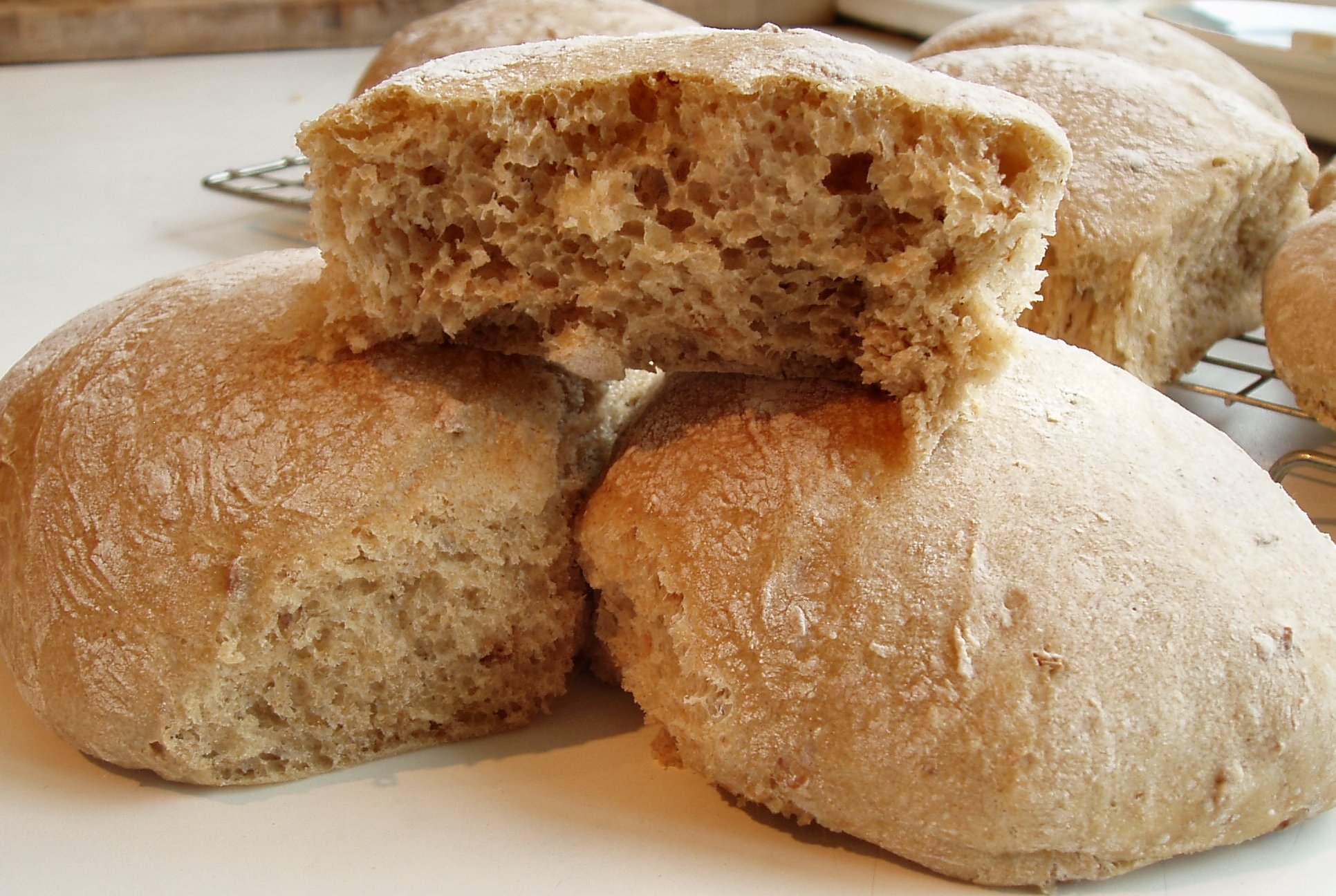
Perhaps I should have baked a cake for my blog’s 1st birthday. Well, I haven’t. Instead, I’ve decided to feed my family with a special granary and spelt bread.

Why do I think this bread is special? Well, it’s an entirely personal reason and I don’t expect anyone else to find it ‘special’. It’s simply because I was intrigued by the antiquity of spelt a few months ago and ever since then I have been attempting to produce a bread from it that I actually enjoyed eating. But I couldn’t. The thing is, I just don’t really like the taste of full-blown spelt.

I have made loaves from 100% spelt, 50-50 mixes of spelt and even a mix that sounded wonderful in principle (spelt, rye, oats and apple) but ended up being entirely inedible and ruined a perfectly good bread pan when I had to scrape down the sides to turn it out! I had almost given up, but my remaining bag of spelt flour was due to be thrown out this month and I couldn’t bear to waste it.

And so, this last week I had another go (well, three goes actually … look in my freezer!). I have found that I can get just the right amount of spelt-nuttiness from the flour by combining a small amount with a malted granary flour from Otterton Mill. Inspired also by my recent successes in substituting a bit of strong flour with Italian flour in my regular white bread recipe, I have also discovered that mixing these spelt and granary flours with plain bread flour and a soft wheat 00 grade flour produces a moist, flavoursome bread without the density I normally associate with wholemeal and granary breads. My children loved this bread most when I shaped and baked it into small dinner rolls (or ‘dough balls’, as they call them) – and if they give it a thumbs-up … well, that’s good enough for me!

Granary and Spelt Rolls

10 oz strong white bread flour (I used Allinson’s)
10 oz malted granary flour (I used flour from FWP Matthews, packed at Otterton Mill)
5 oz wholegrain spelt flour (I used Doves Farm)
5 oz soft 00 grade Italian flour (I used Molino Spadoni’s Gran Mugnaio, which I found in the speciality section of Sainsbury’s).
2 tsp fast action dried yeast
1 tbsp salt
1 pint water
1 tsp honey

Combine the strong white bread flour with the water and 1 tsp of the yeast in a large bowl and mix to a smooth batter.

Mix the remaining flours and yeast together separately, then sprinkle gently over the top of the batter-like mix to cover it completely. Wrap tightly in clingfilm and leave at room temperature for 1 hour.

Transfer the bowl carefully to the fridge and leave it for 10 to 24 hours. Take the kids to Crealy and pretend to enjoy queuing for hours to be soaked on the water slide.

Remove the bowl from the fridge and leave it for an hour or so to return to room temperature.

Sprinkle the salt over the mixture, add the honey and mix well to combine. Turn out onto a lightly floured surface. The dough will be quite sticky and moist but don’t add any extra flour just yet. Scrape it together and knead it with your fingertips (in a sort of scraping and folding sort of way), then cover with the bowl and leave for 20 minutes.

The dough should be tacky rather than sticky now, but don’t be tempted to add too much flour. Knead for 5 to 10 minutes, then place in a large, lightly-oiled bowl. Cover with clingfilm and leave until doubled (about an hour).

Turn the dough over then fold it back on itself a couple of times. Cover with clingfilm and leave until doubled for a second time (about an hour).

Preheat the oven to 220 degrees C (the oven should have about an hour to become hot enough before you put in the rolls to bake).

If you have a tried-and-tested way of shaping and baking rolls, just do that. I don’t have a huge amount of sophisticated bread-making gear or experience, so this is what I did …

I sprinkled the worktop with a handful of rice flour. I cut smallish amounts of dough (and even smaller ones for the children’s dough-balls) and rolled these in the flour. I lined a baking tray with a silicon liner. This held 8 large rolls, although they squashed into each other during final rising and baking. I made a sort of tunnel over the baking tray from aluminium foil (so the rolls were covered but had space to rise) and left them until they had doubled. When I prodded them slightly, the dent filled in slowly.

I baked them on the lowest shelf of my oven for 5 minutes at 220 degres C (I threw a cup of ice-cubes onto a pre-heated tray set on the floor of the oven at the start of baking), then lowered the temperature to 190 degrees C. I baked the rolls for a further 15 to 20 minutes until they were golden and sounded hollow when I tapped the bottom.

  • Enter your email address to subscribe to this blog and receive notifications of new posts by email.

    Join 289 other subscribers
  • Seasonal Recipes

    candied peel

    baileys chocolate truffles

    gingerbread men

    mince pies

    fudge

    smarties cookies

  • Freshly Made

  • Categories

  • Favourite Feasts

  • Awards

    DMBLGIT Award
  • Archives

  • wordpress visitor counter
  • Adventures in food by Kate Coldrick from Woodbury in Devon.