Boom Boom Ain’t It Great To Be Floury

If you’d asked me ten years ago whether I thought I could ever get excited over a bag of flour, I’d have died laughing. No way! I mean, come on – are you serious? A bag of what?  My thoughts on flour (not that I ever lost any sleep over them then) were more along the lines of, “Where the hell is it?” in a supermarket rather than of an ecstatic, jump-up-and-down-with-glee sort of variety.

But that was before I came across an old, slightly dog-eared copy of Rose Levy Beranbaum’s Cake Bible in a second-hand shop in Kirkcudbright.  That was back in 2007. I soon became embroiled in a search to find a replacement for the bleached cake flour that seemed to be so crucial to the success of her most-raved-about recipes. Not that I’m obsessive or anything. Just saying …

Cake layers baked with untreated (L) and heat-treated (R) flour.

I couldn’t simply ship in a whole load of cake flour from the US because the bleaching of flour had been prohibited in the UK since 1997. A bit of online research (okay, googling) revealed that the heat-treatment of flour provides a viable and successful alternative to bleached flour for use in high-ratio cake recipes. Eh Voilà! (I thought). Only, no. After tracking down a supply of heat-treated cake flour at Carr’s Flour Mills Ltd, I phoned them and was frustrated to be told that they only sold it in vat-sized amounts, and they wouldn’t sell any to me anyway because I’m not a business. To be honest, I think they were highly suspicious of my inquiry. They probably thought I was some sort of rival milling industry.

One thing led to another and my poor microwave came in for a bit of a battering as I nuked batch after batch of different flours in an attempt to recreate the heat-treatment process at home. When my hair-brained experiments actually began to generate visible improvements in the cakes I was baking, I started blogging about my results. I was surprised to find that I wasn’t the only one desperately seeking cake flour …

Why on earth were the UK flour mills so reluctant to sell their heat-treated cake flour to home bakers? John Lister from Shipton Mill popped over to A Merrier World to explain a bit of the background:

From the merry Miller in the wood…..Greetings…..stunned by the ingeniuity in the world, happily chortling here to learn of such madness and can hardly believe what happens in the kitchens of England……brilliant news on the cake flour, some years ago the global millers used to spend their time pumping chlorine gas through flour to denature and bleach it to make a perfect functional flour suited to cake making……in the last few years the process was outlawed for health reasons and heat treatment replaced it…..industrial sauce and cake manufacturers now use soft flours that are heat treated, such heat treatment processes are not readily available to smaller millers, still struggling with stone age technology, (Mill stones etc) so the idea of microwaving the flour is fascinating and a perfect solution by the sounds of it, am off to try this out, and will let you know the progress, John

Despite the obvious demand for heat-treated cake flour among home bakers, it seemed likely therefore that supplies would be restricted to commercial use for the foreseeable future.

So … does that explain why I’m so delighted to discover that at least two mills are now selling bags of heat-treated cake flour to individual consumers? (If you still don’t get my excitement, then you probably won’t have read this far anyway).

Dasha kindly left a comment on A Merrier World to let me know about the 16kg bags being sold by FWP Matthews Ltd.  She says, “You need to place the order over the phone as it is not listed in their online shop. The woman I spoke to was super helpful and said that they usually despatch same day with a next day courier.”

The second supplier came to my notice via a comment from AliceL on Rose’s blog. This heat-treated cake flour is being sold in 2kg bags as The Ultimate Cake Making Flour by Cinnamon Square. Furthermore, Alice reported the results of her comparison of the variously-treated cake flours:

Inspired by Rose and Kate, I baked and compared 3 versions of [Rose’s Favorite Yellow Layer] cake:
– one with USA Cake flour (imported via eBay at significant cost 🙂
– one with Kate Flour (made using UK Shipton Mills cake flour, no cornflour)
– one with UK “Cinnamon Square” heated Treated Cake flour (9.65% protein, no cornflour)

Results were all excellent. All three had good x2 rise and were tasty, moist and melting.
USA Cake Flour slightly higher in the centre (~2mm) and marginally finer texture.
Kate and Cinnamon Sq Heat Treated flour cakes were indistinguishable from each other. Just very slightly more fluffy/crumbly than USA cake flour – a tiny bit of Xantham gum would work there I suspect.

Can you hear my feet banging now as I jump up and down with glee?!

Sorry – must dash. Off to buy some flour …

Rocky Road Sticky Toffee Crispie Cakes

Don’t make these.

Just don’t.

Rocky Road …

Sticky toffee …

Crispie cakes …

You’re going to regret this.

Okay then, you can’t say I didn’t warn you …

Rocky Road Sticky Toffee Crispie Cakes

375g (x3 boxes) Cadbury’s Chocolate Fingers
225g pitted dates
300g Green and Black’s 72% cook’s chocolate
300g Green and Black’s white chocolate
200g butter
100g mini marshmallows
115g Rice Krispies

Line a 20x30cm cake pan with baking parchment, leaving flappy bits hanging over the sides to use as handles for pulling the cake out of the pan.

Chop fingers into small, bite-sized pieces (the Cadbury’s chocolate fingers that is – not your own).

Whizz the dates in a food processor until they turn into a smooth paste.

Melt the chocolates and butter in a bowl set over a pan of warm water.

Stir in the dates and mix until combined.

Add the chopped fingers, marshmallows and crispies. Stir to incorporate evenly.

Scrape into the prepared cake pan and spread with a spatula. Leave the cake to set in the fridge for an hour or so, or for as long as you can put off eating it (whichever comes sooner).

Unmould and cut into squares.

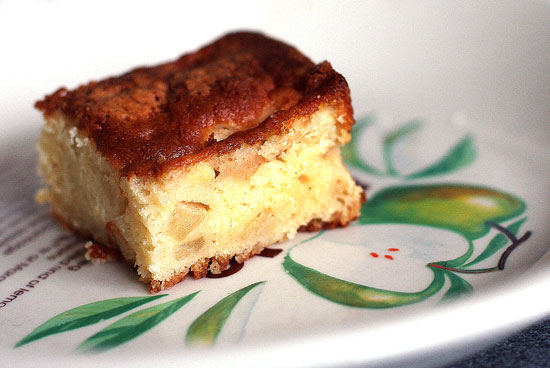
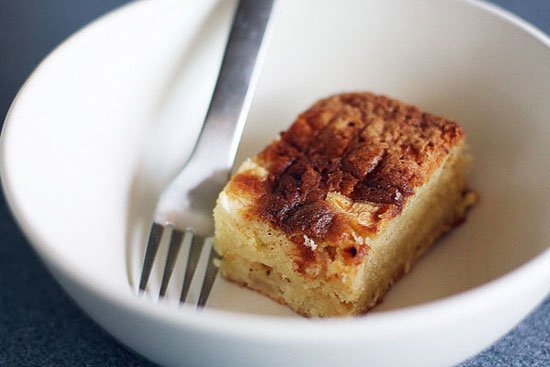
The Best-Ever Apple Cake Recipe

Perhaps I should qualify this before the lawyers come knocking on my door. I’m going to give you the best-ever apple cake recipe, the only recipe you’ll ever want to use from now on, the recipe that beats all other apple cake recipes hands down … according to my husband.

I’ve written before about my husband’s peculiar lack of a sweet tooth, so the fact that he endorses this recipe wholeheartedly should be merit in itself. It wasn’t a snap decision on his part, either – this recipe is the result of many failed and not-quite-right trials over the course of several years of trying to match my apple cakes to his specific expectations. It had to be moist and taste of apples rather than spices. Not too sweet. No faffy crumbly topping stuff. No sultanas or raisins. Noticeable apple chunks – none of that puréed muck. And it didn’t stop there. Nothing baked in a round cake pan – he wanted his slices to be square.

Not demanding in the slightest then, huh?

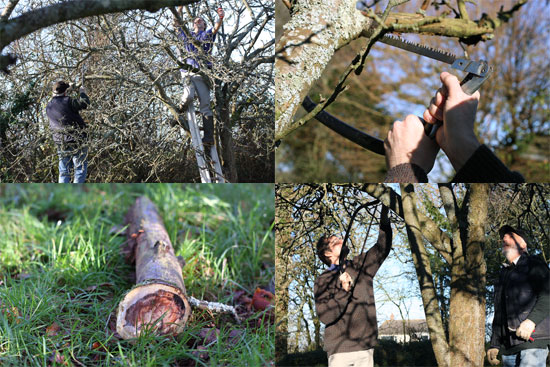
Anyway, I’d given up. And then we moved to a house with an orchard at the bottom of its garden.

As autumn turned into winter, I sent my three children out to collect the windfalls in T’s little red wagon. Seven truckloads later, I faced a showdown situation. If I couldn’t create that perfect apple cake recipe with such an abundance of readily-available fruit, then I would have failed forever as a loving, doting wife and homemaker. Well, whatever – you get the picture.

The pressure wasn’t entirely self-induced. O did point out that his birthday was coming up and please, could I bake an apple cake for him to take into work …?

So I stayed up late, burnt the midnight oil, sweated and slaved, worked day and night …

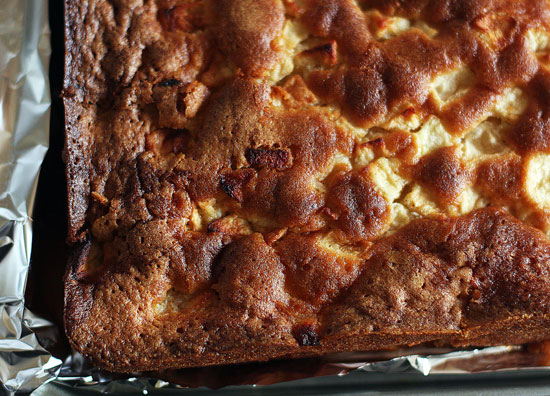
Actually, I hit on the bright idea of mixing a few appple chunks into my favourite yellow cake recipe, tossing it all into a rectangular cake pan and slamming it into the oven for 40 minutes or so to see what happened.

What happened was the best apple cake ever … according to my husband.

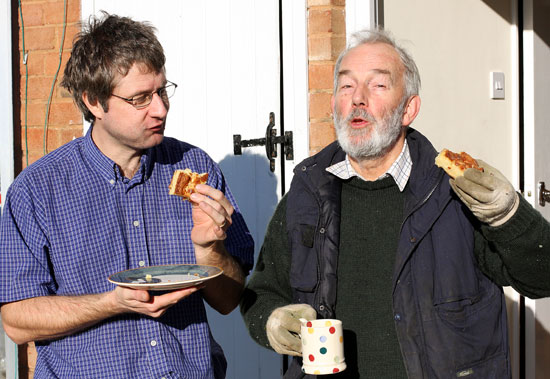
PS – Chris from Green Valley Cyder said that he’d eaten many apple cakes but that this was “one of the best.” So you don’t have to take just my husband’s word for it.

The Best-Ever Apple Cake (by me and according to my husband)

13 1/4 oz peeled, cored and diced Bramley apples
2 tbsp lemon juice
1/4 to 1/2 tsp ground cinnamon
1/4 to 1/2 tsp mace (or grated nutmeg)
7 oz unsalted butter, room temperature
13 1/4 oz castor sugar
5 1/4 oz eggs (weighed without shells), room temperature
2 3/4 oz egg yolks (weighed without shells), room temperature
1 tbsp vanilla extract
8 oz plain flour
2 1/2 tsp baking powder
1 tsp sea salt
160 ml whole milk, room temperature

Preheat the oven to 175 degrees C (165 degrees C for a fan-assisted oven).

Grease and base-line a 9″ x 13″ rectangular cake pan.

Peel, core and dice the apples (c. 4 largeish Bramleys). Toss in the lemon juice, cinnamon and mace (add as much or as little of these spices to suit your own taste). Set aside.

Cream the butter and sugar in a large mixing bowl until they are very light and fluffy (start to beat slowly and then gradually increase the speed – this allows air bubbles to be incorporated and expanded without popping).

Combine the whole eggs, egg yolks and vanilla in another bowl. Mix with a fork, then add gradually to the creamed butter and sugar, beating well to combine after each addition.

Whisk the dry ingredients together in yet another bowl. Beat 1/3 of the dry ingredients into the batter, then 1/2 of the milk. Repeat and then add the final 1/3 of the dry ingredients (ie. dry/wet/dry/wet/dry).

Combine half of the apples with the batter, mixing gently to distribute evenly. Scrape the batter into the prepared cake pan and smooth the top with a spatula. Scatter the remaining apple pieces over the top of the batter.

Bake for 40 to 50 minutes until the cake is golden and springy, and a tester comes out clean (unless you’ve speared an apple, that is).

Cool in the pan for 10 minutes, then turn the cake out of the pan and cool on a wire rack. Trim the sides and cut into squares.

Which Cake is Which?

Back in June, a reader (yes, I do have one!) emailed me to ask whether I thought it would be okay to treat large batches of flour at a time since her microwave would be big enough to accommodate this. I replied that I thought it would be fine as long as the depth of the bed of flour remained the same as for a smaller batch. She tried it and it worked – which means less time overall doing all that standing and stirring.

But it’s easy to forget how exciting that first “It worked!” actually is. Catherine has kindly allowed me to post her photo of the results of her own treated vs. untreated flour experiment, along with extracts from her email to me. I can identify so well with her astonishment on taking the cakes out of the oven. It really doesn’t seem possible that something so simple as heating up the flour beforehand could make such an outstanding difference.

Hi Kate,

Thanks for your prompt reply!  Yesterday evening after emailing you … I baked 2 test cakes, identical in all things other than the heat-treatment of the flour, and was quite astounded at the difference in results. In both cases the flour was comprised of 1/8 by weight cornflour to give cake flour following your recommendations.

I’m attaching a photo to confirm what you already know!  No prizes for guessing which cake is which.  I was sure you were right but there’s nothing quite like seeing the evidence in the flesh…

Best wishes,
Catherine

I’m happy to say that I’m very much looking forward to finally meeting Catherine when she comes to have lunch with Rose, Woody and me next week 🙂


The One with the Jelly Belly Cupcakes

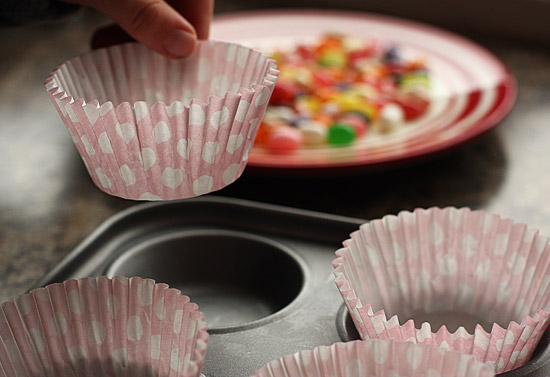
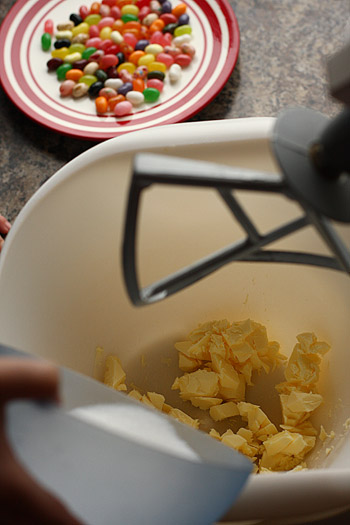
Jellies on the plate …

Mum, I said, there are jellies on the plate!

One, two, three, four, five …

They’re still there, Mum. Look, just over there …

Perhaps she can’t see them. I’m getting worried about this …

Mum … about those jellies …

… the jellies on the plate …

Yes! These jellies! Can I eat one? Please, pleeeeease

Phew, I was seriously worried for a moment there.

Nibble, gobble, nibble, gobble …

… jellies on the plate!

Jelly Belly Cupcakes (adapted from Mary Berry’s Ultimate Cake Book)

4 oz soft butter or margarine
4 oz caster sugar
2 eggs
3 oz self-raising flour
1 oz cocoa powder
1 tsp baking powder
1 tsp chocolate essence

Preheat the oven to 200 degrees C/400 degrees F. Line about 18 holes in bun trays with paper liners.

Place all the ingredients together in a large bowl and beat well for 2 to 3 minutes until well combined and smooth.

Half fill each paper liner with the batter.

Bake in the preheated oven for 15 to 20 minutes until the cakes are well risen and springy to touch.

Transfer each cake to a wire rack to cool.

Jelly Belly Buttercream

6 oz butter
12 oz icing sugar
a few drops of red food colouring

Beat all ingredients together until smooth.

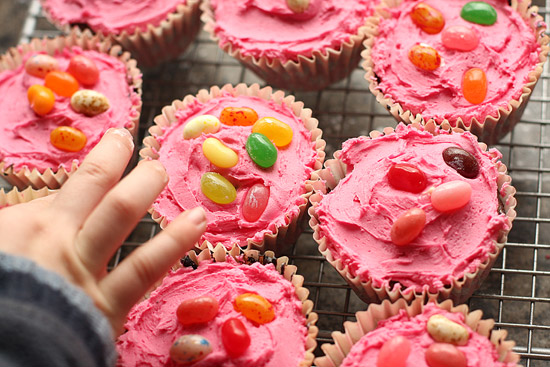
Spread each cupcake with Jelly Belly Buttercream and decorate with jelly beans. 3 year-olds do this better than adults 😉 .

  • Enter your email address to subscribe to this blog and receive notifications of new posts by email.

    Join 289 other subscribers
  • Seasonal Recipes

    candied peel

    baileys chocolate truffles

    gingerbread men

    mince pies

    fudge

    smarties cookies

  • Freshly Made

  • Categories

  • Favourite Feasts

  • Awards

    DMBLGIT Award
  • Archives

  • wordpress visitor counter
  • Adventures in food by Kate Coldrick from Woodbury in Devon.