Devonshire Apple Cake

Four years ago this month, we moved a little bit further West along the South coast of England to a village in Devon so that my husband could take up a residency in clinical veterinary pathology at Exeter. When we moved, we had one daughter and a cat. Our ‘new’ house in Devon was dilapidated and old-fashioned with aluminium window frames, Imperial plumbing and rubber-coated electrical wiring.

Four years on and our lives have changed immeasurably. Two daughters and a son have taken control of every room in our house with their arsenal of toys. The rooms they run through are newly built and refurbished after a rennovation project that has taken the best part of the last two years to complete. I have several more grey hairs (hmm … I wonder why) and far fewer good nights of sleep 😉 .

Every year on the anniversary of our move, my husband has taken a variety of baked goodies into work to share with his colleagues. This year, he requested an appple cake.

Living in Devon, I thought it might be symbolic to try a recipe for Devonshire Apple Cake that I found in a cookbook by Margaret Wilson. As if to prove Melinda’s theory of the British and their propensity for dried fruits, the recipe does indeed include a substantial amount of raisins and currants in addition to the namesake apples. Inspired by Melinda’s observations, I not only soaked these in water before using them in the recipe, but also added a tot of whisky left over from our Burn’s Night celebrations (it worked well and the dried fruits were deliciously plump and moist, but perhaps apple brandy would have been more in keeping …?!).
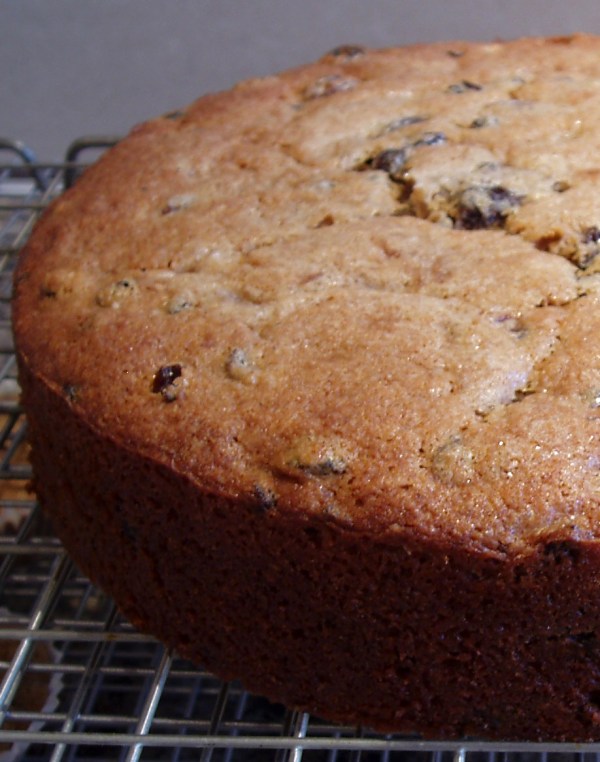
apple cake

A word of warning: the recipe stipulates using an “8-inch shallow cake tin”, which in my mind translates to something like my 8″ x 1 1/2″ pan. The little line drawing underneath the recipe in my book shows a circular cake, so I assume that the pan is intended to be round. When I came to fill my 8-inch shallow cake tin with the batter, it was obvious that my idea of ‘shallow’ is somewhat less generous than that of Margaret Wilson as my poor little pan was soon drowning under an engulfing splurge of cake mixture. I hastily dug out some cupcake cases from my newly-organised baking shelf and scooped out a good 7 cupcakes-worth of batter from the pan. Fortunately for me, this near-disaster at least provided me with some miniature samples of my own to taste – my husband and his colleagues devoured the cake-proper today, leaving not a single crumb.
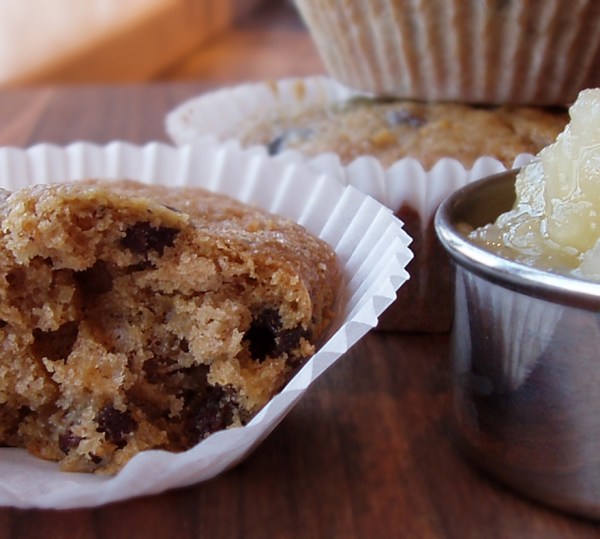
apple cupcakes

Devonshire Apple Cake (adapted from a recipe by Margaret Wilson)

225 g (8 oz) plain flour
1 tsp bicarbonate of soda
1/2 tsp cinnamon
1/2 tsp ground ginger
1/2 tsp mixed spice
275 g (10 oz) mixed sultanas, raisins and currants
2 eggs
450 g (1 lb) cooking apples, peeled and chopped
150 g (5 oz) unsalted butter
175 g (6 oz) light muscovado sugar
pinch of salt
caster sugar for sprinkling
grated rind of 1 lemon
2 tbsp Devon cider

Grease and line an 8-inch shallow cake tin with parchment paper. preheat the oven to 325 degrees F/170 degrees C.

Soak the dried fruit in hot water (plus a tbsp of whisky or apple brandy) for 10 minutes.

Meanwhile, cook the apples in the cider until they are soft and mushy. Mash any remaining lumps with a fork. Leave to cool.

Cream the butter, sugar and lemon rind in a large bowl. Gradually beat in the eggs.

Sieve together the flour, spices, bicarbonate of soda and salt. Fold in alternately with 225 ml (8 fl oz) of the apple sauce (feed the remainder to your youngest child 😉 ).

Strain the dried fruit and stir into the mixture until evenly incorporated.

Place the mixture in the prepared cake tin (until no more than 3/4 full – use any remaining mixture to make cupcakes 😉 ). Sprinkle the top with castor sugar.

Bake in the centre of the oven for 1 to 1 1/2 hours (note: my own ‘shallow’ cake was done in 40 to 50 minutes; the cupcakes took 12 minutes). Cool in the pan for 10 minutes before transferring to a wire rack.


Red Sky, Shepherd’s Pie

The theme for this month’s Click food photography event is Red.

And here is my entry:

red

Now, I do know that I’ve a dreadfully long way to go in developing any sort of expertise with a camera. For the moment, at least, I can pretend to blame it on my hardware, an old Olympus point-and-shoot. Push me only a little bit further and I’ll admit that most errors of lighting, composition, focus (see, I’m learning the lingo, if not the techniques!) are actually the fault of the operator … oh, and of the weather 😉 .

I’ll also be the first to confess that, although I am quite capable of doggedly pursuing an obsession, I have a definite tendency to otherwise waffle about and procrastinate when I have no clear goal in mind. My decision to enter this food photography event is therefore largely born out of my desire to find the proverbial carrot (or stick!) that will encourage me to keep improving my snaps.

My decision was also driven however by a longtime fascination with colours. Even as a small child, I adored sorting my crayons into rows ordered by the colour wheel. I could stand for hours, staring deeply into arrangements of coloured towels and embroidery threads in department stores. I still have memories so strong I can almost taste them of the pictures in my first colour board book.

At this point, I should probably be terribly erudite on the subject of wine or provide you with intelligent quotes about the colour, red. Unfortunately, the only sayings that come to mind are one I remember my headmaster teaching us in assembly:

“Red sky at night, shepherd’s delight”

… and my husband’s usual rejoinder whenever I attempt to apply this particular piece of folk wisdom:

“Red sky, shepherd’s pie.”

Which leads me nicely to tonight’s dinner … 😉

shepherd's pie

Shepherd’s Pie

3 tbsp olive oil
1 onion, chopped
2 sticks celery, chopped
2 carrots, chopped
1 lb lamb mince (for Shepherd’s Pie) or beef mince (for Cottage Pie)
1 tbsp Worcestershire sauce
150 ml milk
250 ml beef stock
2 tsp dried parsley
1/2 tsp dried sage
1/2 tsp grated nutmeg
ground black pepper, to taste

6 medium-sized potatoes, peeled
knob of butter
dollop of milk
1/2 tsp grated nutmeg
ground black pepper, to taste

Heat the olive oil in a large saucepan. Add the chopped onion, celery and carrot. Fry gently until soft.

Add the mince – break up any lumps with the back of a wooden spoon and fry until browned.

Stir in the Worcestershire sauce and add the milk. Boil until this has reduced to a couple of tablespoons.

Add the stock, herbs and nutmeg. Season to taste. Bring to the boil then simmer for 30 minutes (add a little water if necessary to prevent from sticking).

Meanwhile, boil the potatoes until tender when pierced. Add the butter, milk, nutmeg and pepper. Mash.

Pour the mince mixture into the bottom of an oven-proof bowl. Spoon the mashed potatoes on top. Use a fork to fluff up the top (the spiky ridges will brown in the oven).

Place in the oven (200 degrees C) until bubbling and browned (I put a large baking tray on the lowest shelf to catch anything that bubbles too much).

Oatcakes and Haggis Hunter

Has a whole year really passed since our last Burn’s Night supper?

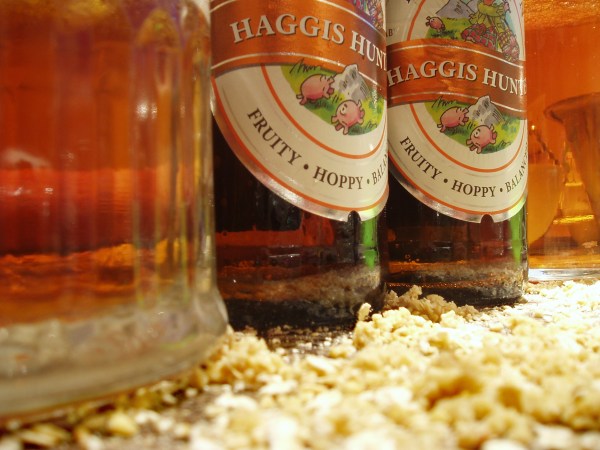
Last year, O brought home a couple of bottles of Haggis Hunter, a real ale from the Harviestoun Brewery. We already knew (and loved) the regular Harviestoun beers from our student days in Scotland, but Haggis Hunter was new to us. It turned out to have a delicious balance of hoppy, tangy and malty tastes, everything that I enjoy most in a beer. We quickly bought up the last remaining bottles in the supermarket and even emailed the brewery to find out if the ale was available for mail order. To our dismay, we discovered that we would have to wait a whole year until the next batch would be produced especially for Burn’s Night.

Forewarned is for forearmed and we were ready for the Haggis Hunter this time around. I’m honestly not receiving any commission for this, but if you can still find any bottles this year, I really do recommend that you buy them up quickly (and send them to me 😉 ).

haggis hunter

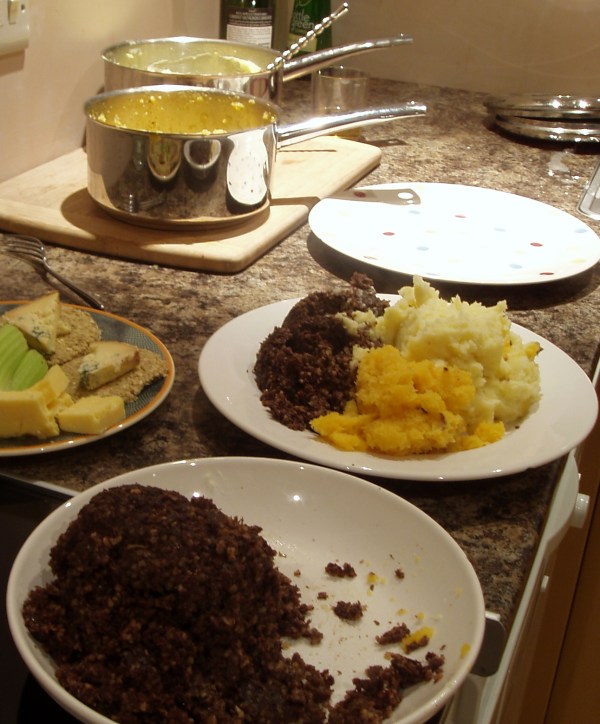
Our kitchen improvements have been galloping apace since my last post and we were able to celebrate Burn’s Night yesterday with a traditional supper of haggis, neeps and tatties.

haggis neeps and tatties

Whilst M and T’s slightly less-traditional fish fingers were cooking in the side oven, I baked oatcakes in the main oven of my new Rangemaster cooker.

rangemaster

I found the recipe for the oatcakes in a book of Traditional Scottish Cooking by Eleanor Cowan. The cover claims that her recipes “employ traditional Scottish methods of cooking and preserving food, adapted for the modern kitchen”. Being used to Rose’s precise, trustworthy details, I was a bit off-put by the direction to add a “generous pinch baking soda” to the oatcake mixture … but I took a deep breath and, in the name of my Scottish ancestors, pinched away generously.

Robbie Burns must have been smiling on me last night as my oatcakes turned out beautifully. I’m not convinced I’ll be so lucky next time – I think my success in achieving just the right consistency was more through luck than good judgement!

oatcake and cheese

Scottish Oatcakes (adapted from a recipe by Eleanor Cowan)

100 g/4 oz medium oatflakes
100g/4 oz pinhead oats
100 g/4 oz regular oatflakes
25 g/1 oz butter, melted
Generous pinch baking soda
1/2 tsp salt (I used 1 tsp)
4 to 7 tsps hot water

Preheat the oven to 150 degrees C.

Combine the oats and stir well until evenly distributed. Weigh out 250 g/10 oz of this mix and reserve the remainder.

Stir the baking soda and salt into the oats, then add then melted butter. Stir until blended.

Add just enough hot water to form a smooth but stiff paste. Form the dough into a ball.

Sprinkle the counter with half of the reserved oats. Place the ball of dough on top and press down with your hands. Sprinkle the rest of the oats on top.

Roll the dough out to about 1/8 inch thickness (the edges will crack – just push the bits together again continue rolling). Use a medium-sized round biscuit cutter to cut out circles. Lift them carefully and place them on a greased baking tray.

Bake in the centre of the oven for about 30 minutes (large oatcakes will take longer, but don’t let them become too brown).

Cool on a wire rack before serving with Scottish cheddar, ale and whisky.

A Chilli for Cooker Day

There’s a box sitting on my driveway. It’s a big, heavy box and it arrived this morning. I know what’s inside, but I’m still having a difficult time restraining myself from tearing off the wrapping. There are only a couple of hours to go now before our builders will be lifting it into the kitchen …

new cooker

It’s 3 pm on January 20th, which means it’s Cooker Day! Although there will be a couple of days or so before the electricians return to work their magic, I’m excited about seeing my new Rangemaster Induction cooker for the first time. I’m hoping that we will soon become very good friends.

I don’t want to give the impression that I’ve fallen out with my old cooker, however. It has served me faithfully throughout my tentative steps into the culinary world. It was there at the beginning, nearly four years ago, when I was first faced with the daunting prospect of taking over cooking the evening meal from my husband. It has reliably tilted its oven shelves so that my cakes sport a characteristic slope, and I’ve come to recognise its quirky hot spots. Yes, I am truly grateful to my old cooker for all that it’s taught me. It’s just that … well … it’s time to say goodbye now.

Last night, in thanks for our old cooker, I made again one of the first ever meals I prepared for my husband. Although he may not remember this, it was around the time of a Valentine’s Day many years ago. I was a complete, total novice at cooking and I chose what appeared to be a tasty recipe from our Good Housekeeping recipe book. It was originally a veggie recipe, but I converted it into a husband-friendly, carnivorous one by simply substituting minced beef for the diced aubergines, courgettes and peppers.

Here it is, cooking for the last time on our trusty, Glen Belling cooker.

old cooker

The recipe was a hit and I’ve made it many times since. It’s lovely in both its meat and vegetable incarnations (as my veggie Mum will attest).

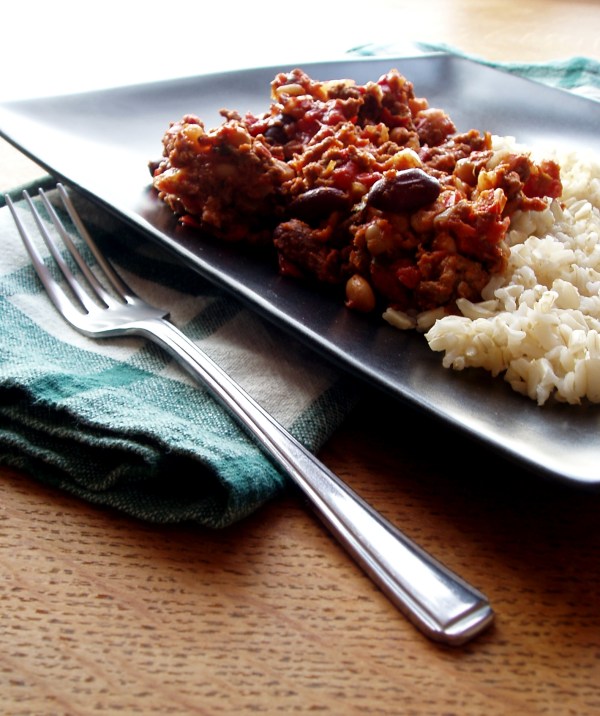
Before I stumbled upon this recipe, I have to confess that I had never really enjoyed chilli con carne. I don’t especially relish the prospect of crying over my food, and every previous chilli I’d tasted had left me snivelling into my handkerchief. The mix of cinnamon, coriander and lemon juice in this recipe gives the chilli a depth of aromatic flavours that goes well beyond the usual ‘can-you-stand-the-heat’ attitude with which I’d formerly associated the dish.

And so, as our builders struggle to carry my solid Toledo 900 up the kitchen steps and through the doorway, please raise a glass with me today as we welcome the new chapters in our lives and bid farewell to the old.

chilli con carne

Chilli con carne (adapted from Good Housekeeping)

235g can red kidney beans
235g can black-eye beans (or you can use dried beans, but you’ll need to soak them etc)
salt and pepper
4 tbsp olive oil
1 red onion, chopped
1 tsp dried crushed chillies
3 garlic cloves, crushed
1 tbsp mild paprika
1 tbsp tomato paste
2 tsp cumin seeds
2 bay leaves
1 cinnamon stick
1 lb steak mince/ground beef
15oz can chopped tomatoes
1 tbsp lemon juice
handful of fresh coriander, chopped

Heat half the oil in a large saucepan. Add the onion, chillies and half of the garlic. Cook and stir for 10mins until the onion is softened.

Add the paprika, tomato paste, cumin seeds, bay leaves and cinnamon stick. Keep stirring.

Stir in the mince and beans. Cook for 5 mins, then add the tomatoes and about 1/4 pint of water. Bring to the boil then cover and simmer for about an hour.

Meanwhile, whisk together the rest of the olive oil, lemon juice, remaining garlic and coriander. Set aside to infuse.

Before serving, stir the coriander mixture into the cooked chilli and check the seasoning.

Mum’s Orange Trifle

I didn’t expect to be posting anything this month. Quite aside from the usual demands on my time made by my three children, husband and cat (okay, leave the cat out of the equation – being rather proud of his nature, he’s a fairly self-sufficient and independent feline friend), my kitchen currently looks like this …

kitchen view

It certainly doesn’t inspire images of heavenly home-baking and cosy family gatherings around the warmth of the stove.

However, when I read that the theme for this month’s Sugar High Friday was Childhood Delights, I instantly thought of my Mum’s orange trifle. And I knew that here was something I could prepare with the barest of kitchen equipment still available to me (namely, a plastic jug and a microwave). Most importantly, I could not only share the wonders of my Mum’s trifle, but I could also reveal the magical secrets of … The Custard Spoon!

I never liked fruit with “bits” in it as a child. This dislike referred specifically to the seeds in berries, the pips in grapes and the stones in prunes and cherries. I still prefer jelly over jam, and have a reputation in family circles for picking the rind out of the marmalade I spread on my breakfast toast. Manufacturers hadn’t cottoned on to the idea of ‘smooth’ yoghurts for children back then, so my Mum used to patiently sieve the berries out of any yoghurts before giving them to me to eat. Of course, my aversion to ‘bits’ meant that I missed out on many of the desserts typically presented during my childhood days … berry-topped cheesecakes, summer puddings, Black Forest gateaux and trifles.

I had another strong dislike. I couldn’t stand, absolutely hated, cream. Yuk!

When I tell you that my Mum’s trifle was one of my favourite childhood desserts, it’s probably obvious that she made something slightly outside the normal cookbook understanding of ‘trifle’ for me. She used tinned mandarins in place of the more traditional raspberries and cherries, and covered the custard layer with a sprinkling of chocolate flake rather than with lashings of cream.

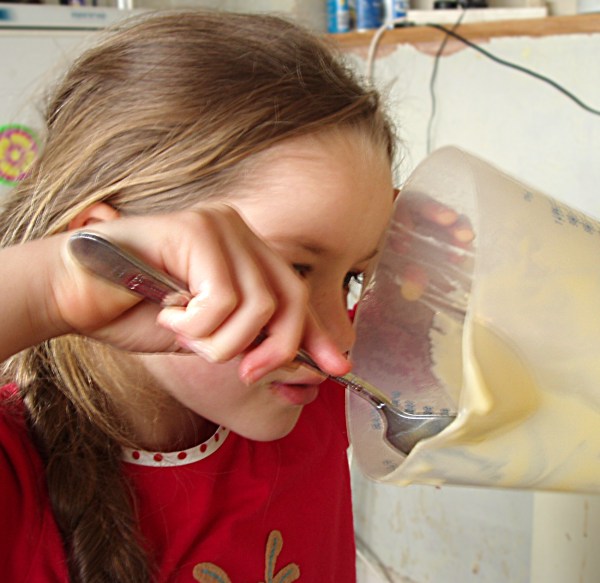
And when she made a trifle, I always got to lick The Custard Spoon. Mmmm. My girls (and probably T too, when he gets a chance), are following me in this tradition. For the best nostalgic effects, it really has to be an old-fashioned Rattail tablespoon in stainless steel from Sheffield … but as I don’t have one quite like Mum’s, we’ve found that any old spoon can be turned into a perfectly acceptable Custard Spoon.

custard spoon

Mum still makes her trifle for me, even now I’m all “growed up”. L says it’s a “Very, very good trifle and it’s really scrummy”.

When I made my own orange trifle this weekend, L and I fought over the jelly-soaked Swiss roll layer on the bottom … and I’m sure there wasn’t quite as much Flake on the top when I came to serve it as there was when I crumbled it onto the custard. Hmmm …

Mum's orange trifle

Mum’s Orange Trifle

1 Raspberry Swiss Roll
1 tin of mandarins, drained
1 Hartley’s orange jelly tablet
1/2 to 1 pint of Bird’s Custard
1 Cadbury’s Flake

(The exact amount of ingredients required varies according to the size of your dish – Mum probably uses a couple of tins of mandarins as her trifles are fairly sumptuous!)

Cut the Swiss roll into 1/2″ slices and use to line the bottom of a glass bowl or dish.

Cover with a layer of mandarins.

Make up the orange jelly according to the instructions on the packet (the microwave method is the easiest). Pour over the cake and fruit levels of the trifle until the jelly covers the mandarins (any remaining jelly can be poured into small bowls or jelly moulds). Place in the fridge and leave until the jelly is set.

Make up the custard according to the instructions on the packet. The custard needs to be thick enough to set when cold, so make sure that it boils. Leave it to cool slightly, then pour over the jelly layer. Enjoy any leftover custard with The Custard Spoon. Return the trifle to the fridge until the custard is set.

Before serving, crumble the Flake over the top of the custard.

  • Enter your email address to subscribe to this blog and receive notifications of new posts by email.

    Join 289 other subscribers
  • Seasonal Recipes

    candied peel

    baileys chocolate truffles

    gingerbread men

    mince pies

    fudge

    smarties cookies

  • Freshly Made

  • Categories

  • Favourite Feasts

  • Awards

    DMBLGIT Award
  • Archives

  • wordpress visitor counter
  • Adventures in food by Kate Coldrick from Woodbury in Devon.