Apple Day at Rosemoor

And the wind sprang up and the sky grew dark … and it rained …

clothesline-web

and rained …

leaf-web

and rained …

leaf-on-wood-web

and rained …

sprouts-web

and rained.

apple-web

But small children never seem to mind the rain. They eagerly pull on their welly boots and rush outside to splash and jump in muddy puddles. Soaked through and dripping, they are unconcerned by such grown-up worries as colds and coughs and sneezes, and are unburdened by the practicalities of ensuring they have a dry change of clothing packed safely away in rucksacks on every outing.

Which is perhaps just as well, since our visit to the annual Apple Day hosted by the Royal Horticultural Society gardens at Rosemoor last weekend was certainly a wet one.

I had only been to Rosemoor once before, nearly five years ago when we first moved to Devon. Back then, we were a family of three, although we were only a few months away from becoming a family of four. In my heavily pregnant state, I waddled around the gardens one afternoon with L while O was busy in his new job. There was little to see – it was March and the beauty of the gardens was still deep in its winter sleep. Only the name tags marking places in the soil gave a hint of what the gardens would become in the Spring.

On that visit, I was particularly intrigued by the fruit and vegetable gardens. Although they were seemingly populated by nothing more than empty, dead twigs, my imagination was kindled by the sheer variety of fruits that were planted there. With each step I took, I discovered apples and pears with magical, evocative names that never appear on the supermarket shelves. Barnack Beauty, Shenandoah, Lady Sudeley, Yellow Ingestrie.

Last weekend, I finally had an opportunity not only to see these fruits growing at Rosemoor, but also to taste them. Despite the steady rain that poured persistently throughout the day, we joined the damp, waterproofed crowds at the garden’s annual Apple Day. Inside a large, dry marquee, tables were stacked high with a myriad of different varieties of apple. Slices for tasting were laid out on paper plates alongside tasting notes and harvesting information. Some apples were soft and sweet while others were crisp and tart. Each variety left a different aftertaste, from nutty to aniseed.

apple-tasting-web

There were dessert apples, cooking apples, juicing apples and apples for making cider. Stalls around the sides of the marquee provided a platform for producers and artists from Devon to show their apple-related products. At one stall, rivers of the purest apple juice gushed from a noisy mulching machine.

“Four parts Cox to one part Bramley,” the producer proudly told us. Whatever the secret, this was the most glorious apple juice I have ever tasted. Its sweetly crisp aromas filled my senses with apple even as the juice was being sloshed from the jug into my glass. It was as if I’d buried my nose deep into the apple blossom and drunk from the very essence of the fragrant fruit.

apple-juice-web

And then out into the rain to the orchards where the bare patches of soil of my last visit were now bursting abundantly with redolent apples of all varieties.
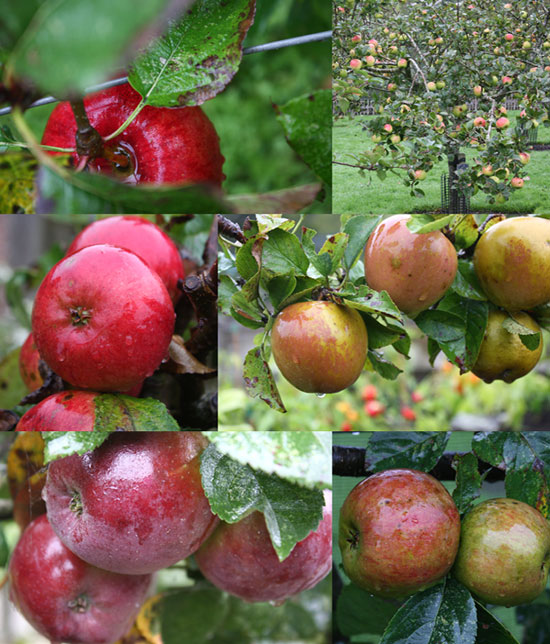
apple-collage-web

That evening as the geese flew overhead on their journey out to sea, I made a spiced autumnal apple cake in celebration of this rainy Apple Day.

applecakeslice

Apple Day Cake

3 ounces seedless sultanas
100 milliliters dark rum
2 ounces unsalted butter
5 ounces castor sugar
2 ounces light muscovado sugar
7 ounces peeled, cored and diced apple (1 medium Bramley apple)
1 tablespoon grated orange zest
1 teaspoon vanilla extract
6 ounces eggs, weighed without shells (3 medium eggs)
5 ounces plain (all purpose) flour
1/4 teaspoon baking powder
1/2 teaspoon bicarbonate of soda (baking soda)
1/2 teaspoon salt
1/2 teaspoon ground cinnamon

Put the sultanas in a small bowl and cover with the rum. Leave to soak for at least 30 minutes.

Preheat the oven to 180 degrees C / 350 degrees F / gas mark 4 with a rack set in the centre of the oven.

Grease and base-line a 20 cm (8 inch) round cake pan.

Melt the butter and sugars together in a small saucepan (or in the microwave, stirring frequently) until smooth and runny.

Place the melted butter and sugars together with the apple, grated orange zest and vanilla in a large bowl. Beat to combine.

Add the eggs gradually, beating after each addition to incorporate. Scrape down the sides of the bowl.

Place the flour, baking powder, baking soda, salt and cinnamon in a separate bowl and whisk to combine thoroughly. Add the dry ingredients to the wet ingredients and stir until well incorporated.

Drain the sultanas well and reserve the rum (set aside). Add the sultanas to the apple mixture and stir to combine.

Pour the mixture into the prepared pan. Bake in the centre of the preheated oven for 45 to 50 minutes. A tester inserted into the centre of the cake should have few crumbs attached when removed (it is a moist cake, so the tester will not be completely clean). Remove from the oven.

Let the cake stand in the pan for 10 minutes before removing from the pan and placing on a wire rack.

Brush the top of the cake with a small amount of the reserved rum. Cool on the wire rack before slicing and serving.

Fantasia on a Theme of Bananas

I remember entering Guildford Cathedral after ringing the bells there for a morning service one Sunday. The air was filled with an emergent hubble-bubble of social chatter, the choir had disbanded and the vast space was slowly disgorging its occupants of the preceding hour. Only the organist remained, lost in the fulfillment of his duty. He played to the emptying cathedral, embroidering the chords of the final hymn in an enthusiastically elaborate extemporization.

With images of J. S. Bach at the keyboard, I was reminded of a little treatise on extemporization written in 1922 by Hamilton C. MacDougall:

To invent and play, on the spur of the moment and without specific preparation, an unwritten piece of music, long or short as the case may demand, conforming reasonably to the principles of musical composition, is to extemporize.

On the spur of the moment … impromptu … a musical improvisation.

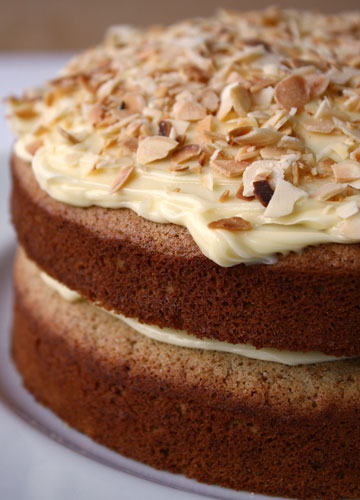
Now, I’m certainly not claiming that my improvised banana cake was anywhere near as elevated or as sublime as a skillful organ extemporization.

banana-cake-close

However, the principles of my baking fantasia (with apologies to MacDougall) were the same.

How can the audience enjoy the extemporizer’s art if it does not recognize his theme?
I took a theme of bananas, one which is surely familiar to my audience.

One needs more than one subject to work with if one is to go on for more than a few measures.
Bananas and … buttermilk.

It is to differences in rhythm more than to differences in harmony or in melody that we have to look for suggestions.
Flour … flour … buckwheat flour.

Before this time, even, the player will have discovered how far his knowledge of harmony is a help to him in his improvisations.
How much of each ingredient? How many eggs? What size cake pans? What oven temperature? How much chemical leavening … what sort …. baking powder or baking soda …?

There is nothing less difficult than to overload a melody with chromatic, complicated and bizarre harmonies destroying the very object for which they were introduced.
A simple frosting that doesn’t compete with the taste of banana … white chocolate and buttermilk buttercream.

See that, wherever possible, melody and accompaniment are contrasted in tone-color, as well as in strength.
A scattering of toasted almonds for an uncomplicated, contrasting crunch.

A “reasonable confirmation to the principles of musical composition” is all that may be demanded of the student.
Well, it certainly looked and tasted like a banana cake to me …

banana-cake-cut

There is no reason why a professional friend should not join with [the organist] in mutual practice and criticism. Men do not seem to do this sort of thing as often or as helpfully as women, but the suggestion may be worth considering.

… and Charlotte enjoyed it too.  (I just had to add MacDougall’s second sentence to the quote above – what an observation!)

banana-cake

Banana Buttermilk Fantasia Cake

8 oz buckwheat flour
1/2 tsp ground cinnamon
1/2 tsp grated nutmeg
1 tsp salt
1/2 tsp baking soda
5 oz light muscovado sugar
2 medium eggs
7 oz mashed banana (2 to 3 bananas)
3 tbsp buttermilk

Topping
1 oz flaked almonds, crushed and toasted
4 oz white chocolate
2 tbsp buttermilk
3 oz unsalted butter, at room temperature

Preheat the oven to 180 degrees C. Grease and baseline 2 x 7″ round cake pans.

Put the dry ingredients together in a large bowl and stir to mix. Set aside.

In a separate bowl, beat the sugar and eggs until they have tripled in volume and are the colour of a frothy cappuccino (4 to 5 minutes).

Add the mashed banana and buttermilk. Stir to incorporate.

Stir in the dry ingredients until all are moistened.

Divide the batter between the 2 prepared cake pans. Bake in the centre of the preheated oven for 25 minutes or until the tops spring back to the touch.

Cool in pans for 10 minutes before removing and cooling the cakes on a wire rack.

To make the topping, melt the white chocolate in a medium-sized bowl. Beat in the buttermilk and softened butter. Refrigerate for 15 minutes before using.

When the cakes are absolutely cool, sandwich them together and cover the tops with the white chocolate and buttermilk buttercream. Sprinkle with the crushed and toasted flaked almonds.

Look and Cook Vegetable Soup

My children think that their Aunty Lucy always brings the most wonderful presents for them. They adore the glittery, shiny stickers that decorate the cards she writes and the luxurious ribbons that tie up her carefully wrapped packages. Tearing off the colourful, glossy paper, they are delighted to find all kinds of imaginative toys and gifts … magnetic fridge gears, candy floss makers, zoingo boingos, black holes.

Last month on her seventh birthday, L read proudly to us all from her new, special Aunty-Lucy present – Look and Cook, a gloriously vintage cookbook for children by Tina Davis. Not only does this superbly illustrated book provide recipes for such evocative things as popcorn balls and forgotten cookies, L was also captivated by the various sections that name each different kitchen utensil, discuss safety in the kitchen and describe how to measure, chop, dice, boil, steam and sauté with skill.

“Now I can cook dinner for all of us,” L announced, feeling sophisticated and grown-up.

She took her job very seriously. In her role as Mummy, she knew that cakes and cookies, however tempting, were not what she should be serving to her children as their main source of nourishment. I watched as she slowly thumbed her way from the delicious puddings and sweet treats at the end of the book, through the pasta and rice of the middle sections, towards the vegetables and main dishes in the opening chapters.

Then her eyes lit up as she spotted a recipe for vegetable soup.

“Just like at Granny and Grandpa’s house,” she smiled, thinking of how much she had enjoyed eating the soup that my Mum had made for us during our recent visit there.

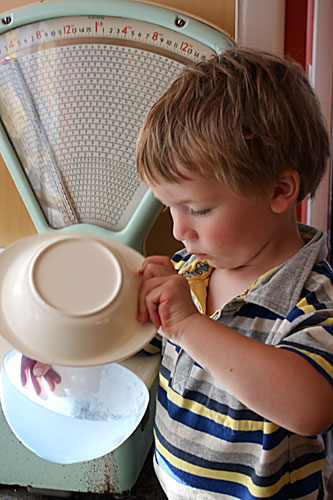
Having made her decision, she set to, rummaging through the cutlery drawers to find the tools she needed for her task.

Of course, if L is busy in the kitchen, then so too are M and T. It’s a matter of sibling pride.

And this is how our quiet, end-of-summer evening became a little (but only slightly!) more chaotic than usual.

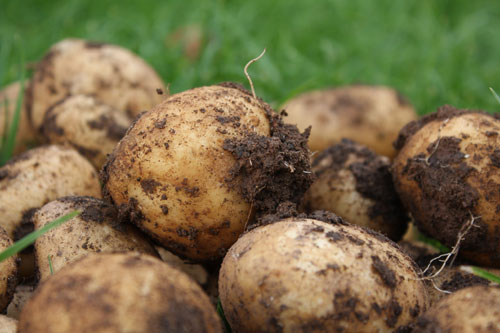
First, there were potatoes to be dug up from the garden ….

potatoes

… and green beans to be picked …

green-beans

… and chopped.

chopping beans

The vegetables were stirred …

vegetables

… while M mixed the dough for some flatbreads to dip into the eagerly anticipated soup.

mixing-dough

T did something he thought would be useful that involved flour …

useful

… and M kneaded the dough.

kneading

L stirred the soup …

lstirs

… and then M stirred the soup.

mstirs

T swept flour onto the floor …

floury-floor

… and into the dustpan.

dustpan

As if by magic (which is, after all, how most things take place in the kitchen), a hot pan of steaming vegetable soup …

steaming-soup

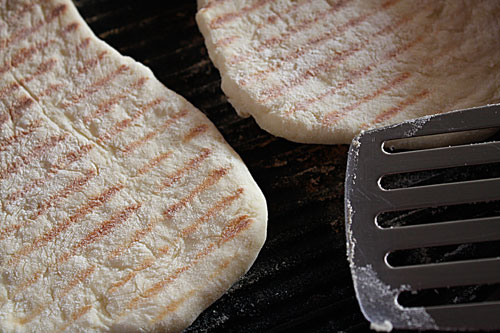
… and a plate of griddled flatbreads …

flatbreads

… appeared at the table.

The unanimous verdict?

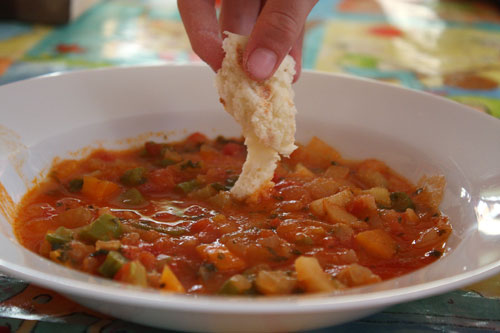
“Mmmm, it’s sooooo good!”

vegsoup

Vegetable Soup (adapted from a recipe by Tina Davis)

2 tbsp olive oil
1 onion, diced
3 carrots, diced
2 sticks of celery, diced
1 clove of garlic, minced
3 to 4 potatoes, diced
a handful of green beans, chopped
1 tin of chopped tomatoes
1 bay leaf
1 tsp salt
1/4 tsp sugar
1/4 tsp ground black pepper
2 tbsp fresh parsley, chopped

Heat the oil in a large pot and stir in the onion, carrot, celery and garlic. Cook over medium heat until softened.

Add 800 ml of water together with the tomatoes, potato, green beans and bay leaf. Boil then lower to a gentle simmer for about 40 minutes.

Season (to taste) with salt, pepper and sugar.

Stir in the parsley and then serve immediately.

Jewellery Box Birthday

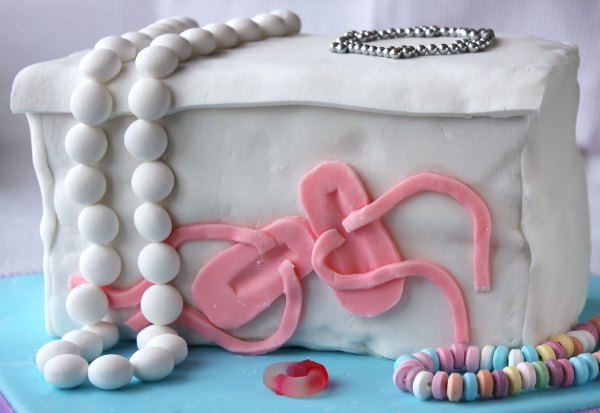
We have a lot of summer birthdays in our family and L’s recent seventh birthday was the latest in the string. I had thought that my days in the icing sugar cloud of despair were over, but L was having a jewellery-making party and had set her heart on the jewellery box cake she found in Debbie Brown’s erroneously-named book, 50 Easy Party Cakes.

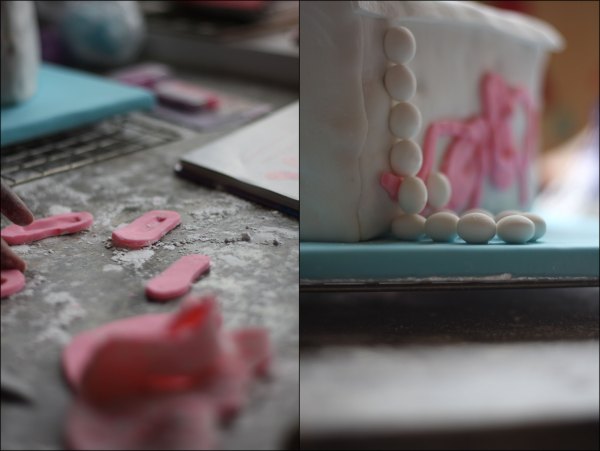
Assembling the cake

I really must hide that book. The cakes look so pretty, so appealingly colourful, smooth and neat. I have other books of party cakes for kids, but my children never give a second glance to their swirling swathes of buttercream icing and multicoloured sprinkles. They are drawn irresistibly by the bewitching charms of Debbie Brown’s cakes with their pretty fondant models and magical themes.

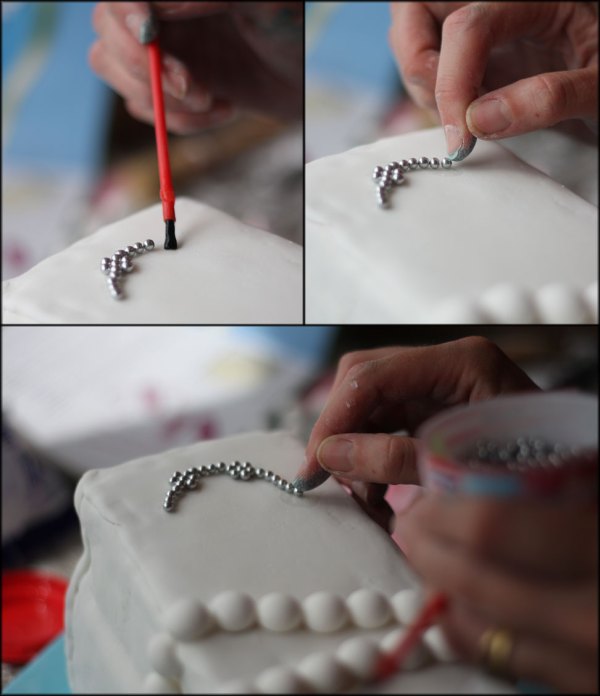
Decorating the cake

If only they really were so easy to make. Debbie Brown’s cakes never seem to have crumbs poking out through the joins in the icing or stray nailprint stabs from a moment’s lapse in concentration. Her sugar glue apparently never runs and her silver dragees stay irritatingly in place, stuck shinily to the cake rather than slipping around in her fingers. Her fondant models never droop and the covering on her cakes never sags. She gives you all the information you need in the book to be able to reproduce her cakes at home, except for that vital witch’s spell that tames the recalcitrant ingredients.

Making the bracelet

I have found a way through this over the years. I have learned not to give up when the fondant icing first sticks to the worktop and the smooth surfaces give way to impressions from my clumsy fingers and thumbs. I keep going even when the details are lost in a fog of icing sugar, when the straight edges are all bumpy and when the whole cursed thing seems to have become an irretrievable disaster.

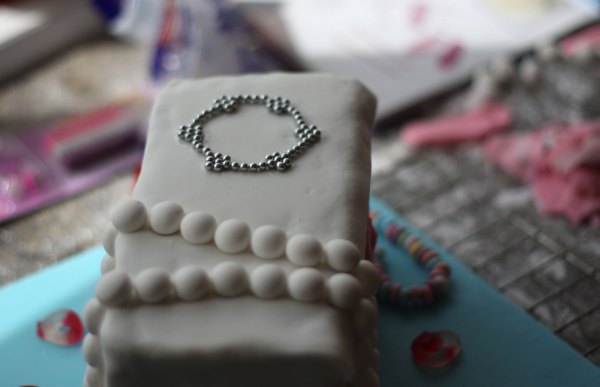
Top of the cake

I carry on regardless until the cake is finished and then I close the book and walk away.

Cake in waiting

Perhaps this is the point at which the charms begin their work for when I return, I invariably find that it hasn’t been such a disastrous endeavour after all.

Necklace and ballet shoes

My cake might not be as perfect as the images in the book …

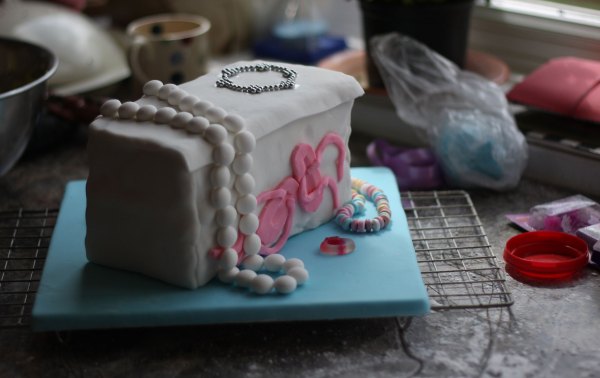
Jewellery box cake

… but the excited appreciation of my children somehow transforms my terminally flawed efforts into the most beautiful party creation …

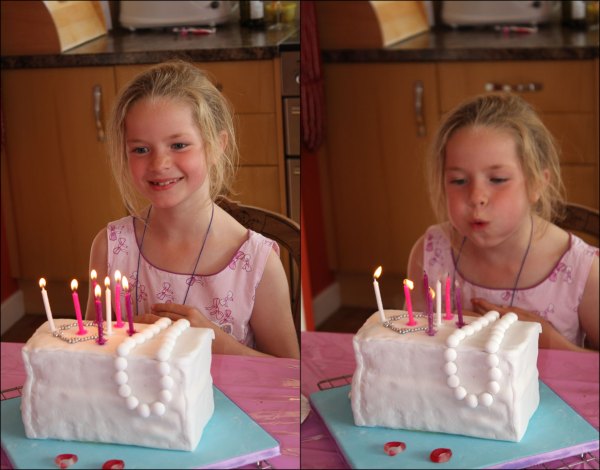
Birthday candles

… and crowning birthday glory.

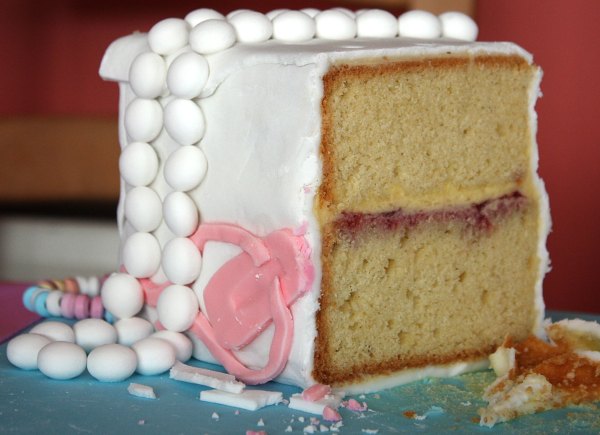
Cutting the cake

Happy birthday, L – and thank you to Mark for calmly photographing my work in the depths of the icing sugar cloud of despair!

The Night of the Lemon Tart

I nearly entitled this post, “Happy Birthday Dear Blog”, for that’s what it is today. Two years ago on August 9th 2007, I first put the virtual pen to the virtual paper and told the world about my obsessive quest to find the perfect chocolate brownie.

Far from counting down the days to this second blogoversary, I only realised it was nearly time to celebrate when I published my last post about our candyfloss activities and was diverted into looking in the archives. I actually got a bit confused and thought we were further into August than we were, so I nearly added a postscript saying something like, “Oops, I’ve missed my birthday!” It just goes to show the addling effect of summer holidays on my brain!

This is the part where I should wax lyrical about all the things that have happened here in this last year … the culinary triumphs (had to get that in for you, Dad 😉 ) and lessons learned. When I look back however, this year has been as much about people as it has been about recipes and food. It has been  a year filled with the excitement of meeting face to face with friends I’ve met through this blog … Rose Levy Beranbaum, Melinda and Jeannette. It has also been a year in which I’ve travelled the world virtually, from Canada to America, the Caribbean to Azerbaijan, getting to know the most wonderful fellow food bloggers on my journey.

This blog has become more than just an online record of recipes. It is a true sharing of experiences and point of connection with my family and friends.

In celebration of this second year of A Merrier World, I’d like to leave you with the most wonderfully sublime, dreamily ethereal lemon tart I’ve ever tasted. I’ve made it several times since I first found Ellie’s recipe on A Kitchen Wench. Yesterday, I made it again for friends who came to dinner.

It’s a tart to die for.

lemon tart

It’s a tart to sink your teeth into, to roll around your tongue and drift away on the smooth, lemon custard of its filling. I can feel my mouth watering as I write, so please excuse me while I go to drool over a slice of the real thing!

lemon custard

  • Enter your email address to subscribe to this blog and receive notifications of new posts by email.

    Join 289 other subscribers
  • Seasonal Recipes

    candied peel

    baileys chocolate truffles

    gingerbread men

    mince pies

    fudge

    smarties cookies

  • Freshly Made

  • Categories

  • Favourite Feasts

  • Awards

    DMBLGIT Award
  • Archives

  • wordpress visitor counter
  • Adventures in food by Kate Coldrick from Woodbury in Devon.