My eye has recently been caught by R khooks’ Stop the Traffic Chocolate Competition in support of the campaign to stop the trafficking of children in the production of chocolate bars.
“Nearly half the world’s chocolate is made from cocoa grown in Cote d’Ivoire, West Africa.”
The 2000 US State Department Human Rights report said “It is estimated that some 15,000 Malian children work on Ivorian cocoa and coffee plantations. Many are under 12 years-of-age, sold into indentured servitude for $140, and work 12-hour days for $135 to $189 per year.”
STOP THE TRAFFIK is calling for consumers to force the chocolate companies to guarantee that their products do not use cocoa harvested by child slave labour on the farms in Côte d’Ivoire.
“The only way chocolate companies will take action is if they see their expected branded chocolate sales drop. The only way that we can stop the trafficking of children in the production of our chocolate bars is to change which ones we eat.”
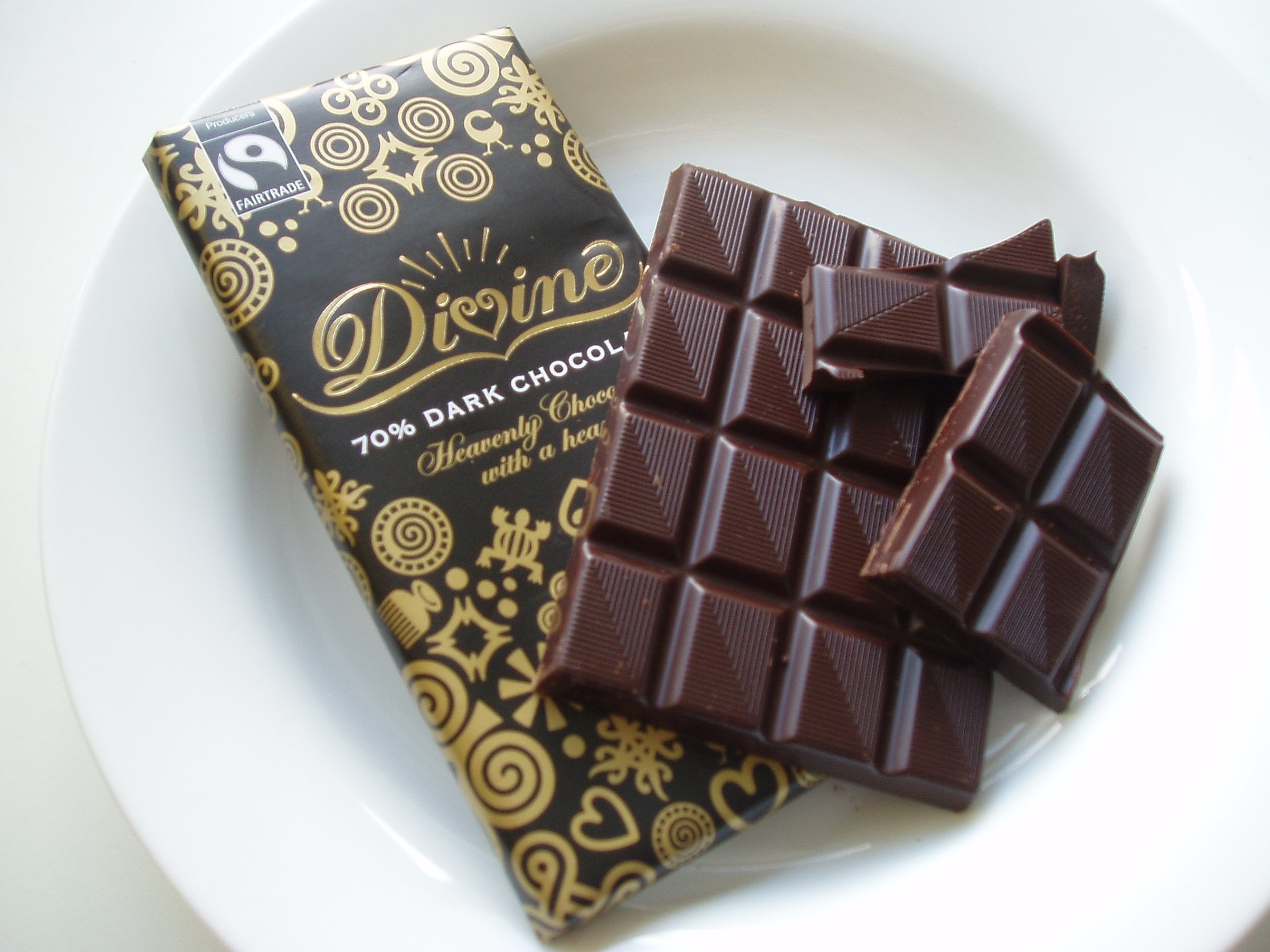
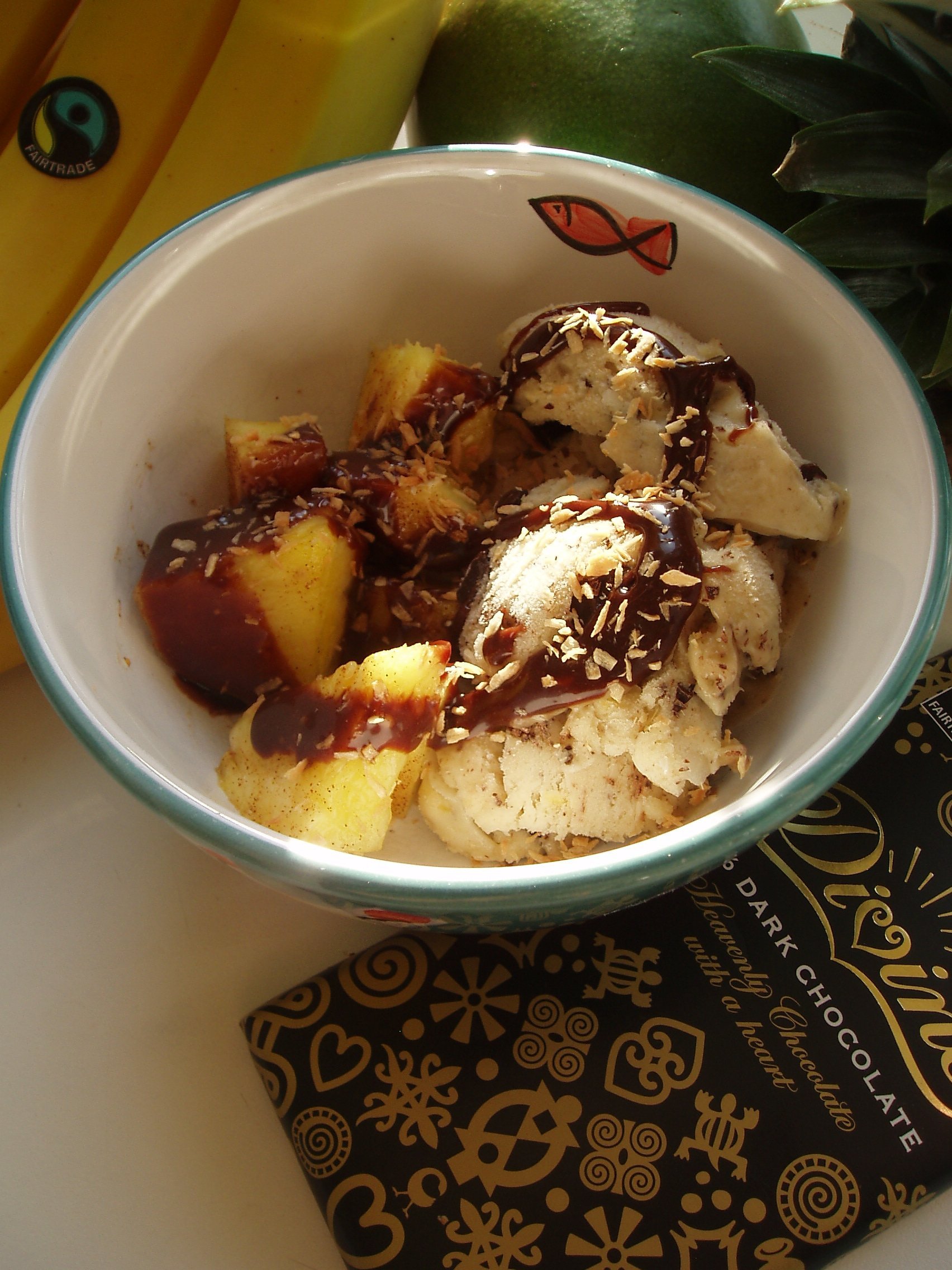
I have to admit that, whilst being aware of Fairtrade chocolate, I’ve always (until now) stuck to my tried and tested favourites when it comes to actually buying chocolate. Fuelled by R khooks‘ challenge to raise awareness of the traffik free guarantee campaign by posting a recipe using fair trade/ethically sourced chocolate, I headed to my local Oxfam shop. It was there that I discovered Divine Chocolate, a Fairtrade chocolate company co-owned by the cocoa farmers cooperative, Kuapa Kokoo. I bought two 100g bars of plain chocolate and a smaller bar that I shared with my daughter on the way home.
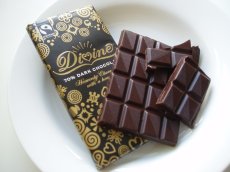
From the first taste, I was hooked. This chocolate is as smooth and glorious as the packaging claims it to be. Even M, my fussy 2-year-old, wanted more – commendation indeed as she normally finds plain chocolate to be too bitter for her taste.
Now I had a problem. The very quality of this chocolate stands for itself – how could I possibly improve on that? On the other hand, I didn’t think that …
‘Open wrapper. Eat’
… would count as a recipe for the purposes of the chocolate competition!
In my reading around the topic, I was struck by the fact that the majority of child labourers working on the cocoa plantations in Côte d’Ivoire have never tasted the end product of the beans they harvest.
“You eat the chocolate biscuits – you who have never seen a cacao tree. We pick the cocoa beans – we who have never tasted chocolate.” Bernard Guri, CAFOD partner, Ghana.
Rather than being a pure celebration of chocolate, my entry is therefore a recipe where the flavours of Côte d’Ivoire meet and unite.
Flavours of Côte d’Ivoire
2 ripe, large bananas
1/2 tbsp golden castor sugar
1/2 fresh mango
50g Fairtrade plain chocolate, coarsely chopped
1/4 cup shredded coconut
1 pineapple, diced
1 1/2 tbsp golden castor sugar
1/4 tsp white pepper
1/4 tsp grated nutmeg
1/2 tsp ground ginger
1/2 tsp ground cinnamon
Chocolate Sauce
50g Fairtrade plain chocolate
1/4 cup creamed coconut
2 tbsp golden castor sugar
2 tbsp palm syrup
1 tbsp groundnut oil
1/4 cup water
Peel and slice the bananas. Freeze until solid (at least an hour). Blend in food processor with sugar and mango until creamy. Stir in the chunks of coarsely chopped chocolate. Scrape into a tub and freeze.
Spread the shredded coconut on a baking tray and toast in a hot oven (200 degrees C/ 400 degrees F) until just browning. Set aside.
Peel the pineapple and slice into rounds. Cut each round in quarters. Place on a baking tray and sprinkle with a mix of sugar, pepper, nutmeg, ginger and cinnamon. Cook in a pre-heated oven 200 degrees C/ 400 degrees F for 10 minutes. Cool to lukewarm.
Melt all of the chocolate sauce ingredients together over a low heat, stirring until the sugar is dissolved and the sauce is smooth.
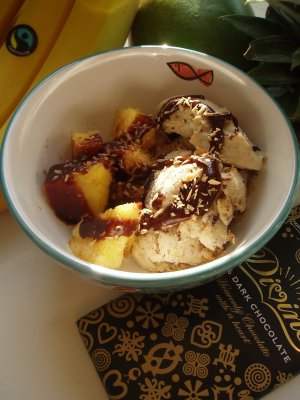
Serve the spiced-pineapple quarters in a bowl with a scoop of banana-chocolate ice-cream. Drizzle with chocolate sauce and scatter with toasted coconut.






 amerrierworld.com