I have been reading a lovely book by Brenda Crowe called Play is a Feeling. As the first National Advisor to the Pre-School Playgroups Association, she was well placed to ask groups of parents to explore their earliest play memories. Although her book was written more than twenty years ago in 1983, many of her discoveries ring true today. Through stimulating discussion and sensitive investigation, she observed clearly how memories triggered by the feel of the word play lead towards a deeper understanding of the world of childhood. Above all, she found that “play wasn’t something apart, it was life itself, a positive and creative way of living.”
I particularly enjoyed reading a chapter about ‘The Feel of Things’. Here, she describes how parents’ memories of events, places and objects from their childhood triggered strong personal associations with tastes, sounds, smells and emotions. She believes that these associations are critical in the development of children’s understanding of the world. Indeed, she claims that these sensory experiences underlie a child’s later use of words and language to convey and share findings and feelings, deepen relationships and extend thinking. In this passage, the importance of smell, touch and taste in childhood is vividly evoked:
“Older people recall individual smells with relish – paraffin lamps, the carbolic soap in the kitchen, camphorated oil in the medicine chest, pickles being made, fresh chrysanthemums brought in from the allotment, sausage and mash and bacon, hardware shops with their smell of oil, creosote and open boxes of nails, wash-days with hot soapy suds, stables, garages and breweries. And the memories bring back the ‘feel’ of the surroundings and relationships associated with each one.
But now there are extractor fans over cookers, furniture shines without the natural smell of beeswax and turpentine, aerosol sprays render rooms impersonal, deodorants perhaps make us impersonal too, modern roses are beautiful, but not many of them have the scent of the old-fashioned deep crimson velvety ones. New heavy-cropping tomatoes lack the scent and flavour of those that used to be grown for their flavour, school dinners are delivered in containers from far-away kitchens. Bread is pre-wrapped and few bakehouse smells waft out on hot air from shops these days – and even in homes there is often no time for home baking. So many distinctive smells that children could read like a book, connecting them with people, homes and seasons, have been removed or replaced by synthetics. The clock can’t be put back. But it doesn’t have to be accelerated – and, if we are aware of what is happening, we can exercise at least some degree of choice.”
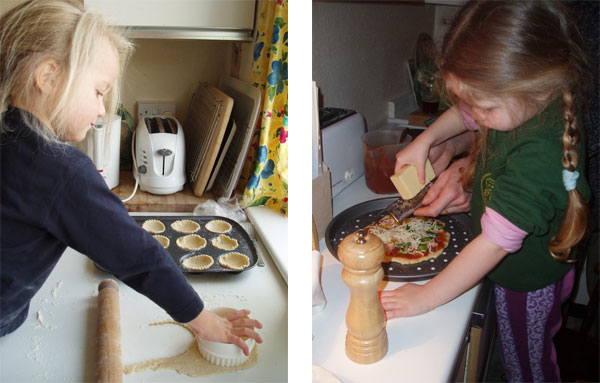
Although I have only just recently come across Brenda Crowe’s urge to parents to provide real sensory experiences for their children, I have nevertheless always unconsciously assumed the same philosophy in bringing up my own children. An important part of this has been my choice to actively engage them in the kitchen. Home baking is an eagerly-anticipated daily event for my three. And for most of the time, the boundaries between play and work are blurred – while we are all immersed in play, we are equally absorbed in real work and my children recognise themselves as an important part of the family team.
It is interesting to note that Brenda Crowe linked a disappearance of homebaking to a lack of time – modern families are too busy to bake or cook. It is this perceived lack of time that accounts in part for the popularity of ready-meals, pre-prepared and fast food on the supermarket shelves. However, there is more at stake than time when we hand over the responsibility for the food we eat to profit-making enterprises. As Elisabeth Winkler points out, many packaged foodstuffs are subjected to processes and chemicals that have little if anything to do with taste or sustenance.
The dark side of all this has been glimpsed slowly but startlingly in the unfolding drama of melamine/cyanuric acid food contamination. Beginning in the pet food industry perhaps as early as 2004, the crisis has spread more recently into the realms of baby food, candies and chocolate. Apparently, the protein content of gluten in a product affects its price and is measured by the level of nitrogen. Melamine has a high nitrogen content and was allegedly used by a firm in China to artificially raise the protein level (and hence the price) of ingredients such as wheat gluten, rice protein concentrate and corn gluten. These contaminated, imported ingredients were then used unwittingly as binders by pet food manufacturers in the United States and South Africa with disastrous consequences. Animals who consumed the products subsequently developed symptoms of kidney failure and many died.
Melamine on its own does not appear to cause too much of a problem. However, it degrades over time to produce cyanuric acid. Although cyanuric acid alone is also not especially toxic, it binds with melamine to produce insoluble crystals. In fact, this is something that was already known to the scientific community before their investigation of the contaminated food products – this patent from 1988 describes how melamine can be added to swimming pool water to remove the cyanuric acid that is regularly used as part of the chlorination process. The resulting crystals are easily removed from the pool by vacuum or filtration.
It seems that swimming pools have superior filtration systems to animals. In the pets who ate the contaminated food, the crystals developed into kidney stones leading to renal failure and death.
Unfortunately, this episode was not enough to prevent melamine being added to milk powder for babies in China earlier this year. This article from September 16th describes how 1253 babies had become seriously ill by that date, whilst this article places the number of affected babies at 50,000 only two weeks later. In the UK, the Food Standards Agency has put in place a new testing regime on all products from China containing more than 15% milk as an ingredient. In China, there are reports that many women are returning to breast-feeding and wet-nursing to avoid the use of contaminated baby formula.
And so we come full circle back to real food … that nourishes as nature intended. As we can see, that nourishment delves deep into the heart of not only our physiological but also our psychological well-being.
I would like to offer this post as my contribution to Elisabeth Winkler’s real food blog competition. She has invited bloggers to write about an ingredient or dish that is usually factory-made and to compare it to the real thing. Although I may be extending the boudaries of the competition rules slightly by writing about homebaking and gluten, I hope she forgives me! For my recipe, I’m offering a real-milk fudge for everyone who wants to rediscover child’s play in an increasingly synthetic adult world.
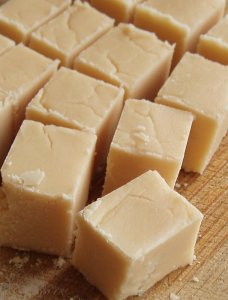
Fudge (adapted from a recipe by Hutton and Bode)
1 lb granulated sugar
1/4 pint milk
1 1/2 oz butter
1 teaspoon liquid glucose
1 teaspoon vanilla extract
In a 4-5 pint heavy saucepan, dissolve the sugar in the milk. Heat only very gently and do not let the mixture boil. This can take quite a long time – be prepared to be patient. Brush any particles of sugar from the sides of the saucepan with a pastry brush dipped in water.
When every single last grain of sugar has dissolved, add the remaining ingredients. Attach a candy thermometer to the side of the pan and boil to 238 degrees F. Stir the mixture occasionally to prevent burning.
Remove the pan from the heat and dip the bottom for a second only into a sink full of cold water. This will stop the temperature rising further.
Leave for ten minutes, then beat the mixture until it thickens. Turn out onto a board and knead until smooth. It will still be quite hot, so I used the backs of two spoons to fold and push the fudge until it was cool enough to touch.
Shape into a cake of about 1/2 to 3/4 inch thickness. Leave until cold and then cut into pieces. The fudge should be stored in an airtight box lined with parchment paper.





 amerrierworld.com