Fantasia on a Theme of Bananas

I remember entering Guildford Cathedral after ringing the bells there for a morning service one Sunday. The air was filled with an emergent hubble-bubble of social chatter, the choir had disbanded and the vast space was slowly disgorging its occupants of the preceding hour. Only the organist remained, lost in the fulfillment of his duty. He played to the emptying cathedral, embroidering the chords of the final hymn in an enthusiastically elaborate extemporization.

With images of J. S. Bach at the keyboard, I was reminded of a little treatise on extemporization written in 1922 by Hamilton C. MacDougall:

To invent and play, on the spur of the moment and without specific preparation, an unwritten piece of music, long or short as the case may demand, conforming reasonably to the principles of musical composition, is to extemporize.

On the spur of the moment … impromptu … a musical improvisation.

Now, I’m certainly not claiming that my improvised banana cake was anywhere near as elevated or as sublime as a skillful organ extemporization.
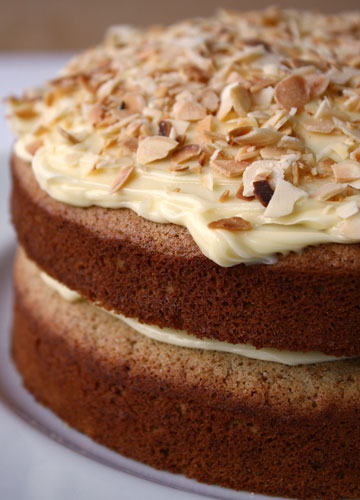
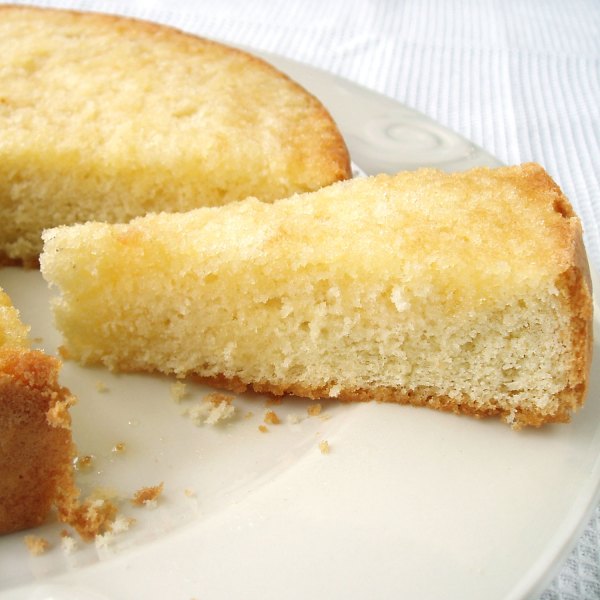
banana-cake-close

However, the principles of my baking fantasia (with apologies to MacDougall) were the same.

How can the audience enjoy the extemporizer’s art if it does not recognize his theme?
I took a theme of bananas, one which is surely familiar to my audience.

One needs more than one subject to work with if one is to go on for more than a few measures.
Bananas and … buttermilk.

It is to differences in rhythm more than to differences in harmony or in melody that we have to look for suggestions.
Flour … flour … buckwheat flour.

Before this time, even, the player will have discovered how far his knowledge of harmony is a help to him in his improvisations.
How much of each ingredient? How many eggs? What size cake pans? What oven temperature? How much chemical leavening … what sort …. baking powder or baking soda …?

There is nothing less difficult than to overload a melody with chromatic, complicated and bizarre harmonies destroying the very object for which they were introduced.
A simple frosting that doesn’t compete with the taste of banana … white chocolate and buttermilk buttercream.

See that, wherever possible, melody and accompaniment are contrasted in tone-color, as well as in strength.
A scattering of toasted almonds for an uncomplicated, contrasting crunch.

A “reasonable confirmation to the principles of musical composition” is all that may be demanded of the student.
Well, it certainly looked and tasted like a banana cake to me …

banana-cake-cut

There is no reason why a professional friend should not join with [the organist] in mutual practice and criticism. Men do not seem to do this sort of thing as often or as helpfully as women, but the suggestion may be worth considering.
… and Charlotte enjoyed it too.  (I just had to add MacDougall’s second sentence to the quote above – what an observation!)

banana-cake

Banana Buttermilk Fantasia Cake

8 oz buckwheat flour
1/2 tsp ground cinnamon
1/2 tsp grated nutmeg
1 tsp salt
1/2 tsp baking soda
5 oz light muscovado sugar
2 medium eggs
7 oz mashed banana (2 to 3 bananas)
3 tbsp buttermilk

Topping
1 oz flaked almonds, crushed and toasted
4 oz white chocolate
2 tbsp buttermilk
3 oz unsalted butter, at room temperature

Preheat the oven to 180 degrees C. Grease and baseline 2 x 7″ round cake pans.

Put the dry ingredients together in a large bowl and stir to mix. Set aside.

In a separate bowl, beat the sugar and eggs until they have tripled in volume and are the colour of a frothy cappuccino (4 to 5 minutes).

Add the mashed banana and buttermilk. Stir to incorporate.

Stir in the dry ingredients until all are moistened.

Divide the batter between the 2 prepared cake pans. Bake in the centre of the preheated oven for 25 minutes or until the tops spring back to the touch.

Cool in pans for 10 minutes before removing and cooling the cakes on a wire rack.

To make the topping, melt the white chocolate in a medium-sized bowl. Beat in the buttermilk and softened butter. Refrigerate for 15 minutes before using.

When the cakes are absolutely cool, sandwich them together and cover the tops with the white chocolate and buttermilk buttercream. Sprinkle with the crushed and toasted flaked almonds.

Jewellery Box Birthday

We have a lot of summer birthdays in our family and L’s recent seventh birthday was the latest in the string. I had thought that my days in the icing sugar cloud of despair were over, but L was having a jewellery-making party and had set her heart on the jewellery box cake she found in Debbie Brown’s erroneously-named book, 50 Easy Party Cakes.

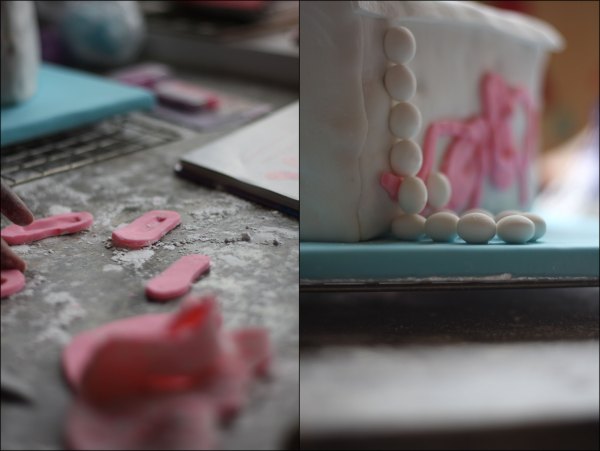
Assembling the cake

I really must hide that book. The cakes look so pretty, so appealingly colourful, smooth and neat. I have other books of party cakes for kids, but my children never give a second glance to their swirling swathes of buttercream icing and multicoloured sprinkles. They are drawn irresistibly by the bewitching charms of Debbie Brown’s cakes with their pretty fondant models and magical themes.

Decorating the cake

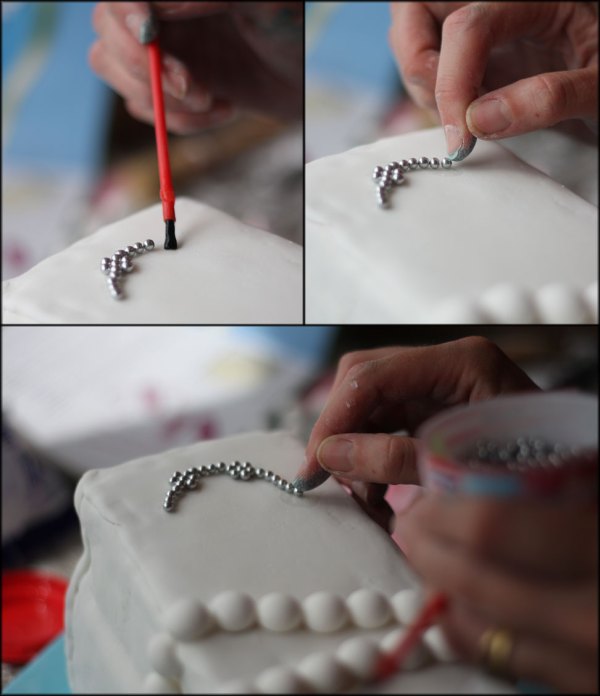
If only they really were so easy to make. Debbie Brown’s cakes never seem to have crumbs poking out through the joins in the icing or stray nailprint stabs from a moment’s lapse in concentration. Her sugar glue apparently never runs and her silver dragees stay irritatingly in place, stuck shinily to the cake rather than slipping around in her fingers. Her fondant models never droop and the covering on her cakes never sags. She gives you all the information you need in the book to be able to reproduce her cakes at home, except for that vital witch’s spell that tames the recalcitrant ingredients.

Making the bracelet

I have found a way through this over the years. I have learned not to give up when the fondant icing first sticks to the worktop and the smooth surfaces give way to impressions from my clumsy fingers and thumbs. I keep going even when the details are lost in a fog of icing sugar, when the straight edges are all bumpy and when the whole cursed thing seems to have become an irretrievable disaster.

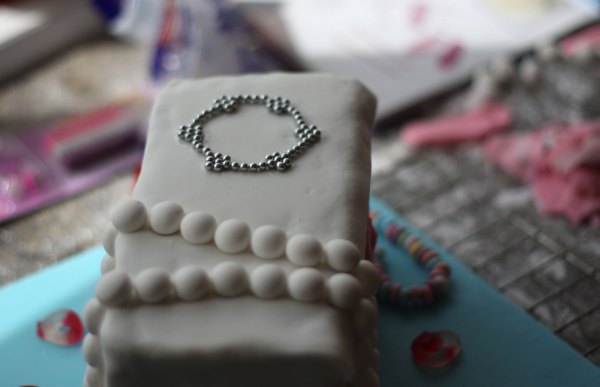
Top of the cake

I carry on regardless until the cake is finished and then I close the book and walk away.

Cake in waiting

Perhaps this is the point at which the charms begin their work for when I return, I invariably find that it hasn’t been such a disastrous endeavour after all.

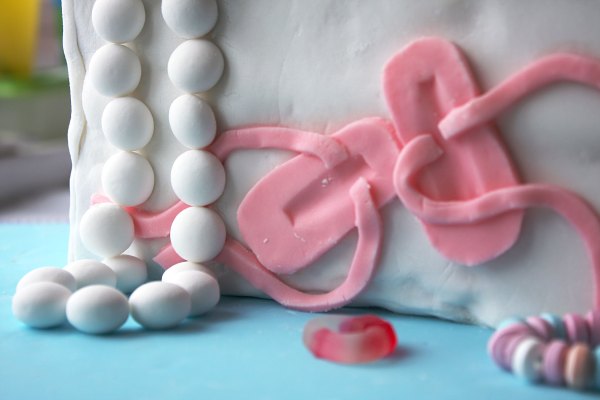
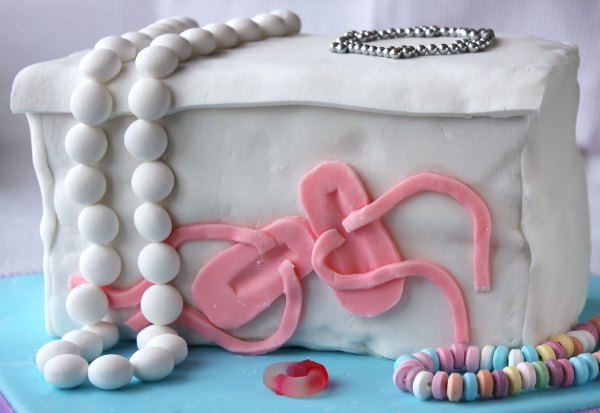
Necklace and ballet shoes

My cake might not be as perfect as the images in the book …

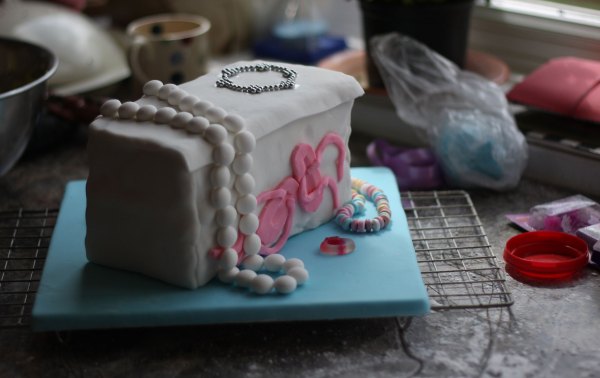
Jewellery box cake

… but the excited appreciation of my children somehow transforms my terminally flawed efforts into the most beautiful party creation …

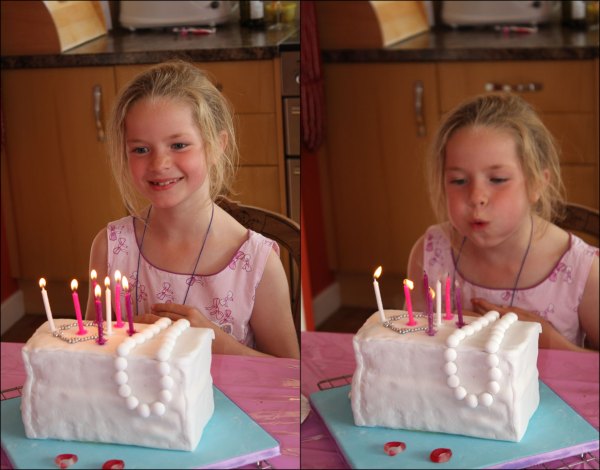
Birthday candles

… and crowning birthday glory.

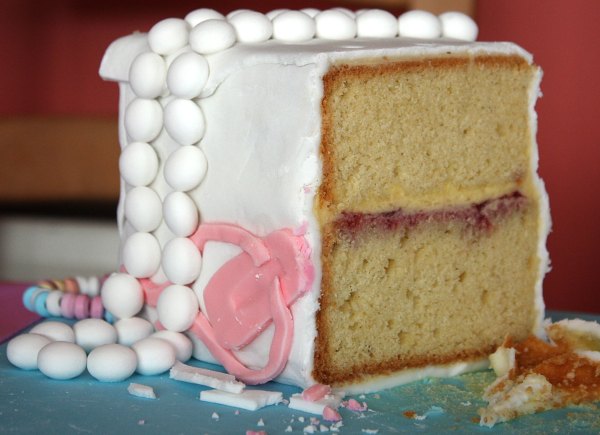
Cutting the cake

Happy birthday, L – and thank you to Mark for calmly photographing my work in the depths of the icing sugar cloud of despair!

Orange Whisky Genoise

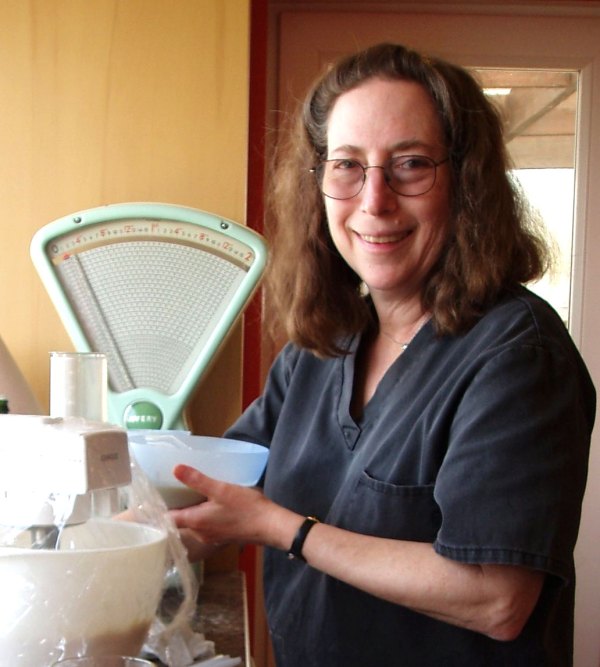
When Rose came to stay, I confessed to her that I’d never dared to make a genoise. I could swear that her eyes lit up with delight as she whipped out some Wondra.

“I’ll show you how,” she said. “It’s easy.”

rose genoise

The lemon genoise that Rose made that day in my kitchen was one of the most perfectly moist and tender cakes that I have ever tasted. It floated softly like a cloud before melting on my tongue into waves of syrupy lemon sea. And although the recipe as a whole had seemed dauntingly complicated, Rose’s patient explanation of each step showed me that I really had nothing to fear from such an infamous undertaking.

I waited awhile before making a genoise entirely on my own, however. Although each step in itself now seemed to be quite manageable, my three little kitchen helpers added an extra layer of complexity that I wasn’t sure would be entirely beneficial to the proceedings. Finally, one morning last week when only my two-year-old T was with me at home, I plucked up the courage.

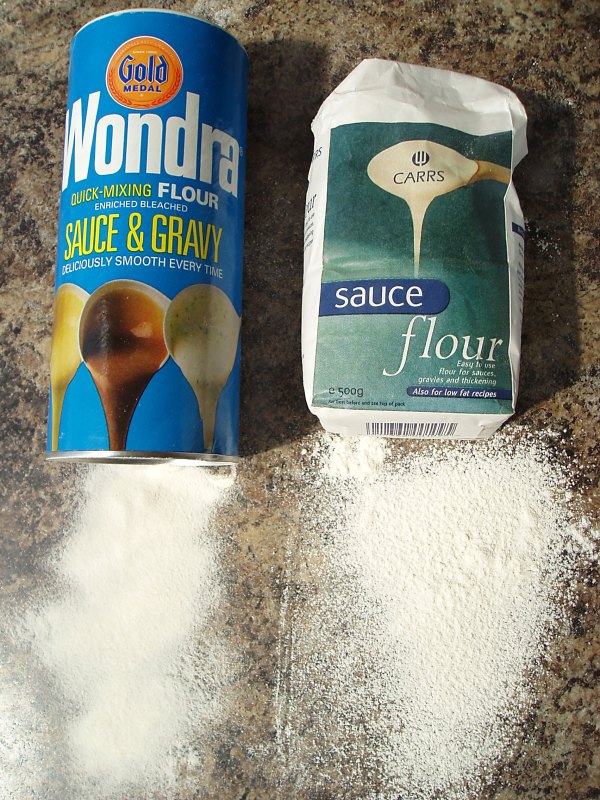
I was spurred on partly by the packet of Carr’s Sauce Flour that was sitting in my flour cupboard. I was curious to discover whether or not it would perform similarly to Wondra flour, a product that is unavailable in the UK.

Rose introduced Wondra to the genoise-making public in her presentation on flour to the Experimental Cuisine Collective at New York University in 2008 (see the third and fourth parts). Marketed as a ‘quick mix wonder’ for thickening sauces and gravies, Wondra is manufactured by a process called agglomeration. This involves hydrating or wetting the flour to form clusters among the particles. These large, agglomerated clusters are then spray-dried to produce uniform particles that flow freely, like salt or sugar. The resulting ‘instantized’ flour dipserses easily and quickly in water. This is because the larger particles are able to overcome the natural surface tension of water better than the finer particles of non-instantized flour (which is also why regular flour tends to forms lumps that are wet on the outside but remain dry on the inside when added to water).

Rose found that this enhanced dispersibility of Wondra was particularly useful when used in a genoise – the flour particles mixed easily and quickly with the batter, which helped to avoid overstirring and deflation of the whisked eggs.

As I said earlier, we can’t get Wondra in the UK. We can get a flour that is similarly marketed as being ‘thickeningly easy’ in sauce and gravy-making, however – Carr’s Sauce flour.

It’s not quite the same. It isn’t bleached, for a start. Or agglomerated (unless they’re just not admitting to that bit). Apparently, it’s made from “wheats that by nature do not form glutinous lumps with the addition of liquids.”

It doesn’t really look the same as Wondra, either. It doesn’t flow freely but behaves like regular flour in the packet and on the spoon. It’s also whiter.

sauce flours

It does disperse easily in water, however … and also in genoise cake batters.

I’m a shockingly inexperienced genoise-baker, but I can certainly confirm that the texture and taste of the orange whisky genoise I made last week with Carr’s Sauce flour were at least as good as I remember them being when Rose made her genoise with Wondra flour. If my own cake didn’t rise quite so high as it should have done, it was purely because about a third of the batter ended up all over T, my little kitchen helper!

I have some Wondra left over from Rose’s visit, so perhaps I will attempt a direct comparison one day soon. For now, I’m happy in the knowledge that I can ‘face my fear and do it anyway’ 😉 .

orange whisky genoise

Rainbow Cake and Unicorns

Update June 2012: detailed photos on how to make a Rainbow Cake are here.

Update April 2010: the activities and games I planned for M’s party are described in a separate post here.

At the end of her birthday party last year, M announced that she would be having a unicorn party for her next birthday. I didn’t realise that she was absolutely serious about this. I thought, “It’s a whole year away – she’s bound to change her mind.” But no, for a whole year M has stuck to her original intention and has been counting down the days until her unicorn party. 

You could argue that I’ve had a whole year to prepare, so why the sudden rush to get everything ready last week? Well, M may have had a solidly clear idea of the grand theme for her party, but she left the finer details entirely up to me. Not wanting to disappoint, I threw myself into turning our house into an enchanted forest in the hope that any passing unicorns might be tempted to pop in on the big day. We made glittery trees and rainbow streamers while M’s big sister created a welcoming poster for the front door.

Last year, M set her heart on a cake she saw in a book by Debbie Brown (here’s a warning to parents – only ever let your children see pictures of cakes that you’re happy to make yourself). Four being so much more grownupperer than three, M has now thankfully entered the chocolate frosting and smarties stage. I’m not so very far removed from the icing sugar cloud of despair that I miss those fondant modelling sessions yet … I’m quite happy to be doing chocolate and smarties.

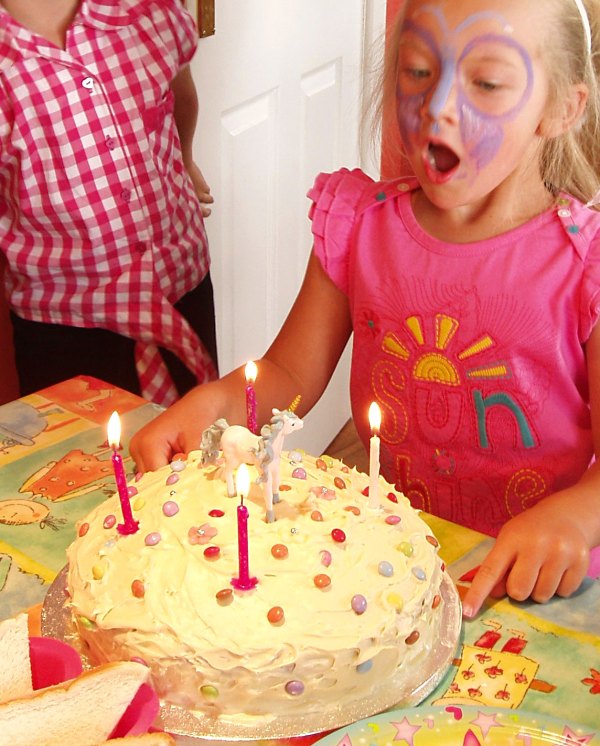
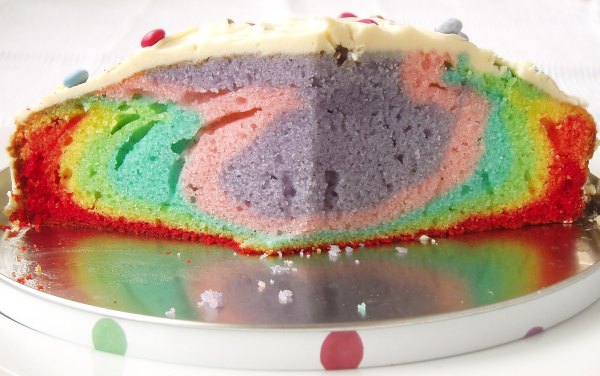
I couldn’t resist giving the birthday girl a little surprise, though. From the outside, M’s cake looked perfectly normal (in a homemade sort of way) – a magical plastic unicorn standing amid swirls of white chocolate buttercream and scattered smarties. M’s seven little party guests looked on dutifully as M blew out her candles and I took a knife to cut into the cake.

unicorn cake

Hesitating before plunging in to make the first slice, I asked them all, “Do you know what happens when a unicorn stands on top of a birthday cake?”

“No,” they whispered with wide eyes.

“He makes a rainbow,” I told them, cutting into the cake.

rainbow cake cut

“Wow!”

The next day, M sidled up to me and asked, “Mummy, how did the unicorn do that to my cake?”

Well, if there’s by any chance anyone left in the blogosphere who hasn’t come across a rainbow cake before now, I’ll explain my own take on the concept … just in case a unicorn happens to pass by and stand on another little girl’s birthday cake 😉 .

I’m not sure who had the original idea – there’s a box-mix version doing the rounds that appears to have started with this thread in the dubiously-named ‘Something Awful’ forums. Rejecting the layered box-mix and diet soda variety however, I based my own rainbow cake recipe on Farida’s beautiful Zebra Cake (stay tuned for more from Farida in an upcoming post).

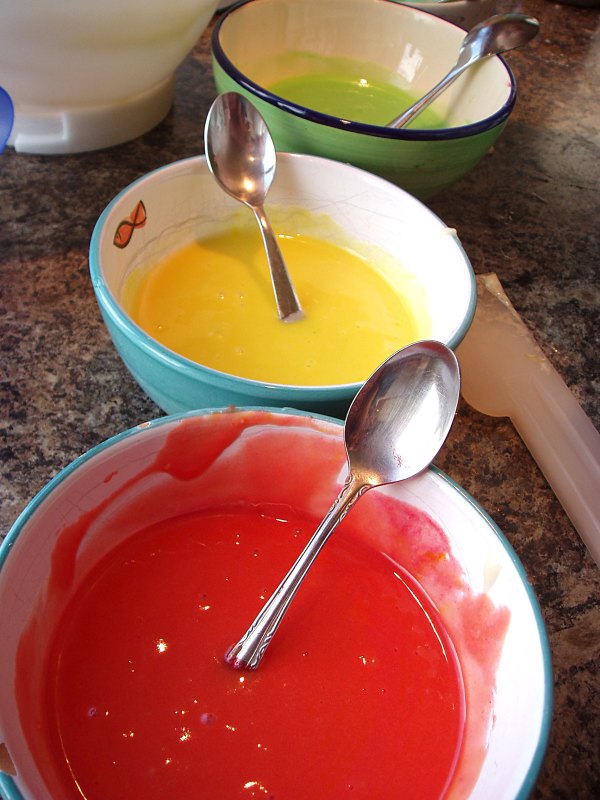
I followed Farida’s instructions to make a yellow cake batter (whichever basic cake recipe you choose, it’s important that it’s one in which the batter doesn’t mix about too much during baking or you’ll end up with a muddy brown cake instead of a rainbow). Then, instead of dividing it into two parts and colouring one part with cocoa as Farida did, I divided the mixture between seven bowls (roughly 4 tablespoons of batter in each) and used my fondant paste dyes to colour each portion a different colour of the rainbow.

coloured batter

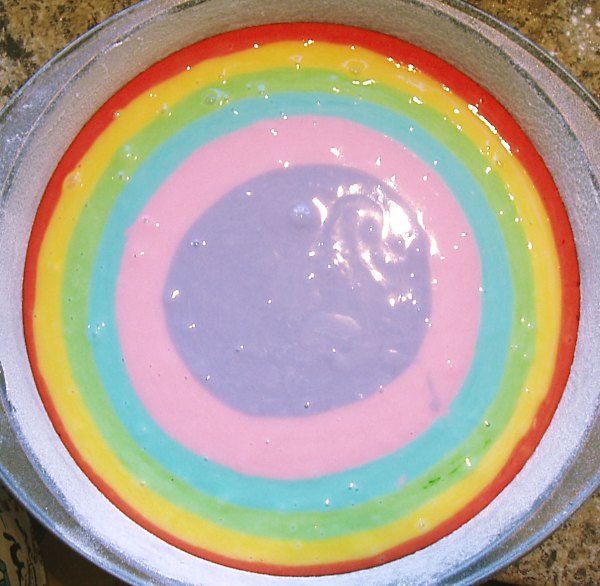
I then poured each rainbow batter in turn (starting with red) into the centre of my prepared cake pan. As Farida says, don’t wait for each colour to spread out before starting with the next – just pour the batter into the centre of the pan, then pour the next colour right on top and then the colour after that without waiting for each to spread fully. The weight of each batter pushes the previous colour out further and, as long as you keep a steady hand with the pouring, they all sort themselves out.

batter in pan

And it’s as simple as that.

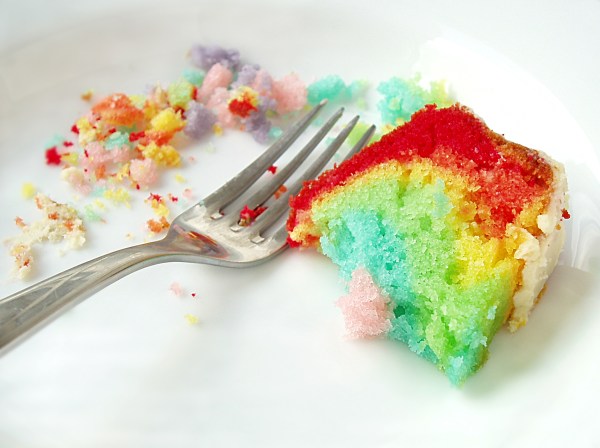
I found out in the school playground this morning that one of the guests has kept her special piece of rainbow cake carefully wrapped up since the party so that she can show it to everyone who visits.

rainbow cake crumbs
You might also like:

Rocky Road

Pumpkin Cake

Fairy Cakes

Chocolate Brownie Puddle Cake

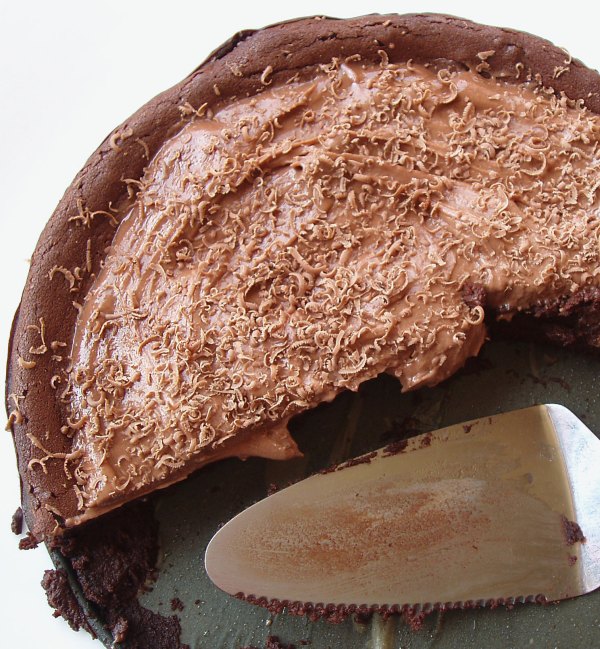
I really wasn’t sure what to call this. To my mind, the base is more of a chocolate truffle or mousse than a brownie, but Matt Tebbutt calls it a brownie, so who am I to object? It is his recipe, after all.

brownie puddle

Let me back-track slightly. The idea for this ‘puddle cake’ started to grow when I came across both Matt’s recipe for Espresso and Walnut Brownies and Emily’s recipe for Chocolate-Peanut Butter Marble Cake on the same day last week (I actually found Matt’s brownie recipe whilst browsing cookbooks in the supermarket – it’s in his book, Cooks Country, and is very slightly different from the version I found online). The brownies were introduced as ‘one of the most popular puds on the menu at the restaurant’, whilst in Emily’s recipe I discovered what she describes as ‘the most delicious chocolate frosting in in the world’.

Knowing that we were soon to be visited by chocolate-pudding-loving friends from Bournemouth, I was keen to take advantage of their tastebuds by trying out my germinating idea on them …

To put it simply, I was wondering, “Why not bake these brownies in a springform pan and fill the part where it dipped in the middle with Emily’s frosting?” Okay, it’s hardly the thought of a genius, but this idea of mine just wouldn’t go away. As the weekend approached, I even began to dream of chocolate puddles and molten brownies.

I very nearly missed my opportunity. Even on the Monday morning when O had taken the children out of the house to give me a chance to get things ready, I still wasn’t sure that I would really go ahead and make the cake. This was partly because I was supposed to be making gingersnaps to go with the lemon-meringue ice-cream and poached rhubarb we were having for dessert in the evening, but also because I knew my savoury-toothed husband would be less than pleased to return to the copious amounts of washing-up I knew this cake would generate!

Needless to say, the chocolate brownie puddle cake found a way of coming into existence once the gingersnaps were safely cooling. I don’t think there were even too many dirty pots left by the time O returned, but that may be my guilty conscience putting a glossy spin on the proceedings.

I was pleased that it did grind me down into subservience, though. As I wrote at the beginning of this post, it wasn’t really a brownie as such. But it was certainly chocolate heaven.

chocolate heaven

Chocolate Brownie Puddle Cake (adapted from a recipe by Matt Tebbett and filled with Emily’s most delicious chocolate frosting)

For the base:

300 g (10 1/2 oz) plain chocolate
150 g (5 1/4 oz) unsalted butter
150 g (5 1/4 oz) light brown muscovado sugar)
4 medium eggs
2 oz raisins soaked in hot coffee
150 g (5 1/4 oz) mascarpone cheese

Pre-heat the oven to 150 degrees C. Grease and baseline a 9″ round springform cake pan.

Melt the chocolate in a double boiler or microwave (I used to do it the first way, but it takes far less time in a microwave – you just need to be careful to stir it frequently and to take it out before all the chocolate has melted completely so the last lumps can melt in the residual heat).

Blend the butter and sugar in a food processor until they are fluffy and pale.

Add the eggs one at a time, whizzing to incorporate.

Drain the raisins and whizz them into the mixture.

Add the mascarpone cheese and whizz to combine.

Pour in the melted chocolate and give the whole thing a final quick whizz to fold everything together.

Scrape into the prepared cake pan and bake in the centre of the oven for 45 to 50 minutes. The centre will be dipped and look gooey, but will feel surprisingly firm and springy when you press it gently.

Leave to cool in the pan on a wire rack (don’t be tempted to speed up the cooling by putting it in the fridge – the texture will change from meltingly smooth to densely fudgy).

To assemble:

When the base has cooled to room temperature, remove the sides of the pan and fill the centre of the cake with a half-quantity of Emily’s most delicious chocolate frosting (or make the full amount of frosting and save the leftovers for something else). Decorate with grated chocolate.

Any leftovers can be kept in the fridge for a couple of days, although the texture will be different (and very delicious too, but in a fudgier way).

  • Enter your email address to subscribe to this blog and receive notifications of new posts by email.

    Join 289 other subscribers
  • Seasonal Recipes

    candied peel

    baileys chocolate truffles

    gingerbread men

    mince pies

    fudge

    smarties cookies

  • Freshly Made

  • Categories

  • Favourite Feasts

  • Awards

    DMBLGIT Award
  • Archives

  • wordpress visitor counter
  • Adventures in food by Kate Coldrick from Woodbury in Devon.