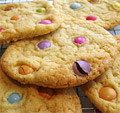
Gingersnaps

On Fridays, I take my younger daughter (M) and baby son (T) to a local toddler group. It is a very popular toddler group that attracts children from many neighbouring villages. It is well organised, has interesting and well-looked after toys and takes place in warm, carpeted church rooms. However, I suspect that its popularity is largely determined by the wonderful selection of home-baked treats that appear for the adults during the children’s snack-time. Cakes, muffins, flapjack, shortbread … all made for us each week by two or three of the Mums who run the group.

Last Friday, platefuls of gingersnaps were passed around. I’d forgotten how much M loves these biscuits. She not only ate mine but managed to sneak at least two more from the plate.

In the afternoon, it was cold and drizzling. What better to do than bake our own gingersnaps?

Gingersnaps

Gingersnaps

12 oz self-raising flour
7 oz golden castor sugar
pinch salt
1 tablespoon ground ginger
1 teaspoon bicarbonate of soda
4 oz butter
1/3 cup Golden syrup
1 egg, beaten

Pre-heat the oven to 170 degrees C.

Sift together the flour, sugar, salt, ginger and bicarbonate of soda.

Melt the butter and Golden syrup together in a pan over low heat until runny. Leave to cool slightly, then add to the dry mixture.

Add the egg and stir well to combine.

Form the dough into walnut-sized round balls and place at wide intervals on an ungreased baking tray.

Bake in pre-heated oven for 10 to 15 minutes for chewy centres, or 15 to 20 minutes for crunchier centres. Let cool slightly on tray before transferring to a wire rack.

Gradus ad Parnassum with Rose Levy Beranbaum

My earliest experiences of baking were guided by my Mum and her well-used copy of the Be-Ro Flour Home Recipe book. When I left home to study music at University, I received my own copy of the Be-Ro book. It was duly filed away until one day several years later when I decided it might be fun to make a birthday cake for my husband.

It would be nice to be able to say that this was a turning point and that I became an avid baker after the birthday cake. Unfortunately, this was not to be. I used the only cake tin I could find in our house. It was a huge, deep affair and the cake I made in it struggled to rise to even a finger-width. Undaunted, I simply repeated the process and sandwiched my two flat discs together with strawberry jam. My husband was very polite and I didn’t attempt any more cake-making until my elder daughter’s first birthday nearly four years later.

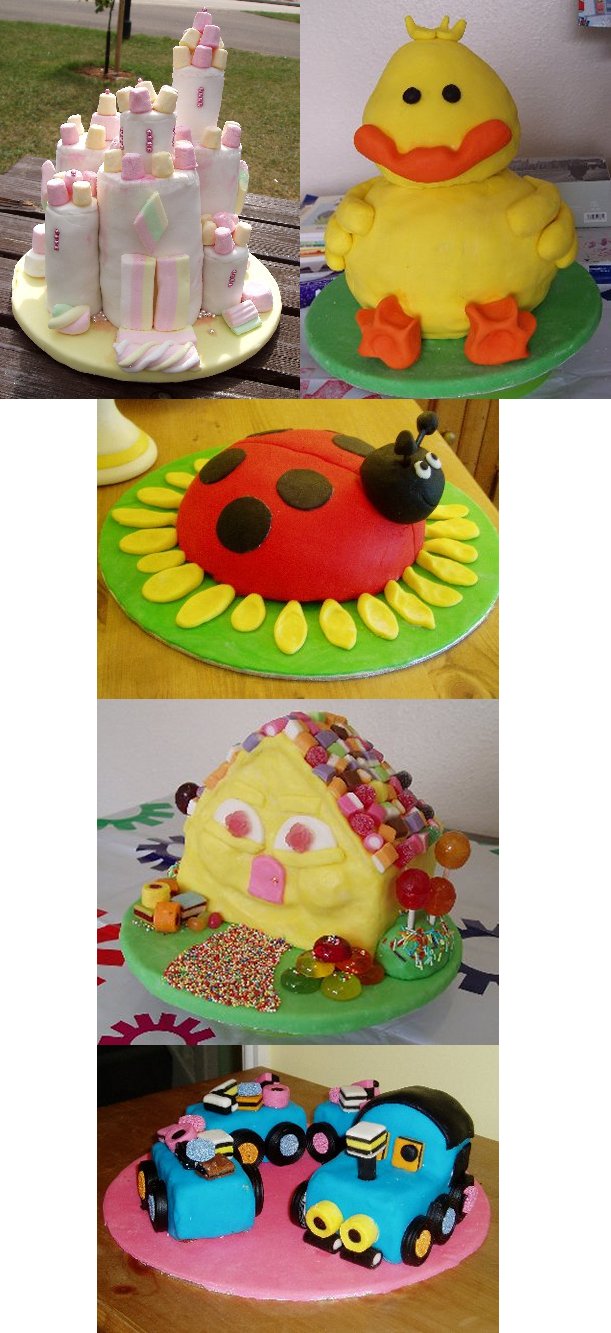
Children have a way of changing your life completely. I bought 50 Easy Party Cakes by Debbie Brown and for the next three years, I made exactly one cake each year. I then doubled my output and made exactly two cakes in the year following the birth of my second daughter.

The recipes for the cakes themselves were secondary to their appearance. Indeed, Debbie Brown advised making a firm cake that was able to stand up to modeling, so I followed her instructions meticulously and never regarded the actual baking-part of the endeavour as anything particularly troublesome. I was more worried about whether the bits were going to stick together or whether the icing would drop off when I moved the cake.

Birthday Cakes

As my children grew, I discovered I held a conviction that they should be introduced to the joys of baking. I still wasn’t very clear at this point what the actual ‘joys’ were, but I believed we should set out to find them nonetheless. Somewhere between the fairy cakes and iced biscuits, I began to realize there was a vast landscape of uncharted territory lying before us. Why was it a Bad Thing if the mixture curdled? What was the reasoning behind the seemingly endless permutations of baking powder and bicarbonate of soda? Why on earth were we told to hang some cakes upside-down to cool? Surely someone somewhere was having a laugh!

Then Rose Levy Beranbaum stepped into my life. Or, to be more precise, I came across her book, The Cake Bible in a second-hand shop in Kirkcudbright. At last, I had found a map for that mysterious realm of cake-making. Moreover, this particular map had been written especially for me! (or rather, for me and the rest of the UK population, since the copy I was holding was the 1992 British Edition of the Bible).

As Rose herself explained in an interview:

“When I started to cook and bake I was very frustrated by unexplained instructions and dictates. When I chose to ignore some I discovered why I shouldn’t have; with others, I saw that there was no reason to have followed them. I wanted to empower the reader to make his or her own choices if they so desired. This can be done effectively only when one understands the reasoning behind the technique. Of course the recipe will work just fine as it is but some people like to make variations and when it comes to baking, you really need to know what you’re doing when you make changes.”

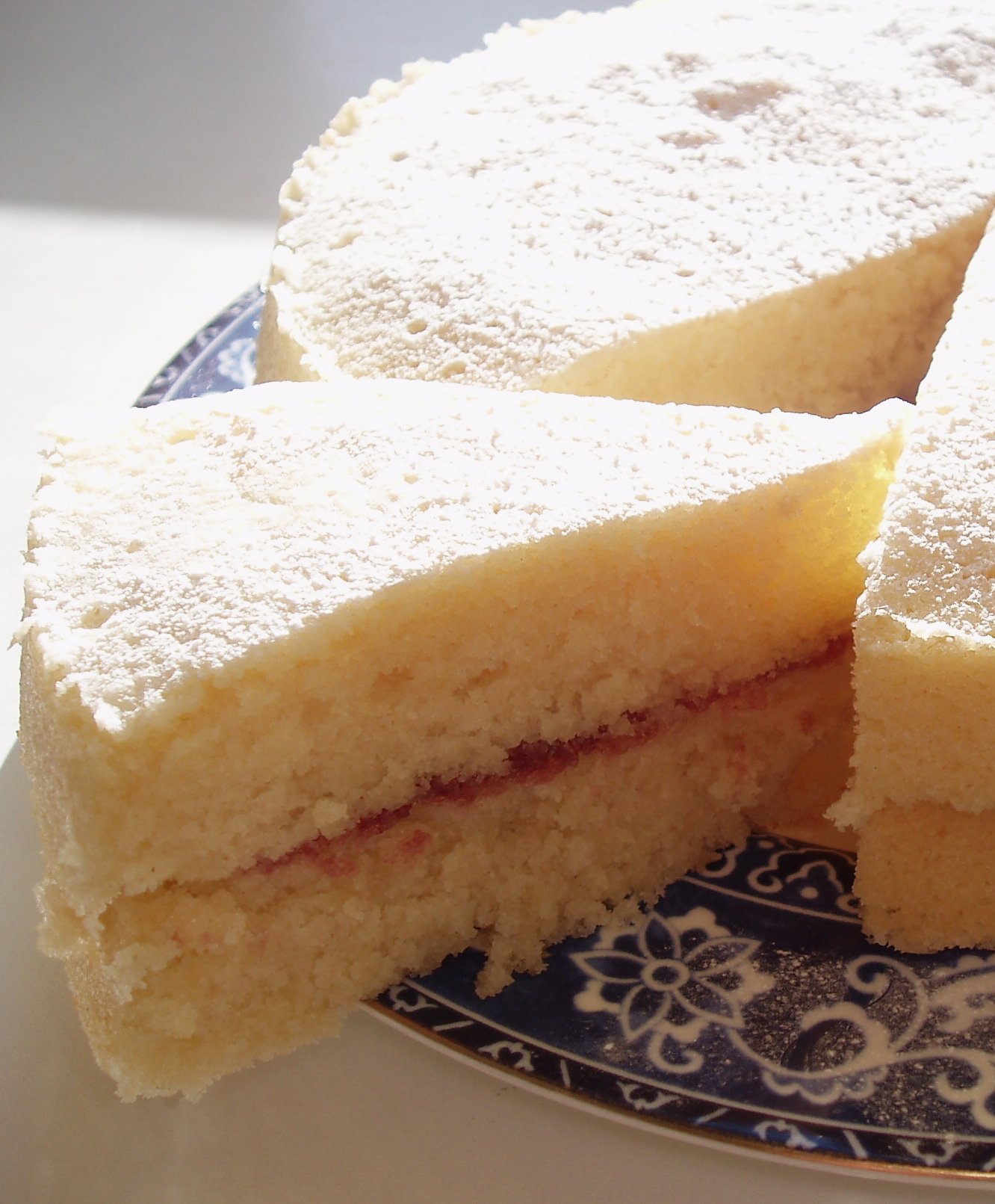
Not only does Rose finally illuminate the mysterious behaviours of flour, sugar, butter and eggs, but she also provides a foolproof method for the production of the most heavenly cakes you have ever tasted. With The Cake Bible by my side, I have successfully brought forth no less than five delicious creations from my oven in the last week alone. And I haven’t even ventured into the icings and fillings sections of the book yet!

White Spice Pound Cake

Needless to say, my family and friends are also full of gratitude to Rose Levy Beranbaum. Perhaps now, when my children look back on their own steps to Parnassus, they will remember that their earliest experiences of baking were guided by their Mum and her well-used copy of The Cake Bible.

White Velvet Butter Cake

Flavours of Côte d’Ivoire

My eye has recently been caught by R khooks’ Stop the Traffic Chocolate Competition in support of the campaign to stop the trafficking of children in the production of chocolate bars.

“Nearly half the world’s chocolate is made from cocoa grown in Cote d’Ivoire, West Africa.”

The 2000 US State Department Human Rights report said “It is estimated that some 15,000 Malian children work on Ivorian cocoa and coffee plantations. Many are under 12 years-of-age, sold into indentured servitude for $140, and work 12-hour days for $135 to $189 per year.”

Stop the Traffik Logo

STOP THE TRAFFIK is calling for consumers to force the chocolate companies to guarantee that their products do not use cocoa harvested by child slave labour on the farms in Côte d’Ivoire.

“The only way chocolate companies will take action is if they see their expected branded chocolate sales drop. The only way that we can stop the trafficking of children in the production of our chocolate bars is to change which ones we eat.”

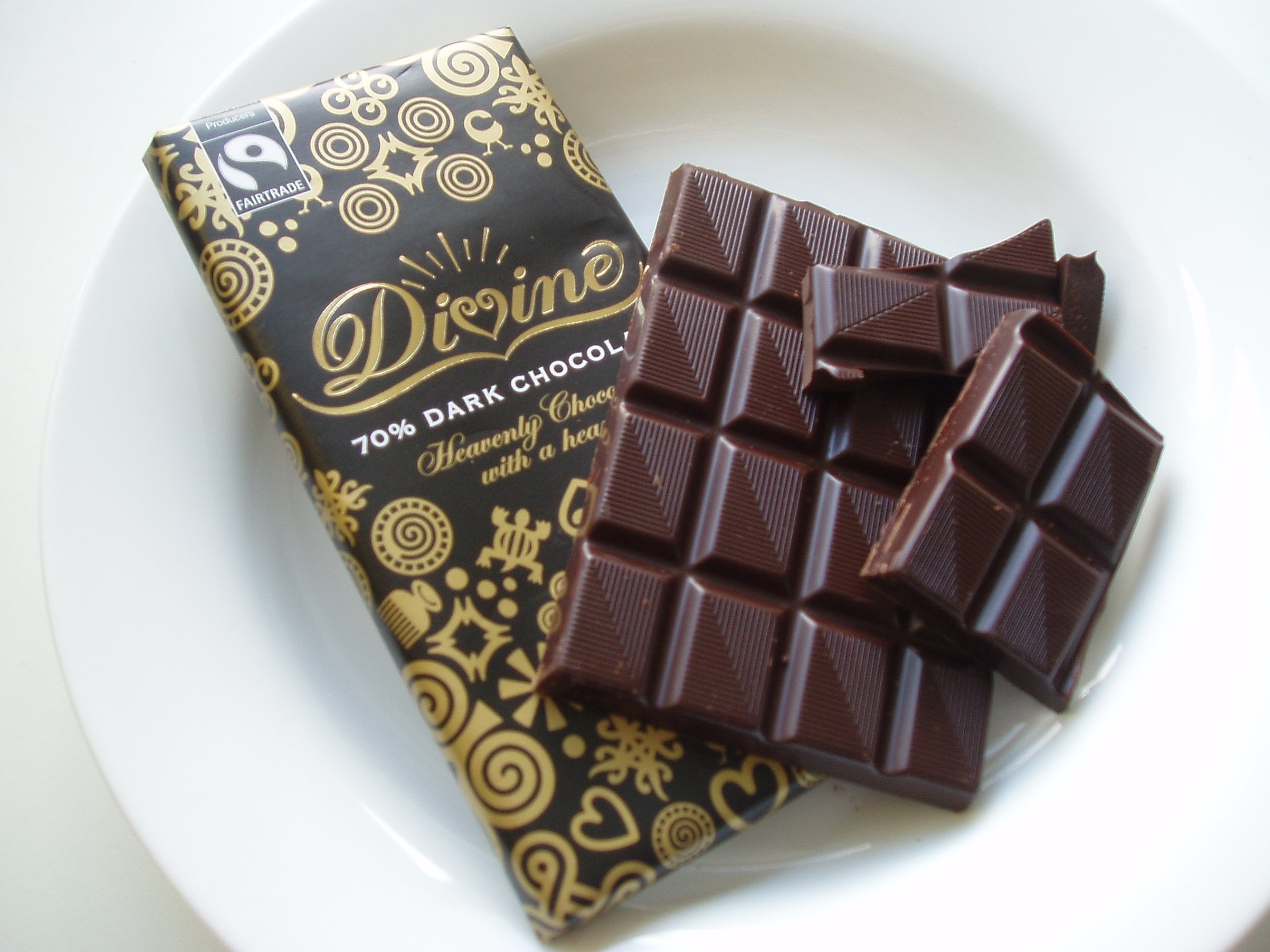
I have to admit that, whilst being aware of Fairtrade chocolate, I’ve always (until now) stuck to my tried and tested favourites when it comes to actually buying chocolate. Fuelled by R khooks‘ challenge to raise awareness of the traffik free guarantee campaign by posting a recipe using fair trade/ethically sourced chocolate, I headed to my local Oxfam shop. It was there that I discovered Divine Chocolate, a Fairtrade chocolate company co-owned by the cocoa farmers cooperative, Kuapa Kokoo. I bought two 100g bars of plain chocolate and a smaller bar that I shared with my daughter on the way home.
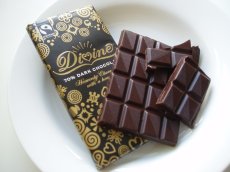
Divine Chocolate

From the first taste, I was hooked. This chocolate is as smooth and glorious as the packaging claims it to be. Even M, my fussy 2-year-old, wanted more – commendation indeed as she normally finds plain chocolate to be too bitter for her taste.

Now I had a problem. The very quality of this chocolate stands for itself – how could I possibly improve on that? On the other hand, I didn’t think that …

‘Open wrapper. Eat’

… would count as a recipe for the purposes of the chocolate competition!

In my reading around the topic, I was struck by the fact that the majority of child labourers working on the cocoa plantations in Côte d’Ivoire have never tasted the end product of the beans they harvest.

“You eat the chocolate biscuits – you who have never seen a cacao tree. We pick the cocoa beans – we who have never tasted chocolate.” Bernard Guri, CAFOD partner, Ghana.

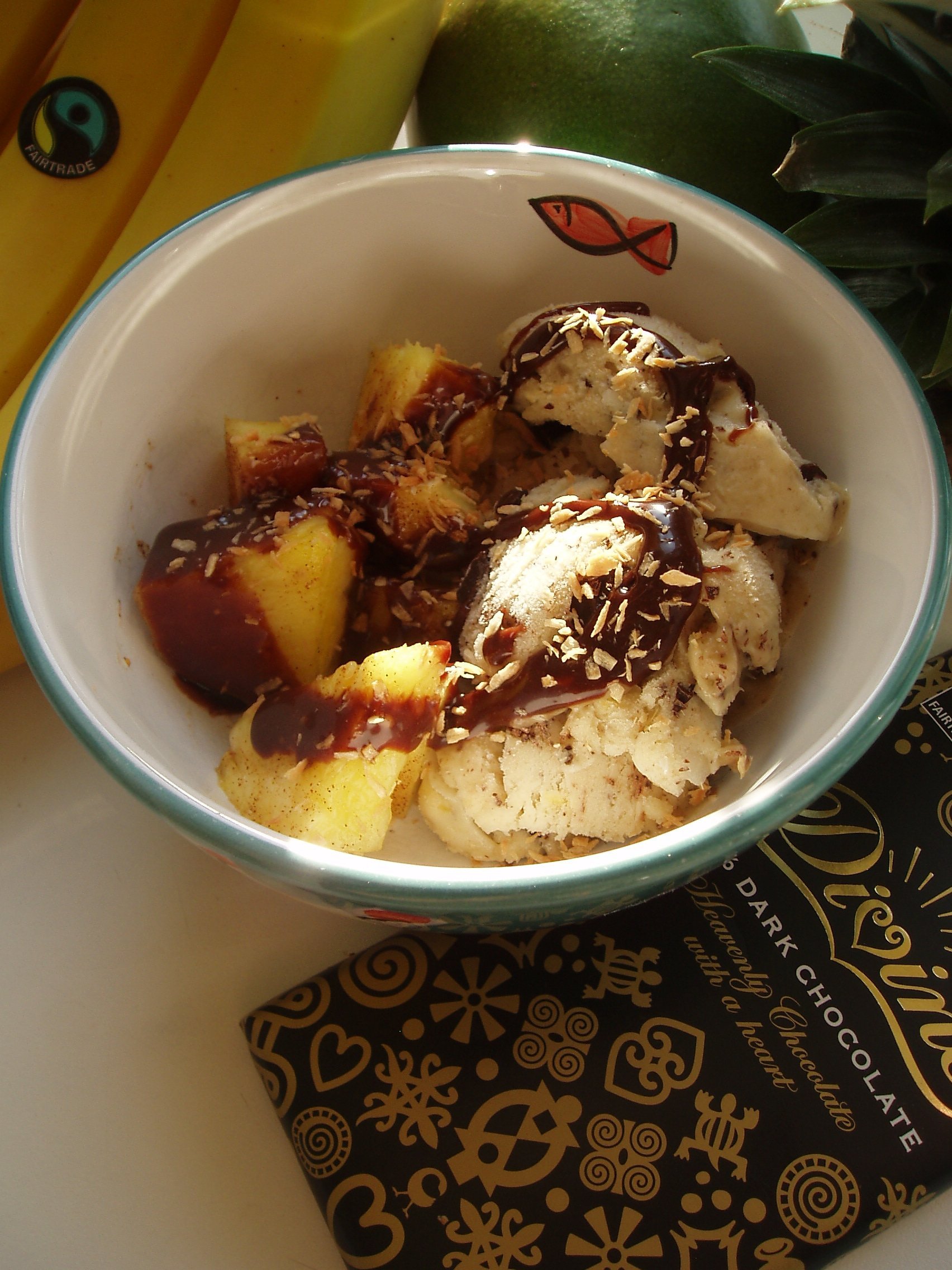
Rather than being a pure celebration of chocolate, my entry is therefore a recipe where the flavours of Côte d’Ivoire meet and unite.
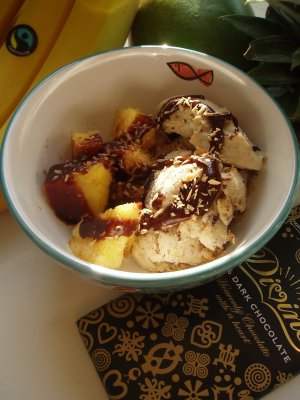
Flavours of Côte d’Ivoire

Flavours of Côte d’Ivoire

2 ripe, large bananas
1/2 tbsp golden castor sugar
1/2 fresh mango
50g Fairtrade plain chocolate, coarsely chopped

1/4 cup shredded coconut

1 pineapple, diced
1 1/2 tbsp golden castor sugar
1/4 tsp white pepper
1/4 tsp grated nutmeg
1/2 tsp ground ginger
1/2 tsp ground cinnamon

Chocolate Sauce

50g Fairtrade plain chocolate
1/4 cup creamed coconut
2 tbsp golden castor sugar
2 tbsp palm syrup
1 tbsp groundnut oil
1/4 cup water

Peel and slice the bananas. Freeze until solid (at least an hour). Blend in food processor with sugar and mango until creamy. Stir in the chunks of coarsely chopped chocolate. Scrape into a tub and freeze.

Spread the shredded coconut on a baking tray and toast in a hot oven (200 degrees C/ 400 degrees F) until just browning. Set aside.

Peel the pineapple and slice into rounds. Cut each round in quarters. Place on a baking tray and sprinkle with a mix of sugar, pepper, nutmeg, ginger and cinnamon. Cook in a pre-heated oven 200 degrees C/ 400 degrees F for 10 minutes. Cool to lukewarm.

Melt all of the chocolate sauce ingredients together over a low heat, stirring until the sugar is dissolved and the sauce is smooth.

Serve the spiced-pineapple quarters in a bowl with a scoop of banana-chocolate ice-cream. Drizzle with chocolate sauce and scatter with toasted coconut.

Chocolate Snickerdoodles

The school bells ring, it’s back to the classroom today for the start of the Autumn term. Where has the summer gone? Are we really gathering in the playground once again, anticipating apple-bobbing, bonfires and Christmas parties?

L seemed happy enough this morning as she caught up with her schoolfriends. Her younger sister wasn’t quite so sure as she waved goodbye to her holiday playmate (which is surprising really, given the amount of squabbling the two of them have engaged in these last few weeks).

I thought it would cheer up M if we made some cookies together (M especially enjoys baking when she doesn’t have to share the mixing with her big sister). Also, I though it would be nice to have some freshly-baked cookies to feed a starving schoolgirl at the end of her first day back.

As it happened, I was right on both counts!

Chocolate Snickerdoodles

Chocolate Snickerdoodles

2 1/4 cups caster sugar
1 teaspoon ground cinnamon
1 teaspoon ground ginger
1 teaspoon ground cardamom
1/2 teaspoon mixed spice
1/2 teaspoon white pepper
1/2 cup cocoa powder
1 cup butter
2 eggs
2 teaspoons vanilla extract
2 1/4 cups plain/all-purpose flour
1 1/2 teaspoons baking powder

Preheat the oven to 180 degrees C/350 degrees F.

Mix together the sugar and spices, then set aside 1/2 cup from the mix for rolling the cookies in later. Add the cocoa to the remaining spiced sugar. Stir well to combine thoroughly and break up any lumps in the cocoa powder (this saves having to sieve the cocoa – a messy job).

Cream the butter and sugar. Add the cocoa/sugar mixture and beat until combined.

Beat in the eggs and vanilla.

Add the flour and baking powder, stirring until well blended.

Use a dessert spoon to scoop out walnut-sized balls. Roll these in the reserved spiced sugar, then place 2″ apart on an ungreased baking tray.

Bake in the centre of the oven for 10 to 15 minutes. Allow to cool slightly on the tray before transferring to a wire rack.

Jam-Making Day

We returned from holiday with a bag of damsons from my mother-in-law. Carrying these into the kitchen on Sunday morning, O announced that it was the day for his annual jam-making. This year we would be having damson and bramble jelly.

Blackberries and Damsons

He disappeared to ring the church bells for the morning service and returned with a second bag, full this time with blackberries he’d collected from the hedgerows. I was dispatched to buy some jam-sugar and the kitchen was soon filled with the glorious smells of gently boiling fruits.

So far, so good …

The first casualty was a pair of oven gloves that somehow managed to catch fire on a hot ring (I wasn’t around at the time, but apparently they subsequently smouldered for some time in the bin before being doused with cold water). Never mind … at least the children had a realistic demonstration of kitchen safety!

The boiled fruits were then strung up in a muslin bag over a pan set in the building site attached to the front of our house (it’s actually an extension, but it seems to have settled into being around in our lives in a permanent state of incompletion).

Fruit Hanging

It was at this point that the flash on my camera decided to stop working, so I was unable to take a photo of the deep blood-red stains that dripped onto the concrete floor when the bag was being taken down. I wonder what the builders will think … when they reappear.

Children can be very distracting when you’re in the kitchen. They often appear to be at their hungriest and thirstiest at the exact moment that a sauce needs continuous attention or your hands are covered in sticky dough. Or they surround themselves with their toys on the kitchen floor and play around your legs. Or they drag chairs across the room and stand on them so that they can ‘help’. Apparently, my husband experienced several of these distractions while the jelly mixture was boiling rapidly … which is why the mixture was suddenly reduced by at least half a pint as it escaped from the pan and why the kitchen floor was cleaned that afternoon.

My husband has made jam once a year for some time now. I can remember eating his bramble jelly at least 5 years ago, if not longer. The only batch that didn’t set was his first … and the batch he made this Sunday. What to do with nine jars of fruit compote? On Monday morning, I tipped the whole lot back into the pan and re-boiled it. 106 degrees later, it flaked off the spoon and wrinkled across the saucer. Bingo – jam!

Cream Tea

Damson and Bramble Jelly

1.8 kg/4 lb mixture of damsons and blackberries
juice of 2 lemons
450ml/ 3/4 pint water
sugar (see method)

Put the damsons, blackberries and lemon juice in a large pan. Bring to the boil and simmer gently until the fruit is soft (about an hour). Stir occasionally.

Using either a jelly bag or a large muslin square, hang the fruity pulp over a large bowl and leave for up to 12 hours so that the juices drip through.

Discard the remaining pulp and measure the juices. Return these to the preserving pan and add 350g/12 oz of sugar for each 600ml/ 1 pint of juice extract.

Heat and stir gently until the sugar has dissolved. Bring to the boil and boil rapidly until setting point is reached – about 105 degrees C, when the mixture will run off a wooden spoon in flakes and hang from it in triangular gloops.

Remove any scum then pot and cover.

Scones

225g/8 oz plain or all-purpose flour
15ml/ 1 rounded tablespoon baking powder
2.5 ml/ 1/2 teaspoon salt
55g/2 oz chilled butter
150ml/ 1/4 pint milk

Preheat the oven to 220 degrees C/425 degrees F and set a shelf in the upper third.

Sift the flour, baking powder and salt together in a large bowl. Cut the butter into small pieces and rub gently into the flour mixture. Work as quickly and as lightly as possible and stop as soon as the mixture resembles coarse breadcrumbs.

Make a well in the mixture and pour in the milk. Use a palette knife to stir the mixture into a soft dough. Do not over-stir.

Turn the dough onto a floured surface. Knead very lightly and quickly until it is smooth, then pat into a flat shape no less than 1 inch thick. Use a fluted cutter to stamp rounds. Make sure that you don’t twist the dough as you lift the scones. This recipe makes about 6 or 7 scones.

Place on a floured baking tray and sprinkle the tops with a little extra flour. Bake at the top of the hot oven for about 7 minutes. The scones should be well-risen and brown (but don’t be tempted to open the oven door too soon to check their progress).

Leave to cool or eat hot from the oven with cream and jam.

  • Enter your email address to subscribe to this blog and receive notifications of new posts by email.

    Join 289 other subscribers
  • Seasonal Recipes

    candied peel

    baileys chocolate truffles

    gingerbread men

    mince pies

    fudge

    smarties cookies

  • Freshly Made

  • Categories

  • Favourite Feasts

  • Awards

    DMBLGIT Award
  • Archives

  • wordpress visitor counter
  • Adventures in food by Kate Coldrick from Woodbury in Devon.