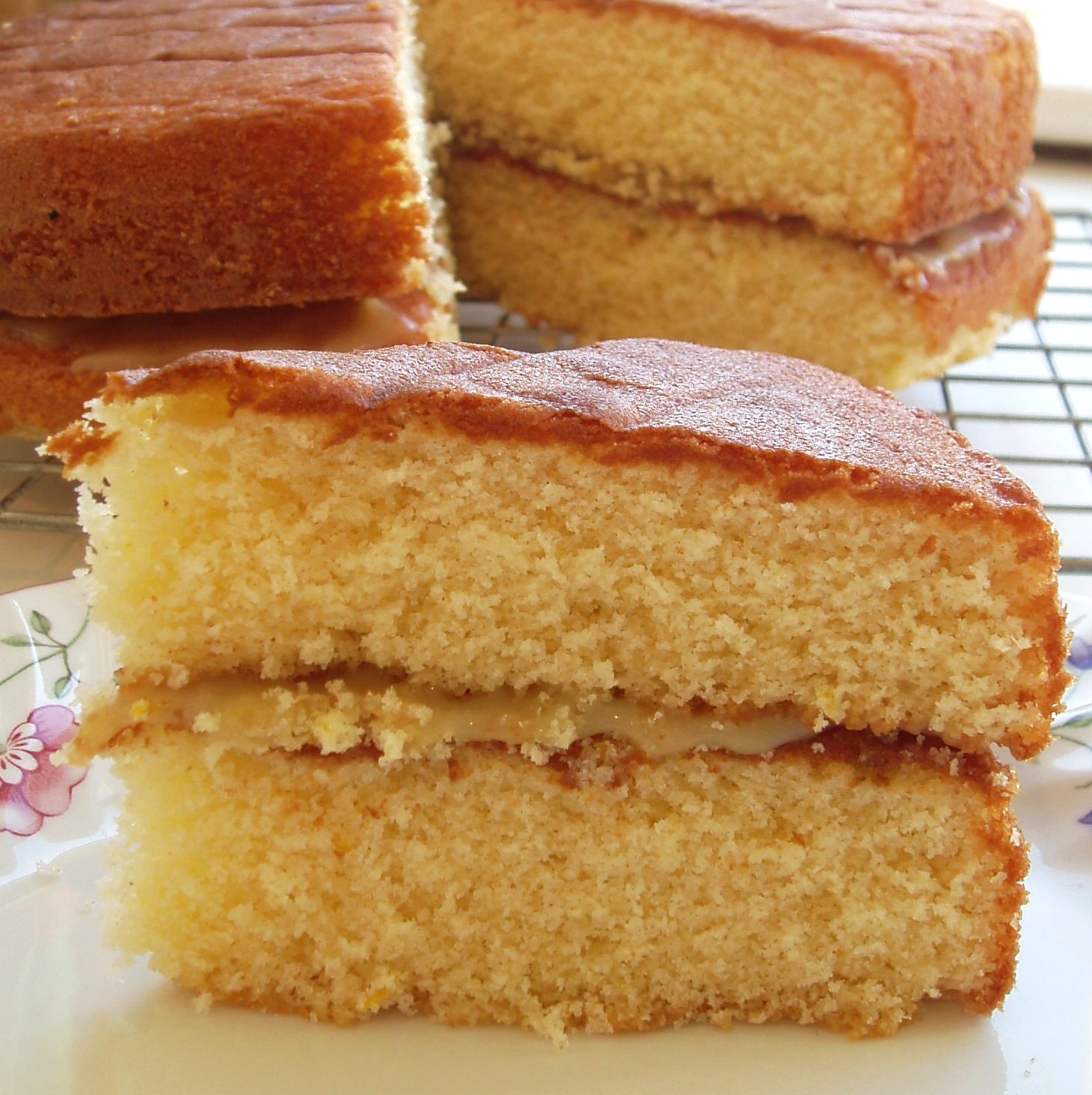
Finding the X Factor

Anyone who has watched Rose’s presentation on flour for the NYU Experimental Cuisine Collaborative may have noticed a point during the event where Rose explained to Woody that some kate flour would be coming his way from the UK. Well, it arrived … and from there we started an exciting series of cross-Atlantic flour experiments.

A few weeks ago, Woody made 2 yellow butter cakes – one with bleached cake flour and the second with kate flour. On the same day, I also made 2 yellow butter cakes – one with kate flour from the same batch as the flour I mailed to Woody and the second with a freshly-made batch of kate flour. My cakes were pretty much the same as each other, which showed that kate flour stores … and, more importantly in terms of the testing, that Woody could be fairly sure that the cake he was making was representative of cakes made with kate flour in the UK. From Woody’s cakes therefore, we were able to directly compare the baking performance of side-by-side examples of cake and kate flour.

We saw that cakes made with kate flour are yellower and have a coarser grain than those made with cake flour. Woody also noticed a taste he described as “slightly popcorny” in the kate flour cake, which we ascribed to the flour’s heat-treatment in the microwave. Additionally, the cake-flour cake was higher at both the sides and in the centre than the kate-flour cake. Here’s one of Woody’s photos (with my grateful thanks to him for recording his testing in such detail 🙂 ):
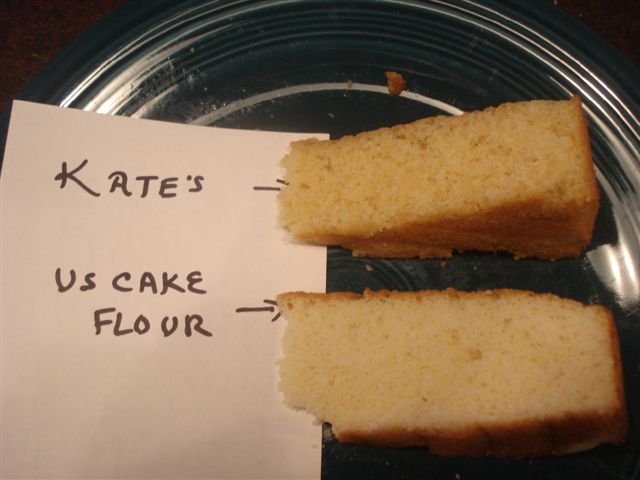
Side by Side Slices

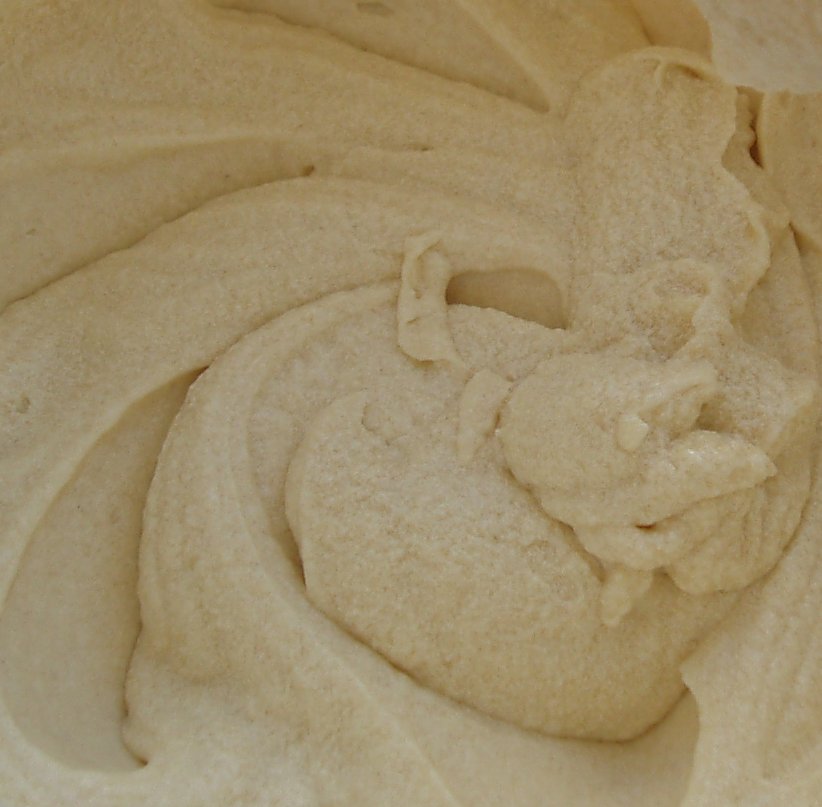
As a result of our cross-Atlantic flour experiments, I also had an opportunity to view and directly compare the batters produced by the two flours. Just as the finished crumb of the cake was coarser when using kate flour, so the batter appeared to be grainier and less gloopy than that of cake flour.

Cake flour batter …

Cake Flour Batter

… and kate flour batter …

Kate Flour Batter

Hmmm.

This was very interesting.

Both chlorination and heat-treatment of flour cause hydrophobicity of starch granules, which improves their oil binding ability and increases the stability of air bubbles in cake batter. It appears that chlorination induces this hydrophobicity through chemical changes, and heat-treatment through conformational changes to proteins on the surface of the starch granules (see this article by Masaharu Seguchi). However, it is likely that starch may be damaged during the microwave treatment of flour.

I discovered from the Food Industries Manual that cake flours need to be low in starch damage. This is because damaged starch granules have a greater affinity for water and can absorb more than twice their weight. Consequently, these starch granules have a lower capacity to bind water in a cake batter, which results in a lower viscosity.

The viscosity of batter is extremely important in defining the overall volume and texture of a cake. Heat from convection moves the batter and this flow has an effect on how the air bubbles incorporated in the batter disperse during baking. In batters with a high viscosity, the rate of gas diffusion is slowed so that air bubbles are encapsulated and retained. When hydrophobic starch granules are bound to the surface of these air bubbles through either chlorination or heat treatment, the bubbles are stabilized and expand uniformly. Cakes therefore have a high volume and fine, regular crumb grain.

In batters with a low viscosity, the convection flow is increased. Air bubbles rise quickly to the surface where they escape from the batter and are lost. Cakes therefore have a low volume and closed, irregular crumb grain.

Significantly, I also read in the Physico-chemical Aspects of Food Processing that it is the increased viscosity of batter made with treated flour that enables a lower amount of flour to be used in relation to sugar without risk of the cake collapsing. In other words, a higher viscosity is crucial to the success of high-ratio recipes. A reduction in flour is desirable because it decreases the starch content level of the cake and causes the crumb to have a softer texture than the crumb of a cake with a higher starch content.

It follows that any damage to starch during the microwave treatment of flour leads to a lowering in the viscosity of a cake batter made with this flour. Could this explain the differences I observed in the batters of cake and kate flour? Armed with a new set of key words, I headed once again for Google.

It turns out that in 1995, a group of cereal chemists from Kansas showed that the addition of xanthan gum to heat-treated flour increased the viscosity of batter and gave rise to an improvement in the volume and texture of cakes made with this flour. This is supported by findings two years earlier suggesting that the insensitivity of xanthan gum to temperature allowed batters to remain highly viscous for longer during baking. As a result, the batter could expand more before the structure of the cake set.

I also discovered a patent in which advantages were claimed for the addition of a non-flour fibre to heat-treated flour:

The addition of a non-flour fiber to the high ratio baking composition of the present invention is essential for obtaining baked volume, improved organoleptic properties and uniform cell structure.

The inventors used oat fibre. However, it is striking that xanthan gum is also a fibre source.

Xanthan gum is widely used as a substitute for gluten in gluten-free baking. I found a bottle of it in the ‘Free-From’ aisle of my local Tesco supermarket. Apparently, it is effective in relatively small amounts. The Kansas chemists recommended adding 0.12% of the weight of the batter in xanthan gum to the dry ingredients before mixing.

I discovered something further from this most recent research. As we had come to suspect, it seems that the crucial factor in heat treatment is the structural change to the starch granules, rather than the reduction in moisture levels per se. It is therefore both possible and beneficial to re-hydrate the flour after heat treatment:

After the heating is completed, the soft flour may be tempered to replace the moisture in the soft flour. Tempering is a process where the soft flour is spread out in a thin layer in a cabinet with humidity control and the flour absorbs moisture from the humidified air until the flour reaches the equilibrium moisture level.

Okay … I could do that!

This is what happened. I microwaved the flour in the usual way, being careful not to increase the temperature so quickly that the flour browned. In practice, this meant that I microwaved the flour in short bursts of no more than 30 seconds at a time. I then spread it out on a baking tray and popped it on the middle shelf in the (cold) oven. I boiled the kettle and filled a second baking tray on the bottom shelf with boiling water. I shut the oven door and waited while the water cooled. I then emptied the water-tray and refilled it a second time with boiling water. Door shut – flour in steam bath. When the flour had cooled, I sieved it. I used 4 1/4 oz of this flour + 1 oz cornflour + 1/4 tsp xanthan gum (kate x flour!) as a replacement for cake flour to make a 9″ x 1 1/2″ yellow cake.

Here is the batter:
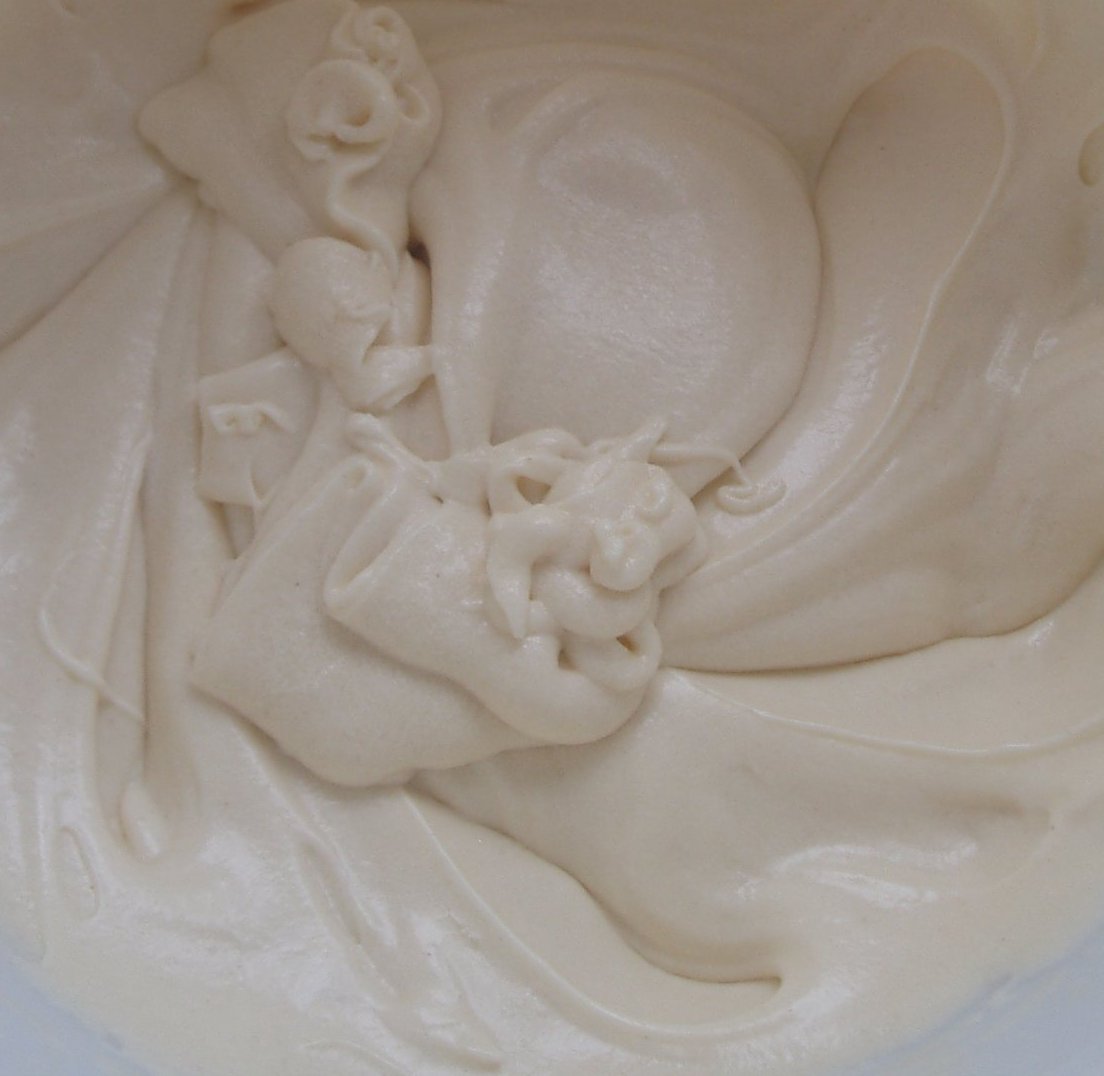
kate x flour batter

And here is the cake:

kate x flour cake

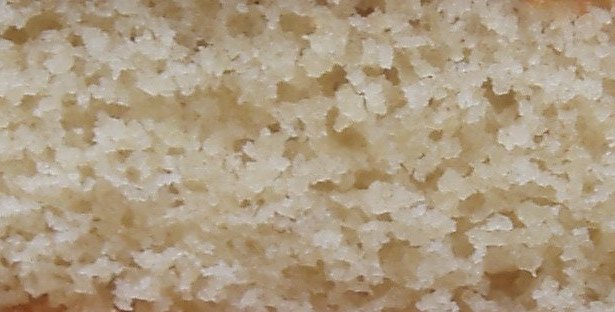
Closer views of the crumb of cakes made with cake flour …

cake flour crumb

… kate flour …

kate flour crumb

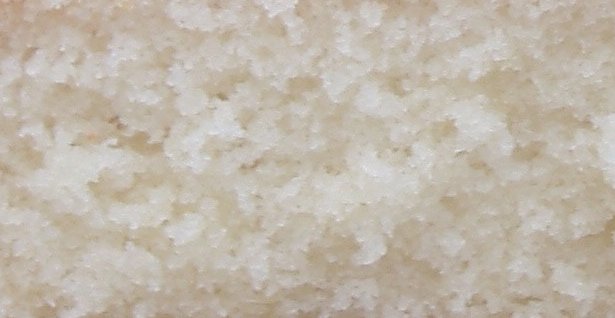
… and kate x flour …

kate x flour crumb

… suggest that we are heading in the right direction. Is xanathan gum the missing x-factor?

Buttercupcakes

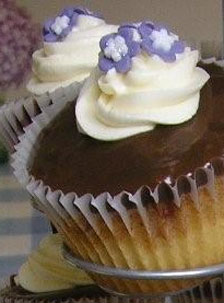
I’ve hinted in previous posts and comments about how busy I’ve been recently, hoping that I may be forgiven for my comparative neglect of A Merrier World. One of the many things that has been occupying me (and one which I so far haven’t mentioned) is my tentative first steps into the world of web design. A couple of months ago, a happy coincidence resulted in my offering to create a website for a friend’s new business … which just happened to be in baking and selling cupcakes.

What a wonderful opportunity, to practise on a subject so in tune with my own interests! I’m in awe of the imagination and perfection of my friend’s cupcakes. This is baking artistry in miniature – heaven and earth in one container.

So … to see my own latest (inedible) creation or, better still, to order a box of my friend’s delicious cupcakes, visit Buttercupcakes.

A Cake for Spring

Although my children and I have been hit by a resurgence of a nasty, child-borne sickness bug over this last week, and although I’ve been shivering in the cold rain and winds, it’s Easter today and Spring is certainly sprouting. I haven’t blogged or baked much for several weeks (more later, I’m sure, about how involved I’ve become with our local Pre School), but I couldn’t let this time of year pass by without any acknowledgment. And I also still need to fix a date with Melinda and Jeannette for April … and what better way to say hello again than to bake a cake for you both? 🙂

And so yesterday, I buffered myself with paracetamol and made Rose Levy Beranbaum’s Sour Cream Coffee Cake. With apples. And no coffee (it’s taken me a while to come to terms with this apparent misnomer, but I think I understand it now – it’s a cake to eat with coffee and not a cake made with coffee). My stroppy-but-gorgeous 2 1/2 year-old finally broke her sickness-induced fast to try some of this cake today when I took it to friends’ for dinner … and then she ate a second slice when we arrived home this afternoon. So far, I have only tried a thin sliver, but there’s a larger slice remaining for me if I feel any better tomorrow. And oh – it apparently pairs beautifully with a large dollop of Tate and Lyle’s Golden Syrup ice-cream (but there isn’t any of that left now, so I’m unable to comment!).

Sour Cream Coffee Cake

Lemon Cake and Cauliflower

I’m guilty of committing a bad scientific sin. I have a glorious cake sitting on my kitchen worktop and I have no way of knowing which of the variables I changed was responsible for its glory. Why? Because I changed all of the variables at the same time!

Was it because I increased the amount of cornflour I added to the flour? Was it because I microwaved the cornflour as well as the flour? Or was it because I had a craving for lemon cake and added some lemon juice, which is acidic?

I’m grateful to Adrian for his comments both here and on Rose’s blog – his observations and clear thinking prompted me to revisit the way in which I typically make up batches of ‘kate flour‘ and have resulted in a much easier and less messy method for its preparation. His questions have also lead me to try increasing the amount of starch so that the protein content of the flour/cornflour mix matches that of cake flour, as well as to introduce something acidic into the recipe to mimic an additional effect of chlorination on flour.

I can certainly confirm that these changes have all proved successful. My lemon cake is beautifully light, fine-textured, moist and well-risen. My sink and dish-cloths are also less clogged up with flour spillages, which is something that will please my husband. Whether or not these changes were all necessary … I really can’t say!

Lemon Cake

Lemon Butter Cake
Adapted from a recipe by Rose Levy Beranbaum

9 1/2 oz Italian 00 Grade flour (or plain flour)
2 1/2 oz cornflour
4 oz egg yolks (approx 6 egg yolks)
8 1/2 oz milk
2 1/4 teaspoons lemon juice
1 tablespoon grated lemon zest
10 1/2 oz castor sugar
1 tablespoon + 1 teaspoon baking powder
3/4 teaspoon salt
6 oz unsalted butter, softened

Grease, line and flour two 9″ x 1 1/2″ cake pans. Preheat the oven to 180 degrees C.

Place the flour and cornflour in a mixing bowl and whisk to combine. Put the mixture into a pyrex pie dish (not a bowl – the flour mix should be at an even depth of about 2cms). I’ve found that a pie dish is less messy than a plate when stirring the flour! Microwave the mixture at 750W for 4 to 5 minutes, stirring well at the end of each minute (I use a fork to fluff it all up and disturb any hot spots).

Remove the pie dish carefully from the microwave using oven gloves. Sieve and discard any residue. Set aside to cool further.

Combine the egg yolks, 2 oz of the milk, lemon juice and zest in a bowl. Set aside.

Weigh out 10 1/2 oz of the flour mix – any remaining flour can be discarded or used to flour your cake pans. Sieve the flour mix into a large mixing bowl and add the sugar, baking powder and salt. Mix slowly to combine.

Cut the butter up into small cubes and add to the dry ingredients. Add the remaining milk. Mix together slowly at first to moisten the dry ingredients, then beat for 1 1/2 minutes at medium speed (I go to no. 4 on my Kenwood).

Beat in the lemony-egg mixture in 3 batches, scraping down the sides of the bowl after each batch to make sure that all ingredients are combined.

Divide the batter between the two prepared cake pans and smooth with a spatula. Bake in the centre of the oven for 25 to 35 mins until the top is springy but the sides have not yet started to shrink. Cool on wire racks for 10 mins before removing the cakes from the pans.

What about the cauliflower? Well, we went to Dart’s Farm this morning and there in the entrance was a table stacked high with the most wonderful cauliflowers I have ever seen. And they were all grown locally in Budleigh. I don’t even really like eating cauliflower, but I couldn’t resist buying one of these beauties!

Cauliflower

Here’s a Health

It is January 25th, wha hae … and here’s a health to all as we honour the birthday of the great Scottish poet, Robert Burns.

Originating from our student days in Glasgow, my husband and I have carried the traditions of Burns Night with us in our gradual migration to the South-West of England. In 1998, we celebrated our first Burns Supper south of the border with a party of vaguely bemused friends, a vast quantity of haggis and a large bottle of whisky. Ten years and three children later, we will still be celebrating tonight with haggis, neeps and tatties along with the essential single malt whisky (albeit in slightly reduced quantities to those of 1998!).

Burns Night

It’s not too late for anyone to join us – here’s a simple recipe for a successful Burns Night Supper wherever you may be …

1. Track down a haggis (don’t believe those stories of wee hairy beasties roaming the Scottish countryside, one pair of legs shorter than the other since they spend their time spiraling steep slopes – try your local deli instead).

2. Remove any plastic covering. Wrap the haggis in kitchen foil (in case it bursts), place in a roasting dish and fill with water so that it reaches about halfway up the side of the haggis. Cook at 180 degrees C for about an hour or so until the haggis is heated through.

3. Peel and boil (in separate pans) your turnip (swede for those south of the border 😉 ) and potatoes … neeps and tatties. Mash.

4. Find someone to play the bagpipes for you while the haggis is cooking (warning: you’ll need to wear industrial-strength ear plugs if your rooms are small – I speak from experience, having survived a piper’s attempts to deafen all in the Uisge Beatha one Burns Night). Alternatively, put on some traditional music or hum a Scottish jig (Linn Records do a Robert Burns Series of CDs that are excellent).

5. Serve the neeps and tatties on a plate. Pour a dram of whisky. Say the Selkirk Grace …

“Some hae meat and canna eat,
And some would eat that want it,
But we hae meat, and we can eat,
Sae let the Lord be thankit.”

6. … then play a rousing tune as you ceremonially carry the haggis to the table. This is called ‘piping in the haggis’.

7. You should now address the haggis. At the appropriate place in this rendition, raise a knife dramatically, stab the haggis savagely and split it along its length …

“Fair fa’ your honest, sonsie face,
Great chieftain o’ the puddin-race!
Aboon them a’ ye tak your place,
Painch, tripe, or thairm:
Weel are ye wordy o’ a grace
As lang’s my arm.”

8. Raise your dram in a toast to ‘The Haggis’.

9. Eat and drink muchly.

10. Give a toast to ‘The Immortal Memory of Robert Burns’, celebrate his works with enthusiasm (one of my favourite songs is Kellyburn Braes) and wish a health to absent friends.

11. End your evening with a rendition of Auld Lang Syne:

“Should auld acquaintance be forgot
And never brought to mind?
Should auld acquaintance be forgot,
And auld lang syne?

For auld lang syne, my jo,
For auld lang syne,
We’ll tak a cup o’ kindness yet,
For auld lang syne.”

Happy Burns Night – Slainte 🙂

  • Enter your email address to subscribe to this blog and receive notifications of new posts by email.

    Join 289 other subscribers
  • Seasonal Recipes

    candied peel

    baileys chocolate truffles

    gingerbread men

    mince pies

    fudge

    smarties cookies

  • Freshly Made

  • Categories

  • Favourite Feasts

  • Awards

    DMBLGIT Award
  • Archives

  • wordpress visitor counter
  • Adventures in food by Kate Coldrick from Woodbury in Devon.