Wholemeal Sandwich Bread

It was difficult to maintain our normal cooking and baking activities last month whilst our kitchen was being pulled apart and rebuilt. Although I was usually able to put something together from scratch in a casserole pot for our evening dinner, we did have to resort to buying the plastic-wrapped, pre-sliced stuff that for some unknown reason is commonly referred to as ‘bread’.

I missed my homemade bread greatly during this time and actually couldn’t bring myself to put any of the supermarket variety in my trolley on shopping trips. Poor O became used to my evening phone calls to him at work, confessing that we had run out of bread and could he pick some up on his way home?

Once the builders were gone, I still didn’t feel able to make any bread until the dust had settled a little. I know that some input from the local environment may be desirable in breadmaking, but I didn’t think the sentiment extended to particles of plaster from our ceiling. And so, for these last few weeks, I have been waiting somewhat impatiently for an opportunity to get my hands sticky again in bread dough.

Whilst I was twiddling my thumbs, I discovered some locally-grown and stoneground wholemeal flour in a local farm shop. I can imagine now that anyone who knows this area of Devon is picturing me at Dart’s Farm, buying flour from Otterton Mill πŸ˜‰ . As wonderful as those places are, I was on an alternative tourist route. I was at the up-and-coming Greendale Farm Shop (which I still prefer to think of as Random Poultry – it’s a much snazzier name) and the flour was from Sidbury Watermill.

Being a numpty, I managed to return home with a packet of plain rather than strong wholemeal flour for my long-awaited loaves. Believing also in the sparkles of serendipity, I’m now looking forward to trying out some wholemeal cakes and pastries. However, I can also confirm for any other numpties out there that Sidbury Mill’s stoneground, plain, wholemeal flour is perfectly adapted for giving a ‘wholemealy’ bite to homemade, soft sandwich bread.
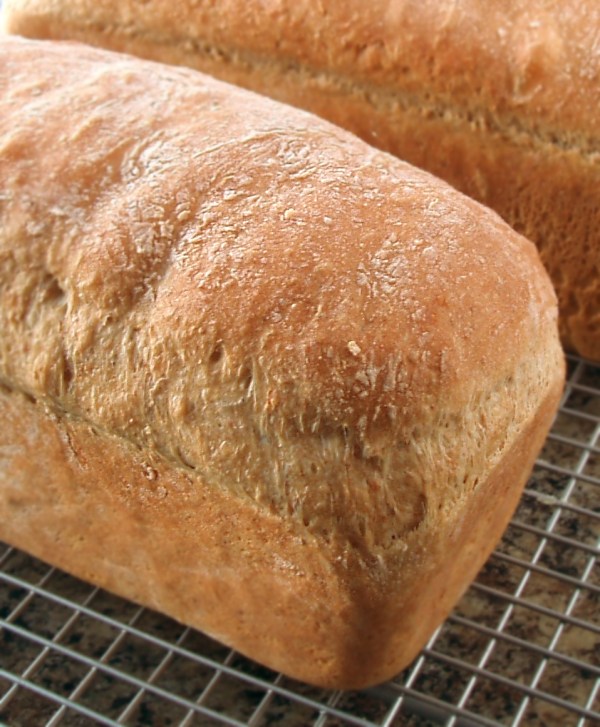
wholemeal loaves

I can probably call the recipe my own, although it is through the genius of far more knowledgeable bakers than myself that I’ve been able to end up with this amalgamation of ingredients and quantities. It is very much an ongoing work-in-progress as I seek to find a sandwich loaf that my husband prefers to those plastic things in plastic wrappings that you find on supermarket shelves.

wholemeal bread

Wholemeal Sandwich Bread

18 oz water
20 oz strong white flour
1 x 7g sachet instant yeast
6 oz stoneground plain wholemeal flour
4 oz plain white flour
1 egg
1 oz butter
1 tbsp salt
1 tsp barley extract
1 1/2 tsp natural molasses sugar

In a large bowl, mix 10 oz of the strong white flour with all of the water and half of the yeast. Whisk to create bubbles in the batter.

Combine the remaining yeast with the remaining flours and sprinkle on top of the batter so that it is entirely covered. Cover the bowl with clingfilm and leave at room temperature for between 1 and 4 hours.

Add the remaining ingredients to the bowl and stir with a big wooden spoon until all the dry stuff is moistened. Scrape out onto the worktop and cover with the upturned bowl. Leave it all like this for about 15 minutes so that the dough becomes less sticky.

After resting, the dough will still be quite wet but it shouldn’t stick to your fingers too much. Flour your hands if it does, but don’t add too much extra flour at this stage.

If you’re like me and only have one bowl large enough for breadmaking, cover the resting dough with clingfilm while you wash out the bowl and grease it with a little olive oil. Otherwise, go ahead and prepare your oiled bowl at any point before now.

Knead the dough for 8 to 10 minutes. Place it in the oiled bowl and cover with clingfilm. Leave it until doubled in volume, about 1 1/2 hours.

Divide as required, shape and place in loaf tins. I use two loaf tins – a small tin that holds 3 cups of water and a larger tin that holds 7 cups of water. M thinks I make a Mummy loaf and a baby loaf πŸ˜‰ .

Cover (I like to flour my clingfilm now before covering the tins so that it doesn’t stick to the dough when I forget to take it off early enough as it is rising) and leave until doubled in volume (this happens more quickly in my baby tin).

Bake at the bottom of the oven for 10 minutes at 220 degrees C, then lower the temperature to 200 degrees C and bake for a further 20 to 30 minutes (or 15 minutes for really babyish loaves). Turn out and stand on a wire rack to cool.

I’m sending these loaves to Susan for her weekly showcase of all things bread, YeastSpotting.

Smarties Cookies

It’s half-term this week, which means wall-to-wall kids at home. Although it’s bad news for housework, I love being able to spend the extra time with them all, especially while they’re so young. School holidays also provide a welcome break for me from the early morning shoe-hunts and last-minute rushes to the school gates. It doesn’t seem to matter how much time I leave for getting ready, there’s never enough of it left when it comes to actually getting out of the house before the school bell rings. Our very literal ‘school runs’ must be a familiar sight to everyone in the village!

It’s not quite true that our house has been filled with children all of the time so far this half-term, though. Throughout these last couple of days, L has enjoyed bending, stretching and otherwise launching herself into the air on a gymnastics course held in the local Primary school. If tiring out kids can be likened to dog-walking, then it’s always good news when you find others who are willing to help with a bit of stick-throwing πŸ˜‰ .

So while L was jumping up and down this morning, M, T and I went into Budleigh Salterton to order blinds for our kitchen windows. As we passed in front of The Crusty Rolle (a high-street bakery whose olde-worlde name is really a pun on the old Devon estate-owning Rolle family), M caught sight of some gigantic cookies decorated with Smarties in their window display. She pulled me to stop and her eyes went large.

“Oooo,” she whispered with reverence, “can we make some when we get home?”

Now, I’m sure that The Crusty Rolle’s cookies are truly excellent. But how could I refuse such a request from my little baker?

Back home, armed with several tubes of Smarties, M set to work in the kitchen. Apart from providing recipe-reading services, I really had very little to do except to keep T out of the sugar, flour, eggs … you get the picture πŸ˜‰ .

smarties_cookies

A Piece of Cake

Ever since my new cooker arrived nearly a month ago, I’ve been putting off that fateful moment when I would make my first kate-flour yellow butter cake in one of its ovens. What if it didn’t work? What if the cake pitted, collapsed and otherwise wimped out? What if … how horrible, but … what if … my old cooker was better ….?

There, I’ve said it, the thought that has been haunting me.

There would be no going back. M, T, the cat and I waved goodbye to our old cooker last week. We couldn’t just install it somewhere in the corner of the garage for those special, ‘butter cake’ moments.

Oh, the agonies.

So, you see, for me this isn’t just ‘yet-another-photo-of-one-of-those-cakes’. This afternoon, M and I (with a little ‘help’ from T πŸ˜‰ ) baked a miracle no less wonderful to us than our first-ever successes with kate flour.

Phew!!

a piece of cake

Italian-style Chicken Casserole

A few days after I posted a round-up of recipes that had been submitted to my Let Them Eat Chicken food-blogging event in July last year, I received an email from my sister. Admittedly a little late, she sent me her own chicken recipe in the hope that I would add it to my collection. I promised to do so … I really, truly meant to do so … it’s just that I’m a little late, too!

To make up for my negligence, I decided that the honourable thing to do would be to make my sister’s recipe for dinner one evening on my new range cooker. Perhaps she would think I’d been waiting all this time until our kitchen was finished so I could showcase her recipe in appropriate splendour …

Hmm, maybe not. My sister knows me too well πŸ˜‰ . Sorry, Lucy – I just forgot. Can you forgive me?

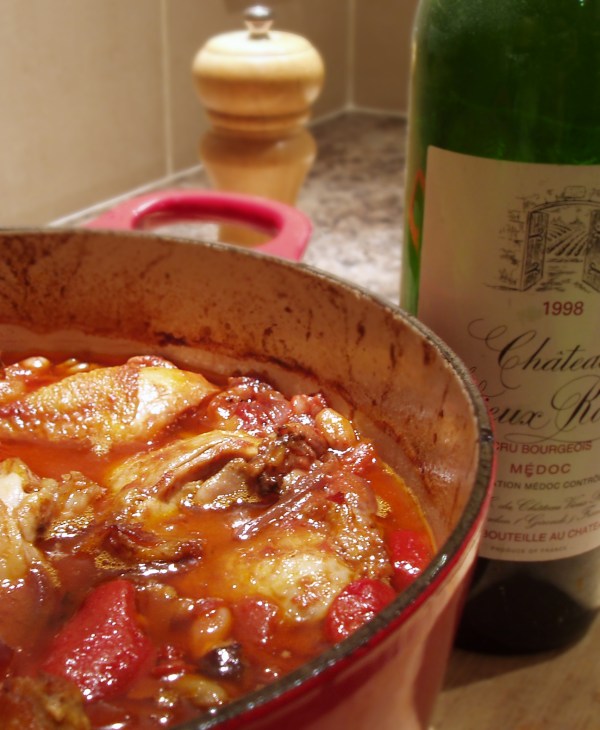
I have to say, it’s my own loss for having overlooked my sister’s recipe before now. O and I enjoyed a scrumptious chicken dinner a couple of evenings ago – a sort of coq au vin with an Italian twist. We ate ours with a pile of creamy mashed potato, although Lucy says it’s also good served with basmati rice.

You may remember that my sister once presented me with some cheese from Neal’s Yard Dairy in Borough Market? Well, when she has time, she likes to buy her chicken from a no less prestigious source nearby – Wyndham House Poultry (how I envy my sister’s shopping habits!). She says she discovered these butchers in a lovely book called Food Lovers’ London (she often refers to this book in her emails to me – I’ve got my fingers crossed that she might take me on a tour around its pages one day πŸ˜‰ ).

Living slightly too far away from Borough Market for a quick shopping dash in between the school runs, I chose to use thighs from Devonshire Red chickens that I bought in my local Sainsbury’s.

devonshire red

The Devonshire Red is a slow-growing breed reared free from the worst practices of intensive farming. The chickens’ higher welfare standards are assured by the RSPCA’s Freedom Food accreditation.

So, here it is – my sister’s chicken casserole … ta daaaaa!

chicken casserole

Italian-style Chicken Casserole

Serves 4

1kg free range chicken thighs and drumsticks
1 red onion, sliced
250ml red wine
1 tin of tomatoes
1 tsp smoked paprika
1 x 410g can cannellini beans, drained
1 x 450g jar roasted red peppers, drained and sliced (note: I roasted some red peppers myself to save a bit of money here)
2 sprigs rosemary, chopped

Preheat the oven to 180 degrees C/ fan 160 degrees C. In a large oven proof casserole dish, sear the chicken for 5 to 6 minutes until brown. Transfer to a plate.

Add the onions to the casserole dish and cook for 3 to 4 minutes stirring until softened. Pour over the red wine and simmer for 2 to 3 minutes to thicken.

Add the paprika, tomatoes, beans, peppers and rosemary. Put the chicken back in to the casserole dish too. Bring to the boil and cover.

Cook in the oven for 30 minutes until the chicken is tender and the juices run clear.

Devonshire Apple Cake

Four years ago this month, we moved a little bit further West along the South coast of England to a village in Devon so that my husband could take up a residency in clinical veterinary pathology at Exeter. When we moved, we had one daughter and a cat. Our ‘new’ house in Devon was dilapidated and old-fashioned with aluminium window frames, Imperial plumbing and rubber-coated electrical wiring.

Four years on and our lives have changed immeasurably. Two daughters and a son have taken control of every room in our house with their arsenal of toys. The rooms they run through are newly built and refurbished after a rennovation project that has taken the best part of the last two years to complete. I have several more grey hairs (hmm … I wonder why) and far fewer good nights of sleep πŸ˜‰ .

Every year on the anniversary of our move, my husband has taken a variety of baked goodies into work to share with his colleagues. This year, he requested an appple cake.

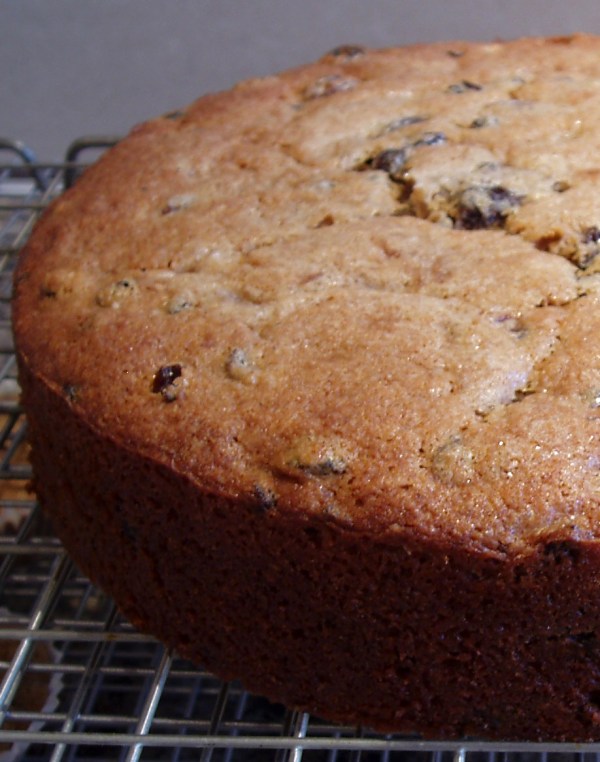
Living in Devon, I thought it might be symbolic to try a recipe for Devonshire Apple Cake that I found in a cookbook by Margaret Wilson. As if to prove Melinda’s theory of the British and their propensity for dried fruits, the recipe does indeed include a substantial amount of raisins and currants in addition to the namesake apples. Inspired by Melinda’s observations, I not only soaked these in water before using them in the recipe, but also added a tot of whisky left over from our Burn’s Night celebrations (it worked well and the dried fruits were deliciously plump and moist, but perhaps apple brandy would have been more in keeping …?!).

apple cake

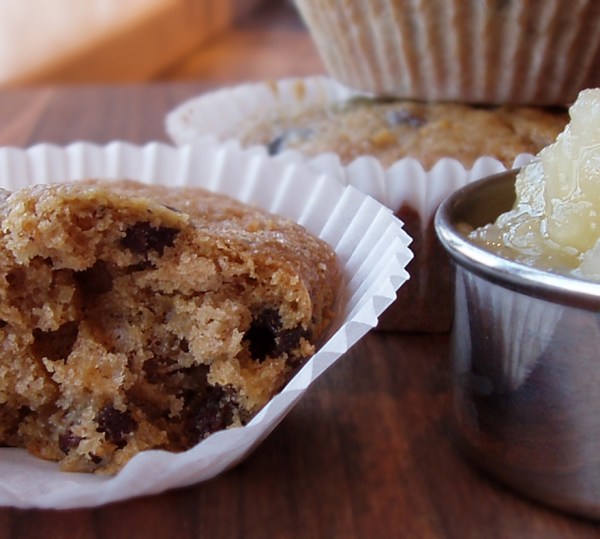
A word of warning: the recipe stipulates using an “8-inch shallow cake tin”, which in my mind translates to something like my 8″ x 1 1/2″ pan. The little line drawing underneath the recipe in my book shows a circular cake, so I assume that the pan is intended to be round. When I came to fill my 8-inch shallow cake tin with the batter, it was obvious that my idea of ‘shallow’ is somewhat less generous than that of Margaret Wilson as my poor little pan was soon drowning under an engulfing splurge of cake mixture. I hastily dug out some cupcake cases from my newly-organised baking shelf and scooped out a good 7 cupcakes-worth of batter from the pan. Fortunately for me, this near-disaster at least provided me with some miniature samples of my own to taste – my husband and his colleagues devoured the cake-proper today, leaving not a single crumb.

apple cupcakes

Devonshire Apple Cake (adapted from a recipe by Margaret Wilson)

225 g (8 oz) plain flour
1 tsp bicarbonate of soda
1/2 tsp cinnamon
1/2 tsp ground ginger
1/2 tsp mixed spice
275 g (10 oz) mixed sultanas, raisins and currants
2 eggs
450 g (1 lb) cooking apples, peeled and chopped
150 g (5 oz) unsalted butter
175 g (6 oz) light muscovado sugar
pinch of salt
caster sugar for sprinkling
grated rind of 1 lemon
2 tbsp Devon cider

Grease and line an 8-inch shallow cake tin with parchment paper. preheat the oven to 325 degrees F/170 degrees C.

Soak the dried fruit in hot water (plus a tbsp of whisky or apple brandy) for 10 minutes.

Meanwhile, cook the apples in the cider until they are soft and mushy. Mash any remaining lumps with a fork. Leave to cool.

Cream the butter, sugar and lemon rind in a large bowl. Gradually beat in the eggs.

Sieve together the flour, spices, bicarbonate of soda and salt. Fold in alternately with 225 ml (8 fl oz) of the apple sauce (feed the remainder to your youngest child πŸ˜‰ ).

Strain the dried fruit and stir into the mixture until evenly incorporated.

Place the mixture in the prepared cake tin (until no more than 3/4 full – use any remaining mixture to make cupcakes πŸ˜‰ ). Sprinkle the top with castor sugar.

Bake in the centre of the oven for 1 to 1 1/2 hours (note: my own ‘shallow’ cake was done in 40 to 50 minutes; the cupcakes took 12 minutes). Cool in the pan for 10 minutes before transferring to a wire rack.

  • Enter your email address to subscribe to this blog and receive notifications of new posts by email.

    Join 289 other subscribers
  • Seasonal Recipes

    candied peel

    baileys chocolate truffles

    gingerbread men

    mince pies

    fudge

    smarties cookies

  • Freshly Made

  • Categories

  • Favourite Feasts

  • Awards

    DMBLGIT Award
  • Archives

  • wordpress visitor counter
  • Adventures in food by Kate Coldrick from Woodbury in Devon.