Double Chocolate Chip Cookies

It’s strange to start a post about double chocolate chip cookies by talking about apple pie, but it was the pie that started it all. O and the girls went blackberry-picking this weekend. It’s slightly too early in the season really, but October will be too late (which is when O will return from the States) and he wanted to make some blackberry jam again this year. The jam was not to be (too few blackberries), but they did return from their Expotition with enough fruit for an apple and blackberry pie.

Living in Devon, we have a ready supply of clotted cream and, since we were entertaining relatives, we decided to splash out on some to go with the pie. But I splashed out rather excessively. Once the pie had all been safely tucked away, we were still left with about half of the pot I’d bought of clotted cream.

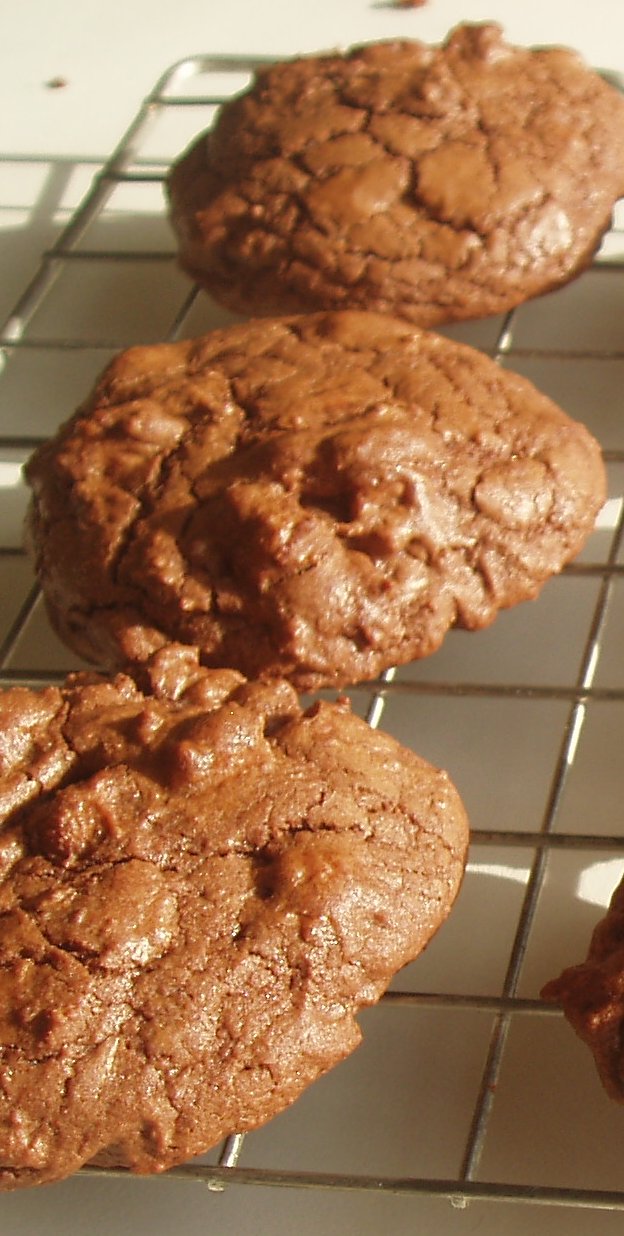
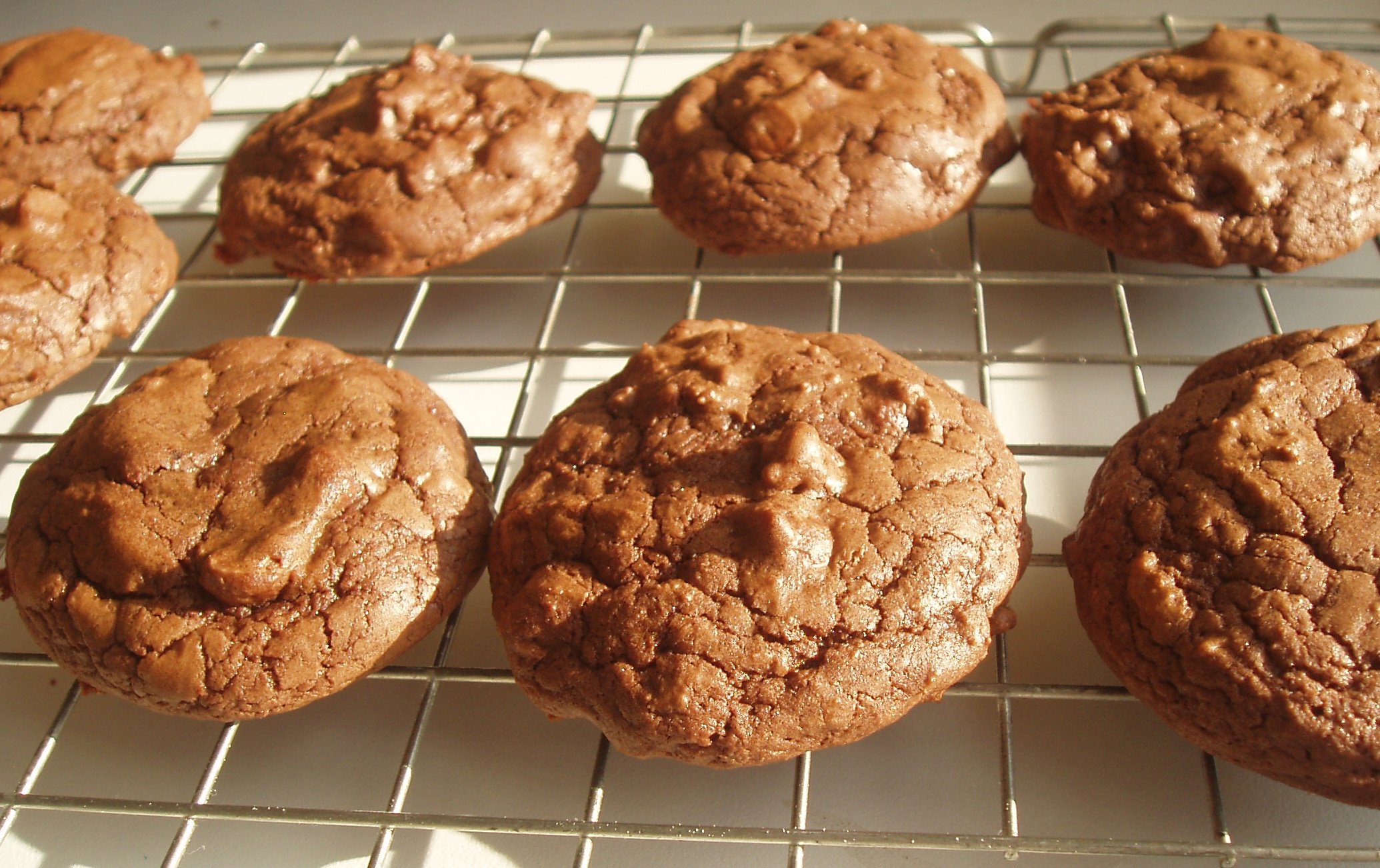
Now, I’m not sure about the regularity of this, but the girls were clamouring for cookies and I had everything I needed … except butter. I know it’s not the same (weighing in at a fat content of only 55% as opposed to butter’s 81%, among other things), but I remembered using clotted cream in place of butter last year when I made Devon Flats. If it hadn’t been for the clotted cream sitting in fridge, I would probably never have tried this, our very own version of double chocolate chip cookies (based loosely on a recipe for Mocha Truffle cookies that I’d jotted down some time ago in my recipe folder).

All I can say is … yummy!

Oh, before I write out the recipe, I should mention that I made a few flour alterations (is that a surprise?!). I used strong, white bread flour to give a protein content of about 12%. I microwaved 10 oz of this flour until it reached 110 degrees C (cookies are forgiving, after all), then re-hydrated it by shutting it in the oven a few times with a bowl of boiling water. I sieved the flour to remove the lumps before weighing out the 8 oz I needed for the recipe. I can’t say definitively that any of that was absolutely necessary as I haven’t tried this recipe any other way. From past experience however, it gives a more rounded, crunchy-on-the-outside/chewy-in-the-middle result than you get in cookies made with untreated flour.
Double Chocolate Chip Cookies

4 oz clotted cream
3 1/2 oz Divine milk chocolate
1 teaspoon instant coffee granules
8 oz strong, white bread flour
1 1/2 oz cocoa powder
1/2 teaspoon baking powder
1/4 teaspoon salt
5 3/4 oz dark brown muscovado sugar
5 1/4 oz castor sugar
2 large eggs
2 teaspoons vanilla extract
7 oz chocolate chips

Melt the clotted cream, milk chocolate and coffee granules together in a small saucepan. Pour/scrape into a large mixing bowl and leave to cool.

Combine the flour, cocoa, baking powder and salt in a separate bowl. Whisk to mix thoroughly.

Add sugars and eggs to the chocolate/cream mix. Beat to combine.

Add the dry ingredients and stir until incorporated.

Fold in the chocolate chips. The cookie dough will be quite sloppy.

Refrigerate the dough for at least 30 minutes, then drop by the tablespoon onto an ungreased baking tray (I used a silicone liner).

Bake for 10 to 12 minutes at 180 degrees C in the centre of the oven.
One Year On

On Saturday, it will be A Merrier World’s first anniversary. In an ideal world therefore, I’d be making this post on August 9th. However, it’s the middle of the Summer holidays and I have 3 small children for whom I’m full-time entertainer, cook, cleaner, doctor, teacher and chauffeur, not to mention variously worst-enemy/best-friend depending on how their mood takes them. At the risk of completely missing a date on Saturday therefore, I’m getting my celebrations in a few days early!

This time last year, I was in the throes of my quest for the perfect brownie. I remember very clearly the trepidation bordering on writer’s block that accompanied my first post. But the deed was done and I launched myself into a journey of discovery. I didn’t realise then that this adventure would take me into the depths of starch molecules and back out through the worst practices of the broiler chicken industry. Rose Levy Beranbaum was a distant name a year ago … I had yet to come across the Cake Bible!

A year ago, we had builders working on our house. Oh … well, actually … nothing’s changed there, then! We still have builders working on our house! A few days ago, they fitted our wood-burning stove and built a warming brick fireplace. They could probably tell you as much as anyone about my baking experiments this past year – indeed (dare I say it?!), without their willingness to clear away my ‘scientific results’, my freezer may well have become so full of cake that I wouldn’t have been able to continue πŸ˜‰ . If anyone’s to thank for kate flour, it’s probably Exeter Lofts!

Perhaps I should have baked a cake for my blog’s 1st birthday. Well, I haven’t. Instead, I’ve decided to feed my family with a special granary and spelt bread.

Why do I think this bread is special? Well, it’s an entirely personal reason and I don’t expect anyone else to find it ‘special’. It’s simply because I was intrigued by the antiquity of spelt a few months ago and ever since then I have been attempting to produce a bread from it that I actually enjoyed eating. But I couldn’t. The thing is, I just don’t really like the taste of full-blown spelt.

I have made loaves from 100% spelt, 50-50 mixes of spelt and even a mix that sounded wonderful in principle (spelt, rye, oats and apple) but ended up being entirely inedible and ruined a perfectly good bread pan when I had to scrape down the sides to turn it out! I had almost given up, but my remaining bag of spelt flour was due to be thrown out this month and I couldn’t bear to waste it.

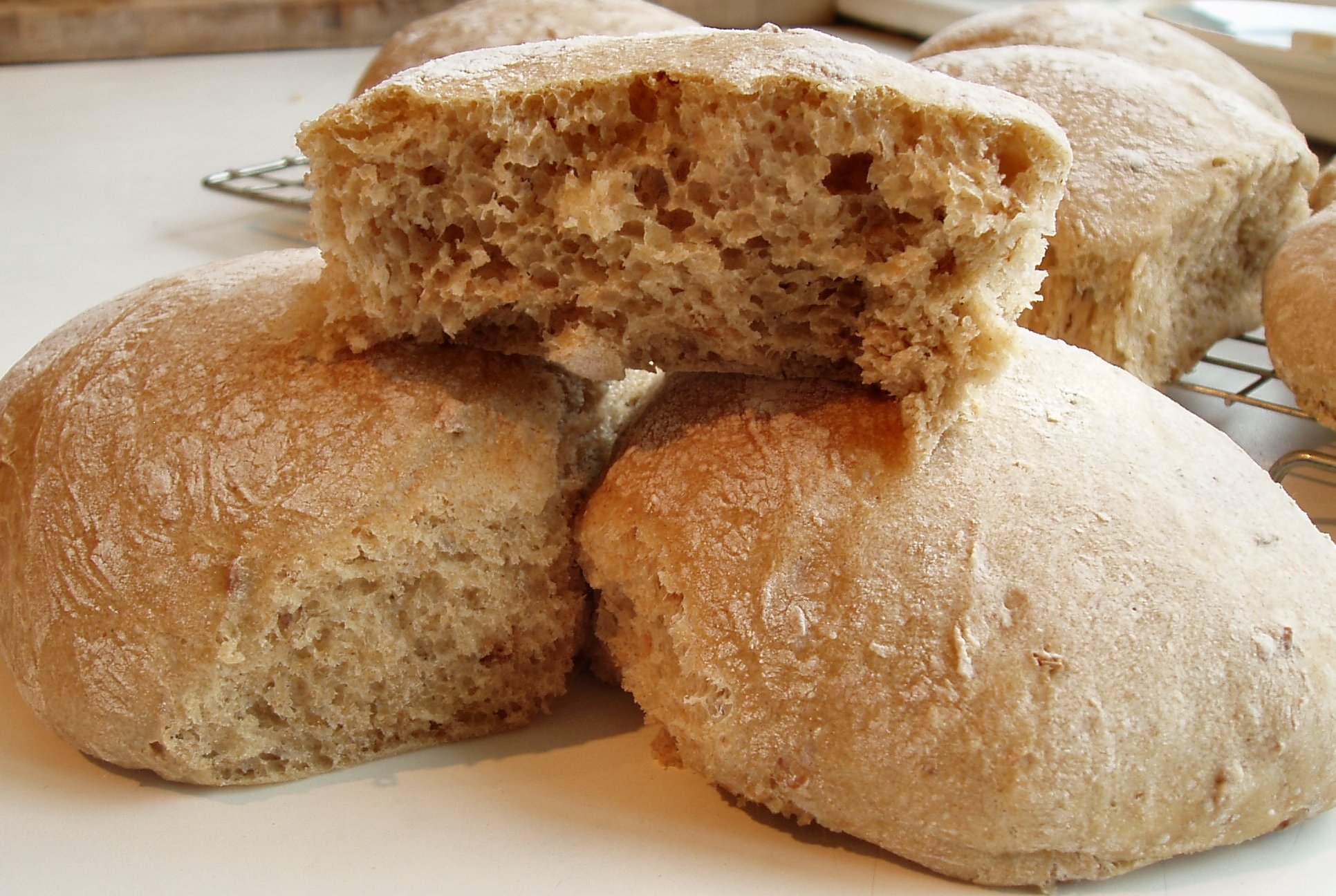
And so, this last week I had another go (well, three goes actually … look in my freezer!). I have found that I can get just the right amount of spelt-nuttiness from the flour by combining a small amount with a malted granary flour from Otterton Mill. Inspired also by my recent successes in substituting a bit of strong flour with Italian flour in my regular white bread recipe, I have also discovered that mixing these spelt and granary flours with plain bread flour and a soft wheat 00 grade flour produces a moist, flavoursome bread without the density I normally associate with wholemeal and granary breads. My children loved this bread most when I shaped and baked it into small dinner rolls (or ‘dough balls’, as they call them) – and if they give it a thumbs-up … well, that’s good enough for me!

Granary and Spelt Rolls

10 oz strong white bread flour (I used Allinson’s)
10 oz malted granary flour (I used flour from FWP Matthews, packed at Otterton Mill)
5 oz wholegrain spelt flour (I used Doves Farm)
5 oz soft 00 grade Italian flour (I used Molino Spadoni’s Gran Mugnaio, which I found in the speciality section of Sainsbury’s).
2 tsp fast action dried yeast
1 tbsp salt
1 pint water
1 tsp honey

Combine the strong white bread flour with the water and 1 tsp of the yeast in a large bowl and mix to a smooth batter.

Mix the remaining flours and yeast together separately, then sprinkle gently over the top of the batter-like mix to cover it completely. Wrap tightly in clingfilm and leave at room temperature for 1 hour.

Transfer the bowl carefully to the fridge and leave it for 10 to 24 hours. Take the kids to Crealy and pretend to enjoy queuing for hours to be soaked on the water slide.

Remove the bowl from the fridge and leave it for an hour or so to return to room temperature.

Sprinkle the salt over the mixture, add the honey and mix well to combine. Turn out onto a lightly floured surface. The dough will be quite sticky and moist but don’t add any extra flour just yet. Scrape it together and knead it with your fingertips (in a sort of scraping and folding sort of way), then cover with the bowl and leave for 20 minutes.

The dough should be tacky rather than sticky now, but don’t be tempted to add too much flour. Knead for 5 to 10 minutes, then place in a large, lightly-oiled bowl. Cover with clingfilm and leave until doubled (about an hour).

Turn the dough over then fold it back on itself a couple of times. Cover with clingfilm and leave until doubled for a second time (about an hour).

Preheat the oven to 220 degrees C (the oven should have about an hour to become hot enough before you put in the rolls to bake).

If you have a tried-and-tested way of shaping and baking rolls, just do that. I don’t have a huge amount of sophisticated bread-making gear or experience, so this is what I did …

I sprinkled the worktop with a handful of rice flour. I cut smallish amounts of dough (and even smaller ones for the children’s dough-balls) and rolled these in the flour. I lined a baking tray with a silicon liner. This held 8 large rolls, although they squashed into each other during final rising and baking. I made a sort of tunnel over the baking tray from aluminium foil (so the rolls were covered but had space to rise) and left them until they had doubled. When I prodded them slightly, the dent filled in slowly.

I baked them on the lowest shelf of my oven for 5 minutes at 220 degres C (I threw a cup of ice-cubes onto a pre-heated tray set on the floor of the oven at the start of baking), then lowered the temperature to 190 degrees C. I baked the rolls for a further 15 to 20 minutes until they were golden and sounded hollow when I tapped the bottom.

  • Enter your email address to subscribe to this blog and receive notifications of new posts by email.

    Join 289 other subscribers
  • Seasonal Recipes

    candied peel

    baileys chocolate truffles

    gingerbread men

    mince pies

    fudge

    smarties cookies

  • Freshly Made

  • Categories

  • Favourite Feasts

  • Awards

    DMBLGIT Award
  • Archives

  • wordpress visitor counter
  • Adventures in food by Kate Coldrick from Woodbury in Devon.