I don’t like it when things get complicated. The most eloquent ideas are usually the simplest. Even although this ‘kate flour’ seems to work, I’ve been uneasy about its formulation. Would we really have to work through each available flour from every different country, specifying by means of trial-and-error the best microwaving times for each and including consideration of all the different powers at which different microwaves function? On a scale of one to complicated, this seemed … well … intolerably complicated.
Time to think again. How could I tell when the flour had been microwaved for long enough? I couldn’t think of a way of assessing its moisture content without knowing its starting moisture content, and waiting until it went black wasn’t really an option either. The only vaguely scientific-looking piece of equipment that I hadn’t yet used in my kitchen was a probe thermometer. So … water evaporation … temperature … I returned to my original Dove’s Farm pasta flour, heated it in the microwave for the time I already knew gave good results in baking and then took its temperature.
132 degrees C.
I scoured my cupboards. 10 0z of McDougall’s 00 grade flour took 5 minutes to reach 138 degrees C. The same amount of McDougall’s plain flour reached 134 degrees C after 6 minutes. And then, just because it fell out of my cupboard when I squashed the plain flour back in, 10 oz of Francine’s bread flour took 7 minutes to reach 136 degrees C. Now I was running out of bowls if not flour, so I decided to start baking.
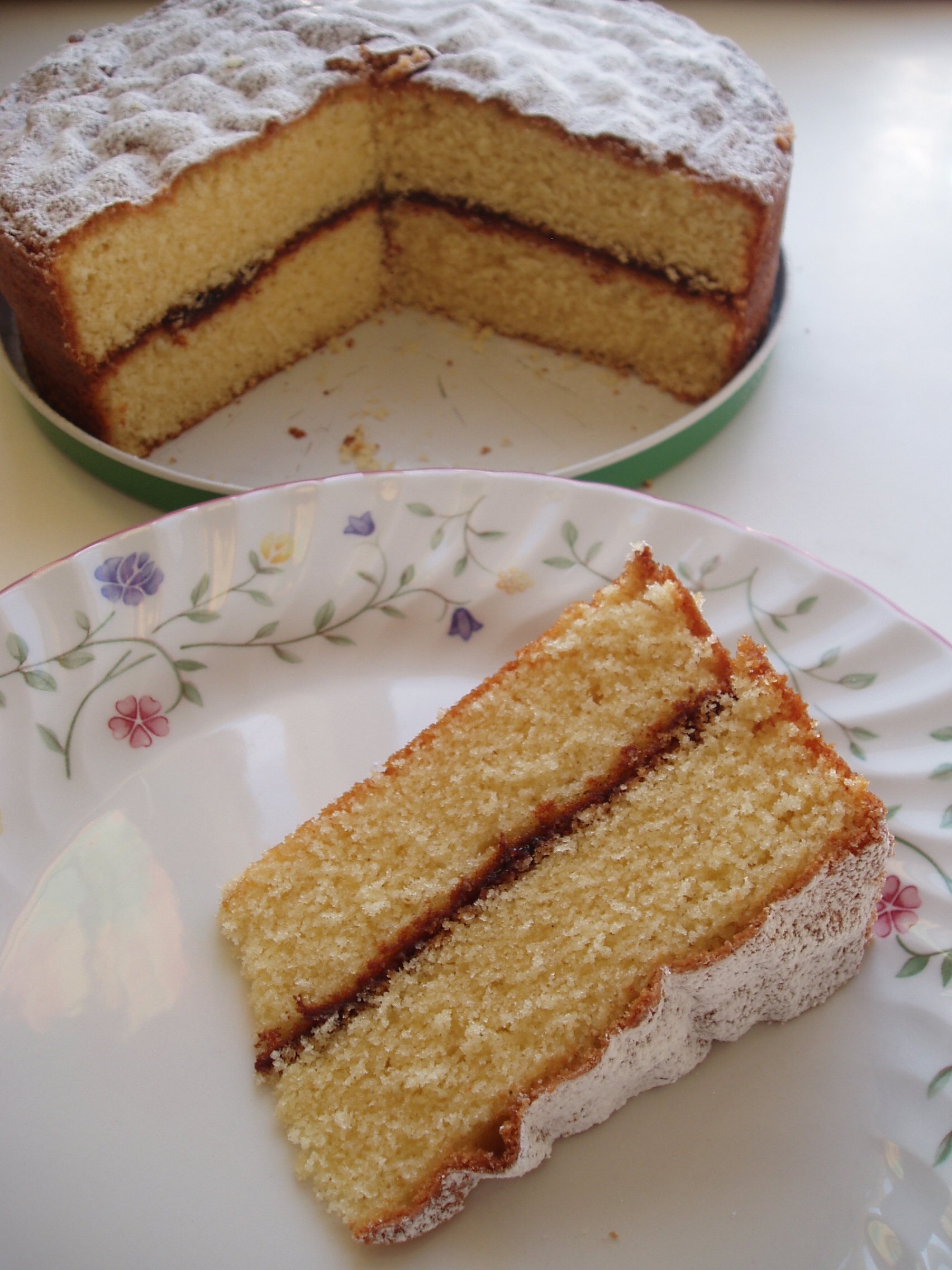
First I turned each of my microwaved flours into ‘kate-flour’, substituting 1/8 of a cup with 1/2 oz of cornflour. I then made 3 Yellow Butter Cakes (thank you for the recipe, Rose 🙂 ), one for each of my ‘kate flours’.
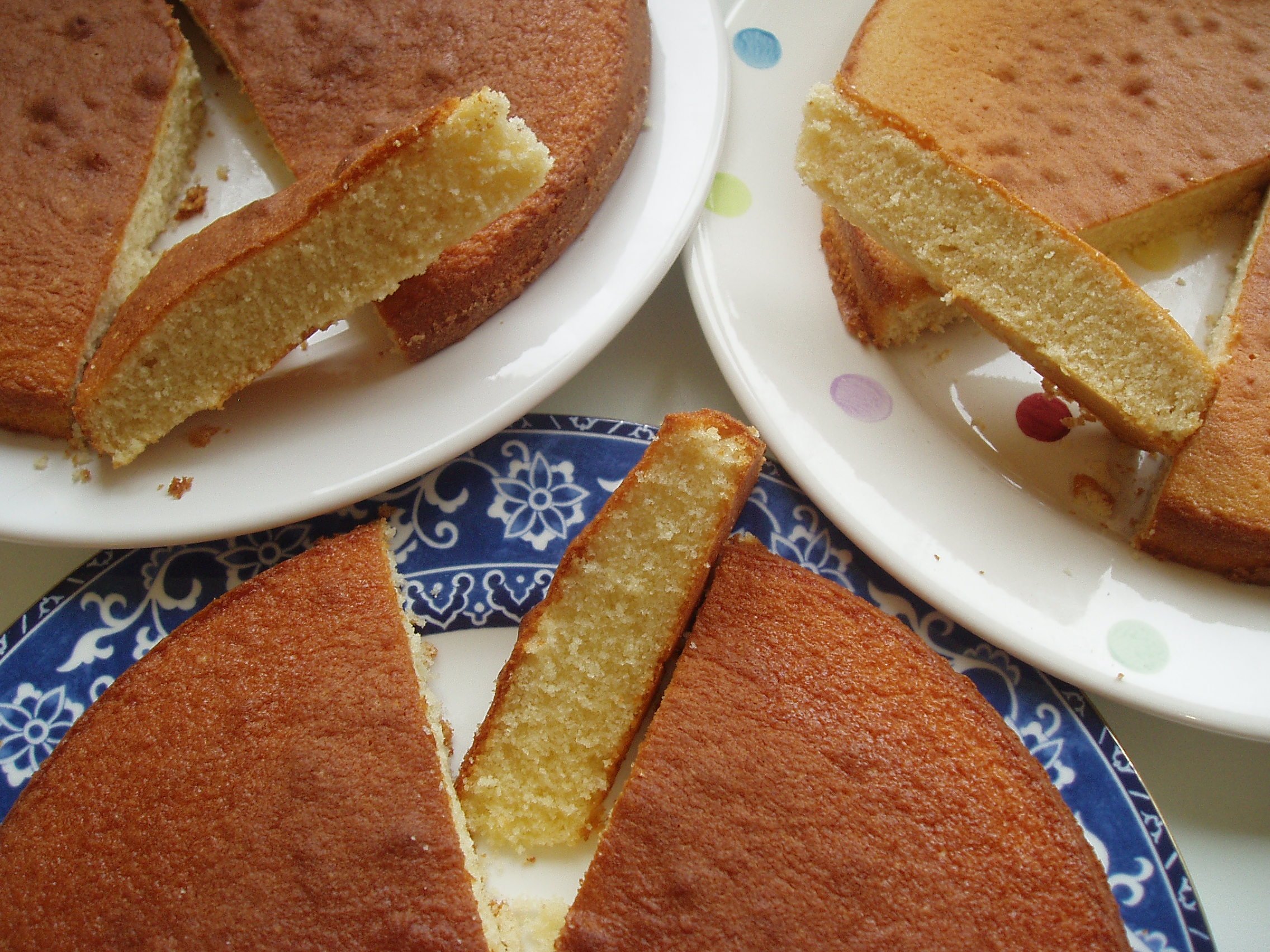
Guess what? They all worked! Yes, even the bread flour came in as a better alternative to bog-standard, unbleached plain flour.

The plain four cake is on the top left, the bread flour cake on the top right and the 00 grade flour cake is on the centre at the bottom of this photo.
Feel free to skip this bit, but here are some specific details 😉
For each flour, I weighed 10 0z and spread this on a pyrex plate (10″ diameter) to give a bed depth of between 18mm and 20mm. I microwaved the flour for 1 minute at a time at 750W. After each minute, I took a temperature reading and then stirred the flour to break up any lumps. I continued heating the flour by successive minutes until I obtained a reading that was at least 130 degrees C.
I removed the flour from the microwave and allowed it to cool to room temperature. I then sieved the flour and discarded any residue. I spooned the flour into a measuring cup (250 ml) and leveled the top with a palette knife. I weighed the flour in the measuring cup, then calculated 7/8 of this amount to obtain a weight for the flour component of 1 part of kate flour (10 0z of flour before microwaving generally yields at least 2 parts of kate flour).
McDougall’s 00 grade flour (microwaved to 138 degrees C)
1 cup = 4 1/4 oz
1 part kate flour = 3 3/4 oz flour + 1/2 oz cornflour
McDougall’s plain flour (microwaved to 134 degrees C)
1 cup = 4 oz
1 part kate flour = 3 1/2 oz flour + 1/2 oz cornflour
Francine bread flour (microwaved to 136 degrees C)
1 cup = 3 1/2 oz
1 part kate flour = 3 oz flour + 1/2 oz cornflour






 amerrierworld.com