
Here’s a celebratory cupcake hug for Rose, whose latest book, Rose’s Heavenly Cakes, has been named Cookbook of the Year by the International Association of Culinary Professionals 🙂 .
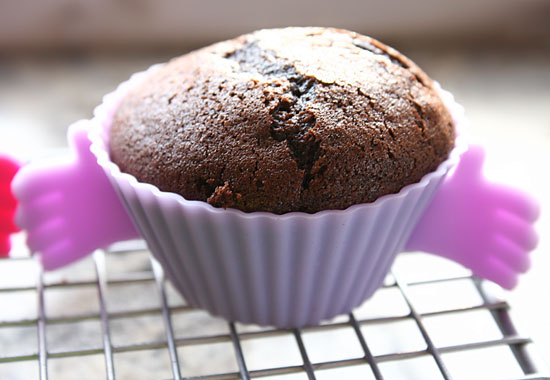
Congrats, Rose!

Here’s a celebratory cupcake hug for Rose, whose latest book, Rose’s Heavenly Cakes, has been named Cookbook of the Year by the International Association of Culinary Professionals 🙂 .
Congrats, Rose!
Posted by amerrierworld on April 24, 2010
https://amerrierworld.com/2010/04/24/cupcake-hug/
Today is the 40th Anniversary of Earth Day, a global campaign to raise awareness of environmental issues. Whilst not without its critics, Earth Day is an opportunity to reflect on our individual contributions to the core issues of environmental sustainability and to consider ways in which we could take action by changing aspects of our lifestyles.
Apparently, these changes don’t come naturally to us humans. According to an interesting article in the New York Times, our brains are not wired-up to be green:
You might ask the decision scientists, as I eventually did, if they aren’t overcomplicating matters. Doesn’t a low-carbon world really just mean phasing out coal and other fossil fuels in favor of clean-energy technologies, domestic regulations and international treaties? None of them disagreed. Some smiled patiently. But all of them wondered if I had underestimated the countless group and individual decisions that must precede any widespread support for such technologies or policies. “Let’s start with the fact that climate change is anthropogenic,” Weber told me one morning in her Columbia office. “More or less, people have agreed on that. That means it’s caused by human behavior. That’s not to say that engineering solutions aren’t important. But if it’s caused by human behavior, then the solution probably also lies in changing human behavior.” …
There are some unfortunate implications here. In analytical mode, we are not always adept at long-term thinking; experiments have shown a frequent dislike for delayed benefits, so we undervalue promised future outcomes. (Given a choice, we usually take $10 now as opposed to, say, $20 two years from now.) Environmentally speaking, this means we are far less likely to make lifestyle changes in order to ensure a safer future climate. Letting emotions determine how we assess risk presents its own problems. Almost certainly, we underestimate the danger of rising sea levels or epic droughts or other events that we’ve never experienced and seem far away in time and place …
A few years ago Weber wrote a paper for the journal Climatic Change that detailed the psychological reasons that global warming doesn’t yet scare us; in it, she concluded that the difficulties of getting humans to act are inherently self-correcting. “Increasing personal evidence of global warming and its potentially devastating consequences can be counted on to be an extremely effective teacher and motivator,” she wrote, pointing to how emotional and experiential feelings of risk are superb drivers of action. “Unfortunately, such lessons may arrive too late for corrective action.”
I don’t think however that Earth Day should be a time when we make ourselves feel as guilty as possible about the things we aren’t doing for the environment – that television we left on standby the other night, the apple core we didn’t compost and the egg carton we didn’t recycle. Instead, I believe it is far more useful if we let ourselves feel good about the things we are doing now, things that perhaps we didn’t do a few years ago or that would have been entirely alien to our way of life when we were children. Then perhaps it will be easier to think about one small extra way in which we could make a difference from today onwards.
I can remember a time when I put glass bottles, teabags and banana skins into the household rubbish bags without a second thought, when our cars were filled with leaded petrol and when our clothes weren’t washed in Ecover products. It wasn’t difficult to make those small changes – it just required a slight shift in thinking. And, far from being tedious, it was even exciting and rewarding to change to cooking on an induction cooktop!
Another small way of living in a more environmentally sustainable way is by growing some of your own food. You don’t need to have a large garden for this. As my children’s current favourite book shows, many edible plants can be grown in containers and window-boxes. We have successfully (and sometimes not quite so successfully!) grown peas, beans, garlic, spinach, potatoes, courgettes, sweetcorn, tomatoes, strawberries and pumpkins over the last three years in our small garden plot. Our huge success so far this year however is purple sprouting broccoli (do click on that link, BTW – it’s full of interesting information on how easy it really is to grow and how much tastier it is than anything you’ve ever found in the supermarket).

We didn’t really expect the plants to be much of a success at all. As they were first sprouting almost a year ago, the plants attracted a large number of beautiful, white butterflies.
“How pretty,” we thought, failing to make the connection between butterflies and caterpillars (despite having read the story of The Very Hungry Caterpillar to M on countless occasions over the course of the last four years). Needless to say, the butterflies departed and the large, juicy, green leaves of the plants were soon finding their way into the tummies of an interminable army of caterpillars.

January then arrived and covered whatever hadn’t become caterpillar nosh with a glistening frost and, just to be sure of finishing off the plants properly, a layer of icy snow.
Miraculously, the plants survived. And flourished … and continue to flourish.
I think M has more in common with a caterpillar than she’s letting on as she likes to sneak into the garden and nibble on a tender stem of the broccoli without even waiting for it to be cooked.

Yesterday evening, we delivered bunches of purple sprouting florets to friends in the village before returning home to a deliciously homegrown Purple Sprouting Broccoli Quiche for our own dinner.
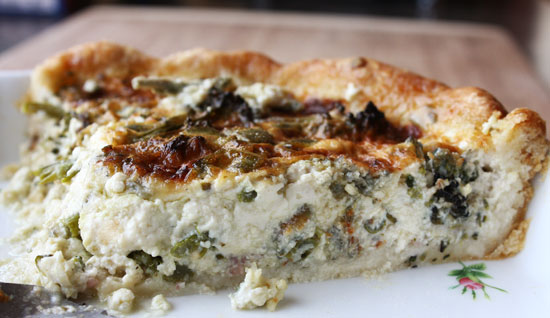
Homegrown Purple Sprouting Broccoli Quiche
Pastry
4 oz plain flour
2 oz self-raising flour
1 tsp salt
3 oz unsalted butter
1 tbsp cider vinegar
2-3 tbsp cold milk
Filling
4 egg yolks + 2 eggs
milk (see recipe)
1 tbsp fresh sage, chopped
1 onion, chopped
6 slices streaky bacon (optional), chopped
1 tbsp green pesto
6-7 stems of purple sprouting broccoli
3 oz Blue Stilton cheese, crumbled
salt and pepper
Note: these quantities are for a 9 1/2″ tart tin and should be scaled up or down for other sizes.
Make the pastry by combining the flours and salt, rubbing in the butter and mixing with the cider vinegar and enough milk to form a soft dough. Wrap in clingfilm and leave to rest in the fridge for at least 30 minutes.
Roll out the pastry and use to line the base of your tart tin. Blind-bake if you wish (confession time – I don’t always do this; yesterday, I brushed the unbaked pastry base of the quiche with a little melted butter, then covered it with clingfilm and popped it back in the fridge. The butter hardens again in the fridge so that it forms a protective layer between the pastry and the sloppy filling in the oven, which allows the pastry just enough time to get a head start in the cooking process before the butter melts and the bottom comes into contact with the filling).
Preheat the oven to 200 degrees C.
Put the egg yolks and whole eggs into a measuring jug. Fill with milk up to the level of 1 1/4 pints for both the eggs and milk. Stir in the chopped sage.
Fry the onions (and bacon) in a little olive oil to soften. Stir in the pesto and leave to cool.
Spread the onion/pesto mixture over the base of the quiche. Arrange the purple sprouting broccoli over the top (I placed them loosely in a grid pattern), then sprinkle with the crumbled cheese. Season.
Pour the egg/milk mixture into the filled pastry case until just before it reaches the top (add a little extra milk if needed). Poke any sticky-uppy florets into the egg mixture to coat them.
Bake in the oven for 20 minutes, then turn the temperature down to 180 degrees and bake for a further 20 to 30 minutes until the quiche is puffed and golden.
Remove from the oven and leave for 10 minutes before serving.
Posted by amerrierworld on April 22, 2010
https://amerrierworld.com/2010/04/22/broccoli-quiche-for-earth-day/
Nearly one year on, my Rainbow Cake and Unicorns post about M’s birthday party is still one of the most popular posts at A Merrier World. I have received several emails and comments since that time, most recently from Rupa, asking for information about the games we played and the treats I prepared for M’s little guests. Hopefully, this post will answer many of these queries and provide further inspiration for anyone planning a similar unicorn-themed party for a young child.
I drew my own inspiration for M’s party from a number of sources on the internet as well as from my own imagination. I will provide references where possible and I’m sorry if I miss any attributions – the exact details are a little hazy after so many months. Please let me know in the comments if you can fill in any blanks 🙂 .
All good parties start with an invitation. I kept M’s invitations deliberately simple, leaving a large space where she could write in the name of each friend she wished to invite. I set the scene of the party by describing an enchanted forest and added an image of a unicorn (hand-drawn and then scanned). Looking at the invitation again, perhaps I could have included an RSVP …

Having planted expectations of an enchanted forest in the minds of M’s guests, I felt that I should actually make some attempts to create an enchanted forest. In the week before the party therefore, my three little helpers and two of their friends painted large trees, butterflies and flowers that I cut out and used to decorate the house on the morning of M’s birthday.

Also decorating the house were several long, sellotape-handled streamers made from rainbow-coloured strips of crêpe paper – one strip each in red, orange, yellow, green, blue, pink and purple. These were to be waved up and down by the children in a rainbow dance during the party, but I used them in the first instance to decorate the front windows of our house by hanging them from the curtain poles.

To complete the rainbow enchantment, O pinned up a large parachute over the entrance to our magical forest so that the guests arrived under a canopy of colours.
As the children were arriving at the start of the party, I collected them all together at our kitchen table by providing unicorn colouring pages for them to complete with colouring pencils, stickers, glitter and glue. We also made a unicorn horn for each child by rolling a sheet of sparkly cardboard into a cone and stapling an elastic strap onto the sides to hold it in place on their forehead.

Once everyone had arrived and sticky, glittery hands had been washed, I gathered the children into a huddle at the door leading through to the forest clearing where the unicorns lived. I explained that unicorns are very shy creatures, but you can tell where they have been by the magical blue pebbles their hooves leave behind when they stand still for long enough. I then gave each child a shimmering drawstring purse which they could use to collect any of the unicorn treasures they found in the enchanted forest (each child’s purse had their name written on a tag to save any arguments later).
Whispering excitedly, the children crept through the hallway to our living room where I had hidden enough blue glass decorative gems for even the most timid child to be assured of finding a good handful to put in her organza gift bag.
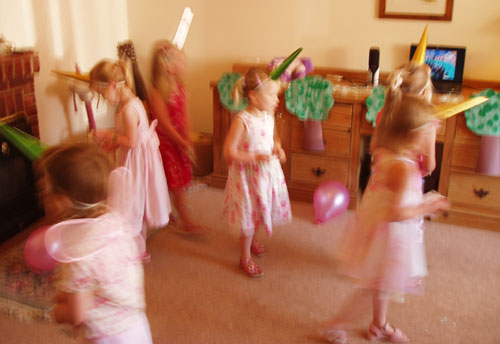
To accompany the fervent unicorn hunting, I played the Unicorn Song on our laptop and blew bubbles (a guaranteed success!).
Magical gems safely stashed away, I then handed each child one of the rainbow streamers that were hanging above the window. All little girls seem to have innate knowledge of the connection between unicorns and rainbows, and our guests danced enthusiastically to the Rainbow Colours song by Nancy Stewart.
After all that activity, we sat down for a game of Pass the Parcel (centre prize a plastic rainbow bracelet) …
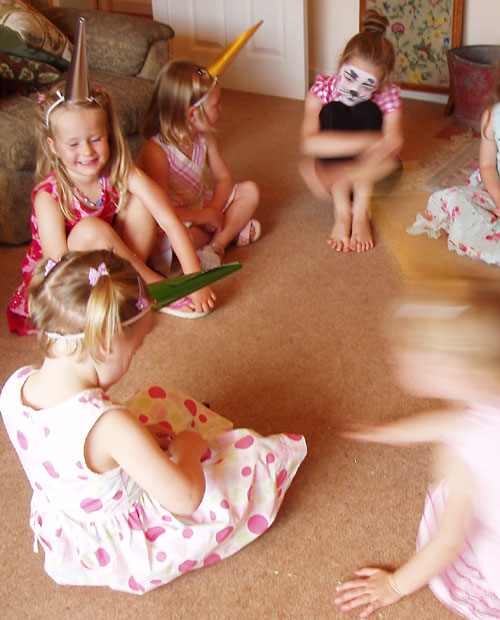
… followed by a game of Pin-the-Horn-on-the-Unicorn (after nearly a year, the drawing is still stuck on the back of our living room door!).

There was only just enough time left after this for a quick game of Musical Unicorn Bumps before returning to the kitchen for the party tea.
I kept the party food simple – cheese and ham sandwiches, carrot sticks, apples, unicorn horns (twirly crisps) and cocktail sausages. The unicorn plates, cups and napkins I used have since been discontinued, but others are available from online party suppliers.

And then, of course, there was the Magical Unicorn Rainbow Cake …

… with its crumb of many colours.

Each guest left the party clutching their organza purse of unicorn gems, a rainbow streamer, a slice of magical rainbow cake and a unicorn horn (ice cream cone) filled with jelly beans and popcorn.

As the sun set over the enchanted forest, one very happy 4-year-old drifted cozily into sleep whilst her exhausted parents sipped a well-earned glass of wine!
Posted by amerrierworld on April 16, 2010
https://amerrierworld.com/2010/04/16/a-magical-unicorn-party/
I was invited to join the worldwide celebration of a man named Arthur and a beer named Guinness just before St Patrick’s day a few weeks ago.
Even as an intermittent food blogger, I regularly receive emails from PR companies asking me to post their latest press releases or promote the newest kitchen gadgets on my blog. Unfortunately for them, my blog is a very personal space that I keep deliberately free from paid advertising and ‘freebie’ giveaways. I dislike reading the same official spiel repeated across countless food blogs and find boredom setting in very quickly when I find yet another incredulously rave declaration of the generosity of such-and-such a brand in providing the free samples that inevitably form the basis of an ensuing favourable blog review (the ubiquity of posts on a certain pomegranate juice comes to mind …).
Additionally, I often find that the emails I receive from PRs are impersonal and demanding – “Write this text, post this image, post by this deadline!” – as well as poorly matched to my interests in food blogging. I know that it’s all part of wider, on-going relationship misunderstandings between PRs and food bloggers, as each are confronted by the hitherto unknown workings of the other, so I don’t take offense. I just don’t usually find much to inspire me in these PR emails, that’s all.
However, I try to keep an open mind on these things and I’ve never yet deleted a PR email without having read it through first. So when I received an email from Stephanie about an official Guinness cookbook, I was genuinely interested.
I already have several treasured recipes that include Guinness among their list of ingredients. There’s a sticky gingerbread cake, Rose’s beer bread, a beef stew … Would I like to learn more about the cookbook, Guinness ®: An Official Celebration of 250 Remarkable Years? Well, yes actually – I would!
Stephanie forwarded two recipes from the book for me to try at home – Steak and Guinness Burgers and an Iced Chocolate, Guinness and Orange Cake (recipes below) – and explained that the book had been published to celebrate the 250th anniversary of the founding of Arthur Guinness’ brewery in Dublin. I also contacted Paul Hartley, the author of the recipes in the book, and he kindly agreed to answer a few of my questions about their development.
This post was supposed to happen on St Patrick’s day (or at least in the week following March 17th), but it obviously didn’t. I was planning to bake the cake on the same day that I made the burgers to enjoy the recipes as a two-course Guinness extravaganza, but the slight issue of 173 cupcakes got in the way (more about that story another day). I therefore had to wait until Easter Sunday before finally being able to complete my plans.
The verdict?
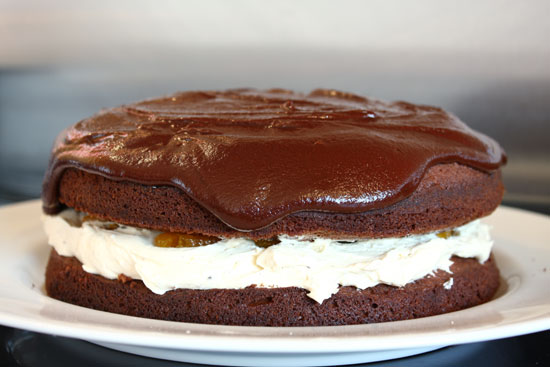
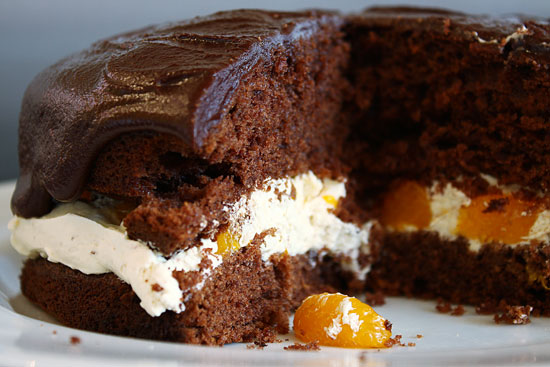
Everybody loved the cake at dinnertime on Easter Sunday. In fact, it was even a real success with O, who my regular reader [sic] will know generally dislikes anything sweeter than a pint of beer. I have to confess that I sandwiched the cake layers together with a white chocolate buttercream rather than whipped cream, but that was purely because the major cake-eaters in my family dislike cream with a vengeance. I’m sure any cream lovers out there would find it beautiful with lashings of whipped cream, too.
The burgers had a smaller audience than the cake but were also unanimously declared to be tasty. We found that we needed to cook them for longer than stated in the recipe, but I usually cook meat slightly on the longer side when I’m serving it to kids anyway. Or perhaps our burgers were over-generously sized …
Here’s my conversation with Paul Hartley about the book and his recipes in general …

First of all, how many of your recipes are included in this book?
18 different recipes – some sweet, some savoury.
Are the recipes traditionally Irish in any way (apart from the inclusion of Guinness, that is!)?
Yes, Galway Oyster Bisque. Have you ever been to the Galway oyster festival? I haven’t but am planning to go. Sausages with Guinness gravy and colcannon (which is traditional Irish potato cakes). Beef and Guinness pie is a very traditional Irish dish.

Did you use Guinness in any of your cooking before you developed these recipes?
I’ve cooked with Guinness for years – whenever a recipe called for stout I would reach for the Guinness. Having already been a great fan of cooking with Guinness made this book a real treat for me.
What aspects of Guinness did you have in mind when you set out to develop these recipes?
Cooking savoury dishes was always my favourite so this was a chance to develop sweet Guinness creations in our kitchen.

How does Guinness work in the recipes to create something that is more than just a plain old chocolate cake, for example – does it truly make a difference or is it just there as a gimmick for the anniversary?
Certainly no gimmick – these dishes are definitely taste enhanced by adding Guinness. For as long as recipes were written, Guinness has been used to add depth of flavour to rich fruitcakes, and a heartiness to rich meat stews. Guinness added to batter produces a light and crisp result.

Which do you believe is the most successful recipe?
Steak & Guinness burgers with rosemary & garlic butter.
Did you try anything that really didn’t work out at all?
Whenever you are pushing the culinary boundaries there will always be dishes that just don’t work. Luckily these were few.
How many pints of Guinness did you get through while you were working on these recipes for the book?
Lots, just didn’t keep count…
And finally, do you now cook any of these recipes regularly at home?
I am a partner in Hartleys Café Bistro in Somerset and we regularly include one of the Guinness book recipes on our menu. As for cooking at home, yes sometimes but I’m currently writing the Horlicks cookbook so that’s the cut and thrust of most home cooking right now.
Thank you, Paul 🙂
Steak & Guinness burgers with rosemary & garlic butter (reprinted from Guinness ®: An Official Celebration of 250 Remarkable Years with permission from the publishers)
Minced beef is marinated overnight in Guinness, then mixed with roasted red onions, griddled and served topped with rosemary and garlic butter to make a memorable burger.
Preparation time 20 minutes, plus marinating, chilling & freezing
Cooking time 10 minutes
Makes 6 burgers
500 g (1 lb) top-quality lean minced beef, ideally from grass-fed Irish beef
150 ml (¼ pint) draught Guinness
1 large red onion, finely diced
olive oil, for drizzling and oiling
3 smoked streaky bacon rashers, finely diced
1 teaspoon creamed horseradish
1 free-range egg, beaten
½ teaspoon paprika
2 heaped tablespoons plain flour
1 rosemary sprig
75 g (3 oz) butter, softened
1 garlic clove, finely chopped
salt and pepper
step 1 Lay the minced beef out in a shallow dish and cover with the Guinness. Using your hands, massage the Guinness into the meat, cover with clingfilm and leave to marinate in the bottom of the refrigerator for at least 12 hours.
step 2 When ready to make the burgers, spread the onion out in a baking dish, sprinkle lightly with salt and drizzle with oil. Scatter the bacon on top. Roast in a preheated oven, 150°C (300°F), Gas Mark 2, for 15 minutes. Leave to cool.
step 3 Lift the beef out of its marinade, gently squeeze out any excess liquid and put the beef in a large bowl. Add the roasted onion and bacon, the horseradish, egg and paprika, season with pepper and sprinkle the flour over. Using your hands, mix together well. Divide the mixture into 6 equal portions and form into round patties about 2.5 cm (1 inch) thick. Carefully lay the patties on a baking sheet lined with greaseproof paper, cover with a second sheet of greaseproof paper and chill in the refrigerator for at least 1 hour and up to 6 hours to firm up.
step 4 Meanwhile, pluck the rosemary leaves from the stem and plunge into boiling water for 30 seconds. Drain, then chop as finely as possible. Add to the softened butter and garlic in a small bowl and beat together well. Lay a piece of clingfilm on a flat surface, form the butter into a sausage about 3.5 cm (1½ inches) in diameter and roll up in the clingfilm. Freeze for 20 minutes until set.
step 5 Lightly oil a griddle pan. Heat until just beginning to smoke, add the burgers and cook over a high heat for about 5 minutes on each side, or until well browned on the outside and just pink inside. Serve immediately, each burger topped with a slice of the rosemary and garlic butter.
Iced chocolate, Guinness and orange cake (reprinted from Guinness ®: An Official Celebration of 250 Remarkable Years with permission from the publishers)
This sumptuous cake is perfect for a special occasion. The recipe may seem a little involved, but it’s easy to accomplish if tackled stage by stage.
Preparation time 45 minutes
Cooking time 1 hour
Serves 8
2 large oranges
250 g (8 oz) caster sugar
175 g (6 oz) unsalted butter, plus extra for greasing
150 g (5 oz) self-raising flour
25 g (1 oz) cocoa powder
2 teaspoons baking powder
3 free-range eggs, beaten
25 g (1 oz) ground almonds
5 tablespoons draught Guinness
150 ml (¼ pint) double cream
Icing
20 g (¾ oz) unsalted butter
50 g (2 oz) caster sugar
3 tablespoons draught Guinness
100 g (3½ oz) plain dark chocolate (70% cocoa solids), finely chopped
step 1 Peel one orange. Finely grate the zest of the other orange and set aside. Using a sharp knife, pare away the pith from both oranges. Cut the oranges into 5 mm (¼ inch) slices. Put them in a small saucepan and just cover with cold water. Bring to the boil, then reduce the heat and simmer for 10 minutes. Add 50 g (2 oz) of the sugar and continue to simmer until all the liquid has boiled away, watching carefully to ensure that the oranges don’t burn. Leave to cool.
step 2 Beat together the butter and the remaining sugar for the cake in a large bowl until very pale and fluffy. Sift together the flour, cocoa and baking powder, then beat into the butter mixture alternately with the eggs. Add the ground almonds, reserved grated orange zest and Guinness and beat for 3–4 minutes until you have a soft dropping consistency.
step 3 Grease and line the base and sides of 2 x 20 cm (8 inch) round cake tins, then divide the cake mixture equally between the tins, smoothing the surface. Bake the cakes in a preheated oven, 190°C (375°F), Gas Mark 5, for 25 minutes until risen and firm to the touch. Leave to cool in the tins for 5 minutes before carefully turning out on to a wire rack to cool completely.
step 4 Whip the cream in a bowl until soft peaks form, then spread over one of the cakes. Arrange the cooled orange pieces over the cream and carefully place the other cake on top.
step 5 To make the icing, put the butter, sugar and Guinness in a small saucepan. Stir over a gentle heat until the sugar has dissolved, then bring to the boil. Remove from the heat and add the chocolate. Leave to soften, then beat gently with a wooden spoon. Leave to cool and thicken. While still warm but not too runny, pour the icing over the cake and use the back of a spoon or a palette knife to spread it evenly.
Posted by amerrierworld on April 7, 2010
https://amerrierworld.com/2010/04/07/to-arthur-or-a-celebration-of-guinness/




 amerrierworld.com