Rainbow Cake and Unicorns

Update June 2012: detailed photos on how to make a Rainbow Cake are here.

Update April 2010: the activities and games I planned for M’s party are described in a separate post here.

At the end of her birthday party last year, M announced that she would be having a unicorn party for her next birthday. I didn’t realise that she was absolutely serious about this. I thought, “It’s a whole year away – she’s bound to change her mind.” But no, for a whole year M has stuck to her original intention and has been counting down the days until her unicorn party. 

You could argue that I’ve had a whole year to prepare, so why the sudden rush to get everything ready last week? Well, M may have had a solidly clear idea of the grand theme for her party, but she left the finer details entirely up to me. Not wanting to disappoint, I threw myself into turning our house into an enchanted forest in the hope that any passing unicorns might be tempted to pop in on the big day. We made glittery trees and rainbow streamers while M’s big sister created a welcoming poster for the front door.

Last year, M set her heart on a cake she saw in a book by Debbie Brown (here’s a warning to parents – only ever let your children see pictures of cakes that you’re happy to make yourself). Four being so much more grownupperer than three, M has now thankfully entered the chocolate frosting and smarties stage. I’m not so very far removed from the icing sugar cloud of despair that I miss those fondant modelling sessions yet … I’m quite happy to be doing chocolate and smarties.

I couldn’t resist giving the birthday girl a little surprise, though. From the outside, M’s cake looked perfectly normal (in a homemade sort of way) – a magical plastic unicorn standing amid swirls of white chocolate buttercream and scattered smarties. M’s seven little party guests looked on dutifully as M blew out her candles and I took a knife to cut into the cake.
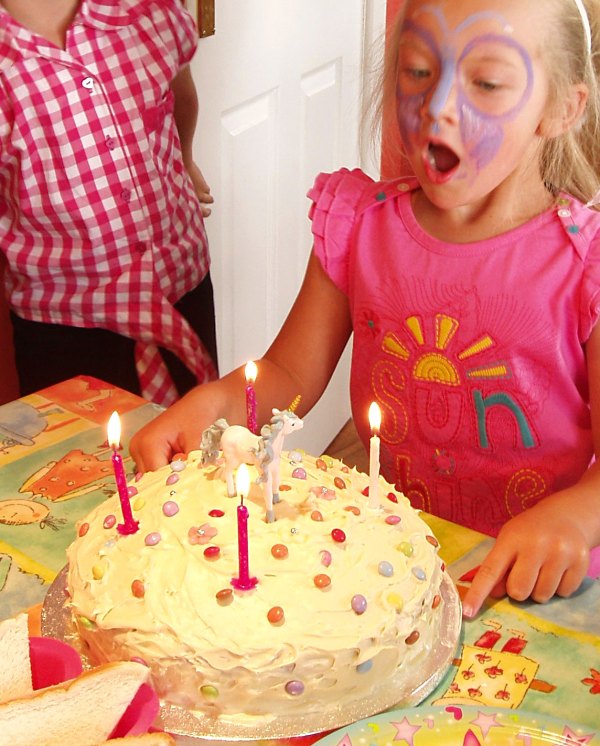
unicorn cake

Hesitating before plunging in to make the first slice, I asked them all, “Do you know what happens when a unicorn stands on top of a birthday cake?”

“No,” they whispered with wide eyes.

“He makes a rainbow,” I told them, cutting into the cake.
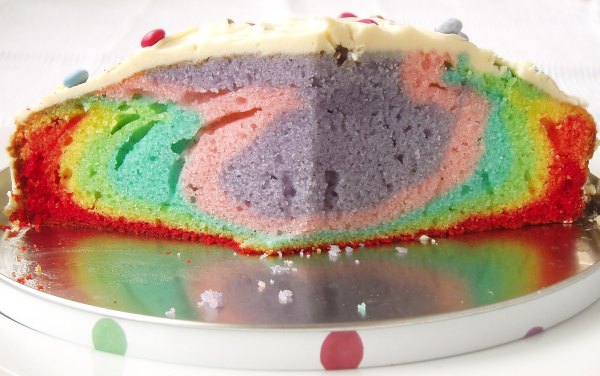
rainbow cake cut

“Wow!”

The next day, M sidled up to me and asked, “Mummy, how did the unicorn do that to my cake?”

Well, if there’s by any chance anyone left in the blogosphere who hasn’t come across a rainbow cake before now, I’ll explain my own take on the concept … just in case a unicorn happens to pass by and stand on another little girl’s birthday cake 😉 .

I’m not sure who had the original idea – there’s a box-mix version doing the rounds that appears to have started with this thread in the dubiously-named ‘Something Awful’ forums. Rejecting the layered box-mix and diet soda variety however, I based my own rainbow cake recipe on Farida’s beautiful Zebra Cake (stay tuned for more from Farida in an upcoming post).

I followed Farida’s instructions to make a yellow cake batter (whichever basic cake recipe you choose, it’s important that it’s one in which the batter doesn’t mix about too much during baking or you’ll end up with a muddy brown cake instead of a rainbow). Then, instead of dividing it into two parts and colouring one part with cocoa as Farida did, I divided the mixture between seven bowls (roughly 4 tablespoons of batter in each) and used my fondant paste dyes to colour each portion a different colour of the rainbow.
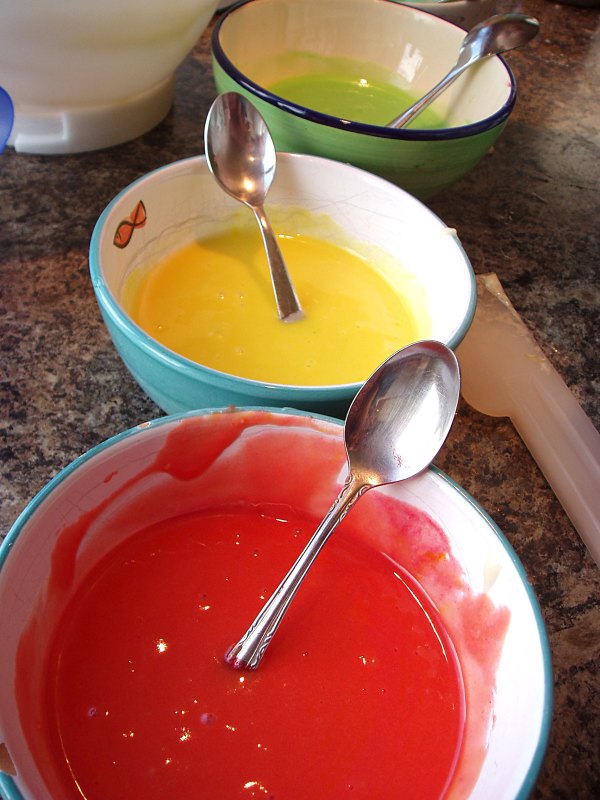
coloured batter

I then poured each rainbow batter in turn (starting with red) into the centre of my prepared cake pan. As Farida says, don’t wait for each colour to spread out before starting with the next – just pour the batter into the centre of the pan, then pour the next colour right on top and then the colour after that without waiting for each to spread fully. The weight of each batter pushes the previous colour out further and, as long as you keep a steady hand with the pouring, they all sort themselves out.
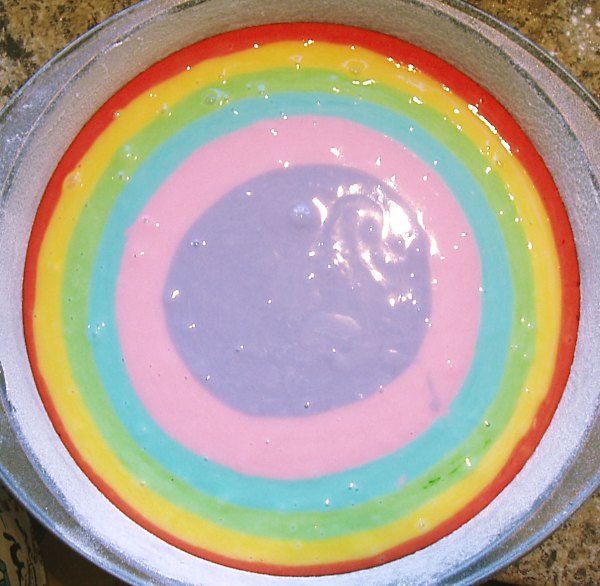
batter in pan

And it’s as simple as that.

I found out in the school playground this morning that one of the guests has kept her special piece of rainbow cake carefully wrapped up since the party so that she can show it to everyone who visits.
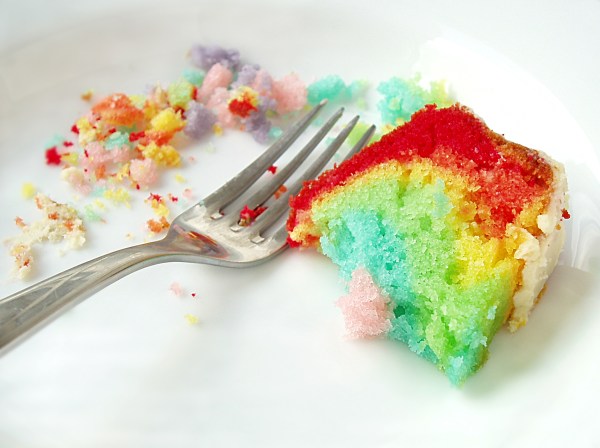
rainbow cake crumbs
You might also like:

Rocky Road

Pumpkin Cake

Fairy Cakes

Elderflower Cordial

I remember the very first time I ever tasted elderflower cordial. It was an extremely hot summer and I had traveled the great distance between the North and the South of England (which is a far greater divide psychologically than physically, as anyone from ‘Up North’ will confirm) to be with my boyfriend during the holidays. As the sun beat down on the yellowing grass, we sipped cool, refreshing drinks of elderflower cordial and loitered with our fellow bellringers in the shady ringing chambers of old church towers.

The taste of elderflower cordial today transports me straight back to that time. Only now, the boyfriend is my husband and we have three young children who are already in love with the smell and taste of elderflowers.

T smelling elderflowers

Although elderflowers grow abundantly in the hedgerows of Devon, this is the first year that we have collected the flowers to make our own cordial. It was O’s idea last weekend.

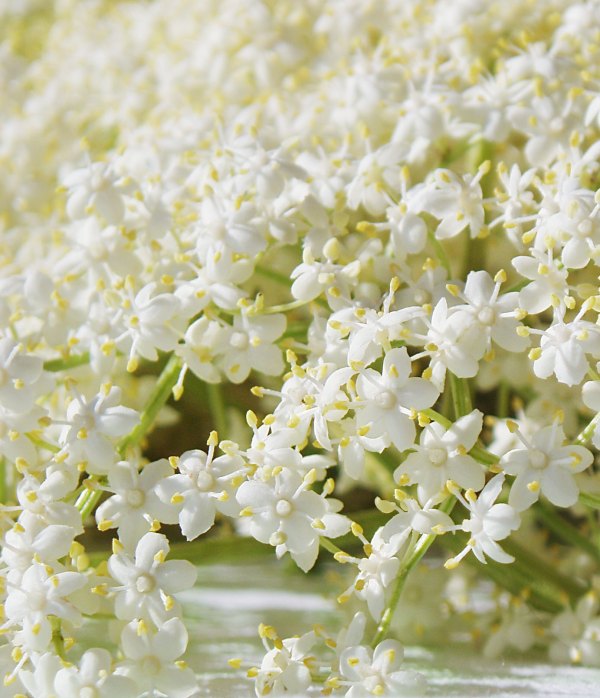
elderflowers

My collection of cookbooks on the kitchen bookshelves yielded two recipes for elderflower cordial. The first was by Sophie Grigson and the second was in The Cook’s Scrapbook (a lovely book with a whole section on foods from the wild). At first sight, Sophie Grigson’s recipe seemed the more appealing as the elderflowers only required steeping overnight, rather than the five days called for in the second recipe. However, Sophie’s recipe also used relatively more sugar, and we wanted to avoid making the cordial too sickly sweet. In the end, we decided to combine the two recipes by using less sugar and straining the mixture after one day (largely through fears that it would become a mildewed pond if left for any longer).

Both recipes included citric acid, something which I do not happen to keep in ready supply. Apparently, this acts as a preservative so that the bottled cordial can be kept for up to a year. It also enhances the charateristic sour zing of the elderflowers.

Although citric acid is found naturally in the juice of the lemons that are also used in the recipes, it is in too small a quantity in lemons to provide a substitute for the amount of citric acid required – it would take about thirteen lemons to produce an equivalent amount of citric acid, something which would also override the essence of elderflower in the cordial.

Unfortunately, the larger chain pharmacy stores in the UK no longer stock citric acid because it can be used to make heroin more soluble. However, it is also used in wine-making so can be found in small quantities in home brewing shops. We tracked down a supply locally at Quay Side Easy Brew on the Historic Quay in Exeter.

If you haven’t yet made elderflower cordial, I can reassure you that it is simply the easiest thing to do. The most important part is to make sure that the flowers you gather are fresh and white and not creamy or brown, which means that you have to get the timing right – generally, the flowers will be at their best for only two weeks in the early summer of each year. Apparently, it’s also best not to pick blossoms from beside a road … a piece of advice that we didn’t follow to the letter, although the narrow Devon lanes we get around here could hardly be classified as major motorways 😉 .

elderflower cordial

Elderflower Cordial

2 kg / 4 lb 6 oz caster sugar
1700 ml / 3 pints boiling water
90 g / 3 oz citric acid
30 large elderflower heads, flowers snipped from stems
3 lemons, sliced

Put the sugar into a large bowl and add the boiling water. Stir until all of the sugar has dissolved, then add the citric acid, elderflowers and lemons (we were concerned about the many bugs that seemed to be living in the flowers, so we put the pot on the oven top and boiled everything up for a minute or so … I haven’t seen anywhere that recommends you do this, but it certainly didn’t impair the flavour of our finished cordial at all).

Cover the bowl and leave to stand at room temperature for 24 hours.

Scald a sieve, jug and muslin cloth with boiling water, then strain the cordial through the muslin (double-thickness) into the jug.

Clean and scald 3 or 4 bottles (we used wine bottles with screw caps). Pour the strained cordial into the bottles. Cork or cap the bottles, then store in the fridge.

To drink, dilute one part cordial with two or three parts water (still or sparkling), tonic, soda or gin.

  • Enter your email address to subscribe to this blog and receive notifications of new posts by email.

    Join 289 other subscribers
  • Seasonal Recipes

    candied peel

    baileys chocolate truffles

    gingerbread men

    mince pies

    fudge

    smarties cookies

  • Freshly Made

  • Categories

  • Favourite Feasts

  • Awards

    DMBLGIT Award
  • Archives

  • wordpress visitor counter
  • Adventures in food by Kate Coldrick from Woodbury in Devon.